

Table of Contents
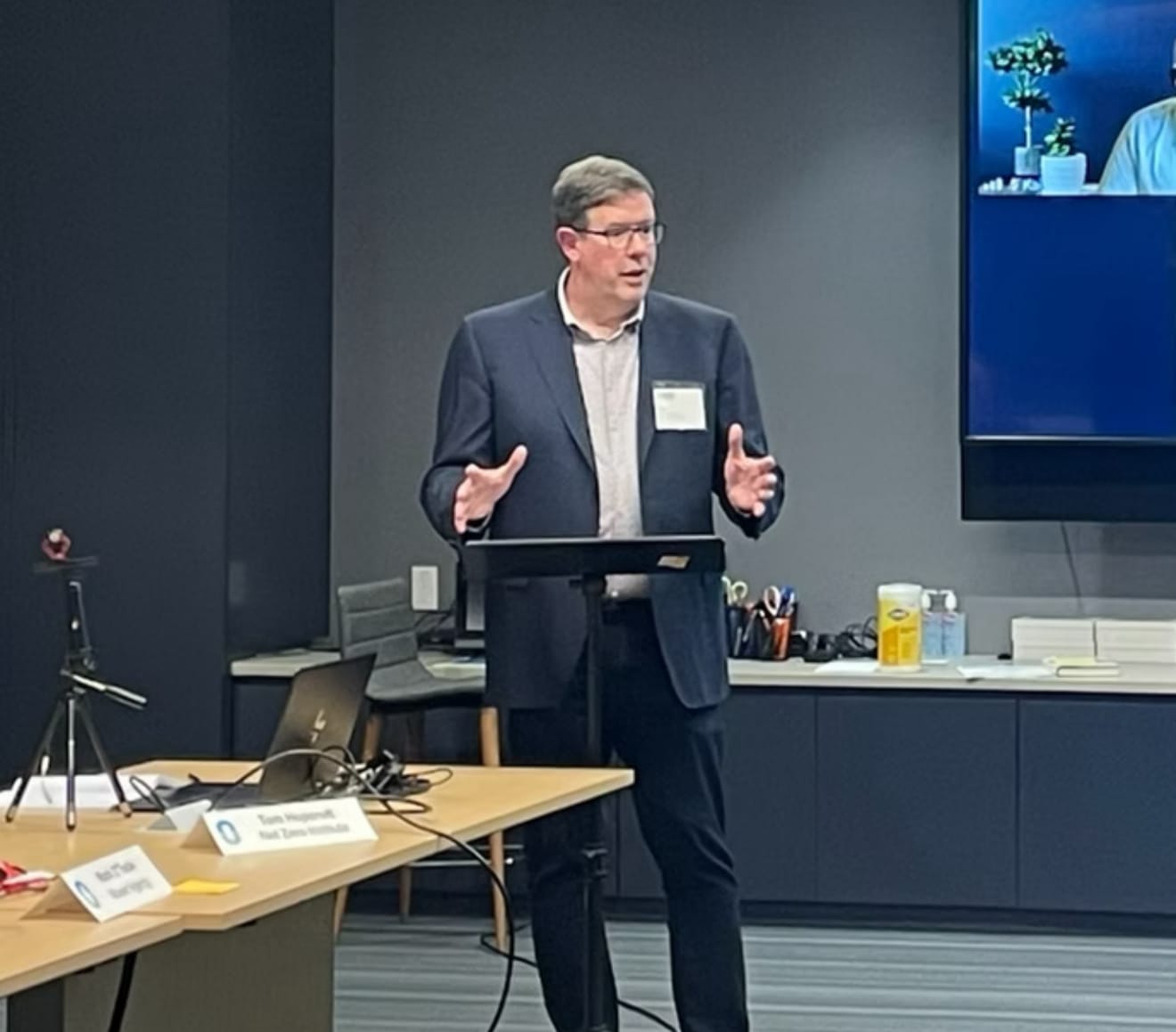
Winchester School Committee member Tom Hopcroft describes the Second Middlesex Senate district as a place built around education, research and innovation — and newly vulnerable to decisions made far beyond it.
He pointed to what he called “headwinds from Washington,” including federal moves he said could raise energy costs and slow down biomedical progress. “We have National Institute of Health funding being held up,” Hopcroft said, arguing that delays ripple outward — slowing research on rare diseases and “delaying [postdocs’] progression into their careers.”

Hopcroft, a longtime technology and climate-sector leader, is running for the Massachusetts Senate seat in the Second Middlesex District currently held by Sen. Pat Jehlen, who has said she will not seek re-election. The district includes Medford and Somerville and parts of Cambridge and Winchester.
Jehlen, a Somerville Democrat first elected to the Massachusetts Senate in 2005, has built her tenure around reducing inequality — from pay equity and worker protections to education funding, criminal justice reform and aging-in-place policy.
The state primary is scheduled for Sept. 1, with the general election Nov. 3.
A candidate who talks in systems
In an interview, Hopcroft kept returning to a governing style he framed less as ideology than as method: zooming out, looking for leverage points and trying to pull together interests that don’t usually share a table.
“For me, I’m often about the systems — how does this stuff fit together?” he said, pointing to the way affordability pressures land differently on seniors on fixed incomes, families trying to stay in place and younger residents trying to move in.

In explaining what he means by equity, Hopcroft reached for a simple metaphor.
“Someone once said to me that [the difference between] equity and equality was there’s this little example of kids trying to watch a ball game over of a fence, and the kids were different heights, and giving them all the same level box to stand on is equality, but giving the shortest kid a taller box was equity,” he said. “Some boats need to be lifted a little bit more because of their circumstances.”
That approach, he argued, is necessary now because the district is being hit by multiple crosscurrents at once — from housing supply to climate to the “changing future of work” and the risks of algorithmic decision-making in areas like hiring and health care.
‘Life and death’ stakes in National Institutes of Health
Hopcroft’s NIH point wasn’t abstract. He said two of his children have autoimmune disorders — “some rare and some don’t have cures yet” — and he sees the biomedical pipeline as something state leaders should treat as both an economic engine and a moral urgency.
“I think dealing with some of the NIH funding is a big issue,” he said. “One of the priorities is: how do we shore up and ensure that new research and drug development and therapies keep moving — whether it’s for kids like mine, or cancer patients, or other people.”

He argued that speeding the path to a therapy by even a year can be decisive.
“If we can bring a drug or therapy to market a year — or five years or 10 years — faster, that’s literally life and death for people,” he said.
In Hopcroft’s telling, the downstream effects extend beyond labs: research jobs support other jobs in the district who would represent — the “multiplier” effect that keeps local businesses busy and families rooted.
Beacon Hill transparency
Hopcroft also signaled that transparency reform would be of importance to him, arguing that secrecy on Beacon Hill erodes trust.
“From what I can see, it feels like there’s a real issue with transparency,” he said, calling it “damaging for democracy and for confidence in public government.”
He singled out committee processes — not just final floor votes — as the place where accountability often disappears.
“I do think the public should know who voted which way in the committee,” Hopcroft said. “We should know who is voting which way, so we can hold our public leaders accountable.”
He also raised concerns about outside employment and undisclosed client relationships. When “lawmakers are getting paid by outside entities” without disclosing clients, he said, it becomes hard for constituents to know “who you’re really representing.”
Still, he acknowledged the trade-offs.
“The Open Meeting Law is really frustrating” in certain settings, he said — a nod to the tension between sunlight and candor that local officials wrestle with.
A concrete climate lever: school-building rules
On climate policy, Hopcroft argued that one of the most immediate levers for the state is the Massachusetts School Building Authority, which helps fund school construction — long-lived projects that can lock in energy costs and emissions for decades.
“When you build a school, it’s 50 or 80 years that thing’s going to be around,” he said. “2050 is in 25 years … We shouldn’t be building buildings that don’t shift us to be more carbon neutral.”
His proposal: require net-zero or all-electric design as a condition of MSBA support and cover the cost difference so towns aren’t penalized for doing the right thing. If a town insists on gas or oil, Hopcroft suggested the state should be willing to withhold funding.
The “hidden tax” of electric vehicles
Hopcroft also floated an example of the kind of “pattern” he thinks lawmakers need to catch sooner: transportation funding in an era of electric vehicles.
“Electric vehicles create a hidden tax problem,” he said, arguing that as higher-income drivers shift to EVs, they pay less into the gas tax that supports road repairs — leaving a larger share of the burden on residents who can’t afford the switch.
Personal experience with health care’s “back doors”
Hopcroft’s health care critiques, he said, come from lived experience navigating pediatric and mental health crises. He described a system where access often depends on knowing workarounds.
He recalled his family being “in crisis” and facing long waits for psychiatric care. Their pediatrician told them that if they needed an immediate evaluation, they could go to an emergency room — “the back door” — for a same-day psych eval.
“In our case … it was for Pediatric Autoimmune Neuropsychiatric Disorders Associated with Streptococcal Infections,” he said, referring to pediatric autoimmune neuropsychiatric disorders associated with streptococcal infections, and he described being advised to go to Massachusetts General Hospital’s emergency room for an on-the-spot evaluation.
His broader point: families shouldn’t need insider knowledge to get help quickly.
A listening tour, and a learning curve
Hopcroft is explicit that he is still building out his platform — and that, as a would-be freshman senator, he would have limits.
“The way I approach things is not to assume that I know all the answers,” he said.
He said he is planning “a nine-month listening tour,” and that he is open to learning that “I don’t fully understand something.”
Asked what voters should look for two years into a term, Hopcroft framed success as structural — not just incremental — change: “What matters is, are we making the structural improvements that are going to have lasting change…policies that future-proof, so you’re not going back to fix things and keep putting Band-Aids on things.”
He also added: “There’s going to be a learning curve.”
Will Dowd is a Massachusetts journalist who covers municipal government and community life for Winchester News. He previously co-founded the Marblehead Current and now runs The Marblehead Independent, a reader-funded digital newsroom.