Table of Contents
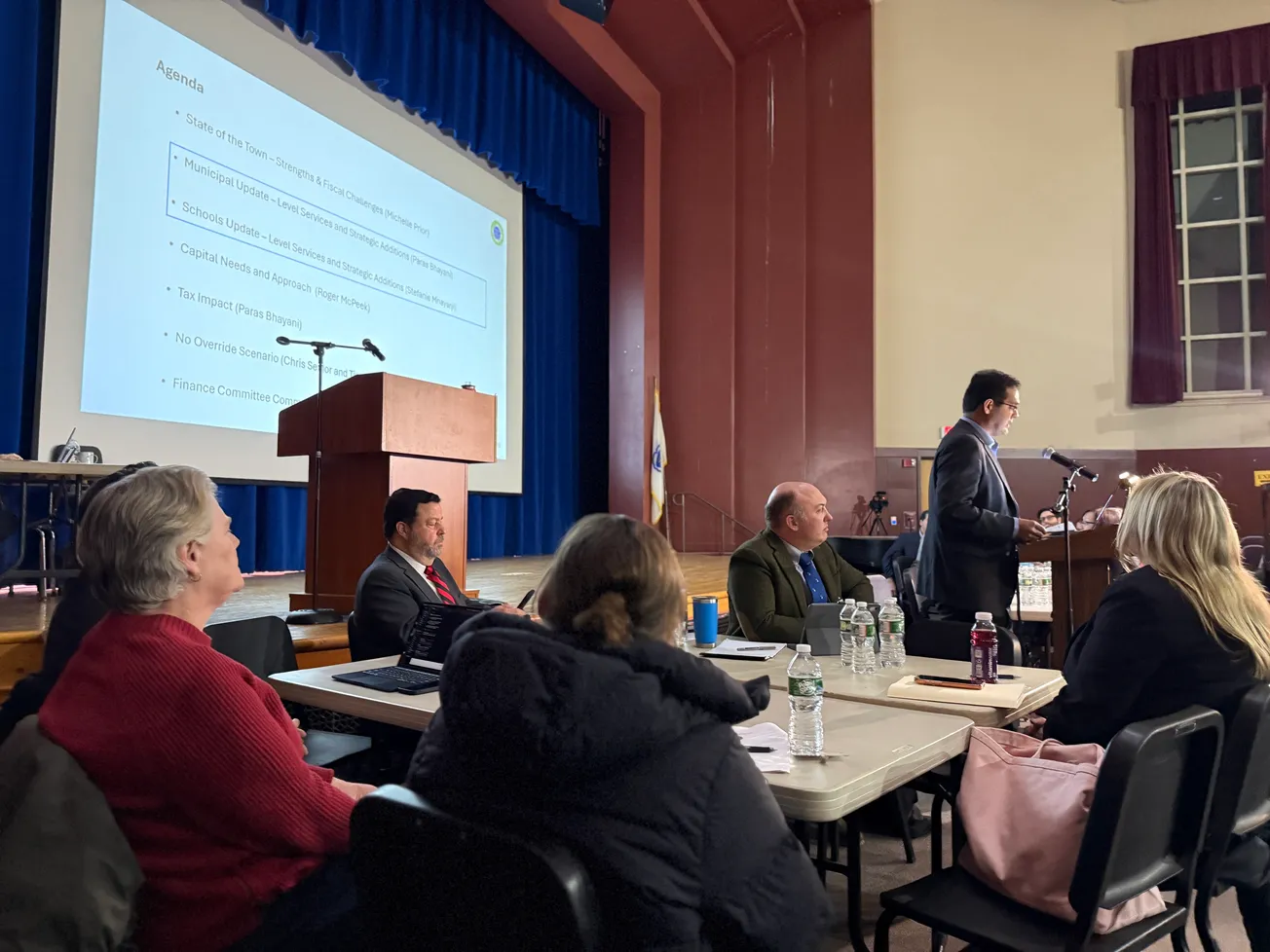
Winchester’s Special Town Meeting and a subsequent Select Board public hearing on Feb. 9 unfolded as two linked stages of the same unresolved argument: how large a Proposition 2½ override should be, how long it should last and how much risk the town should be willing to assume.
Supporters of a larger override framed it as the outcome of months of modeling and cross-committee work. Skeptics warned that pushing the number too high risks voter rejection and argued that long-term cost control, not new revenue alone, remains the town’s unresolved structural problem.
Select Board members signaled agreement on the need for an override in fiscal 2027 but left unresolved the final figure and its operating-capital mix.
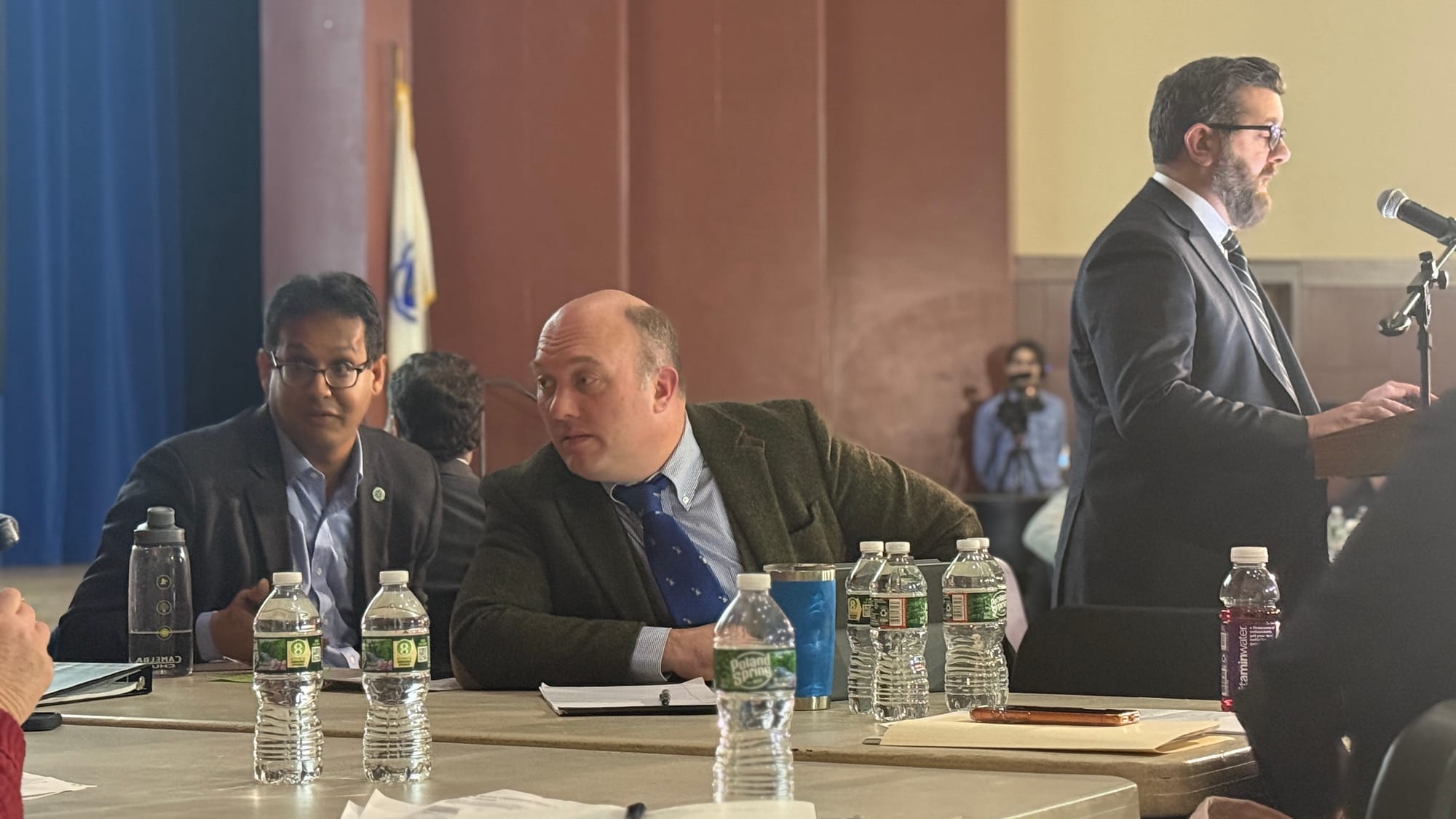
The Special Town Meeting opened with a sequence of prepared presentations.
Slides described a structural deficit entering fiscal year 2027, with a gap of roughly $5 million driven by revenue growth of about 3% under Proposition 2½ against faster-rising costs, particularly health insurance and school spending. The override will combine both operating and capital needs into a single ballot question rather than separate override mechanisms.
The town’s last operating override, approved in 2019, was expected to last three to four years, but ultimately lasted seven.
Select Board Chair Michelle Prior framed the discussion around what she described as Winchester’s “position of strength” while also pointing to the growing gap.
Select Board member Paras Bhayani followed with a municipal update, saying the board capped municipal level-services growth at 3% annually and reviewed more than $1.6 million in requested strategic additions, ultimately prioritizing about $800,000 for fiscal 2027. He framed those figures as inputs to a longer-term model rather than a final override amount.
“The key question,” Bhayani said, “is how long do we want the override to last?”
Stefanie Mnayarji, a member of both the School Committee and the Capital Planning Committee, presented a four-year plan for school spending priorities.
“The total request amounts to roughly $1,000 per student for the entire time horizon to help our kids catch up and provide the right supports at the right time and to deliver the level of academic excellence we expect for every Winchester student,” Mnayarji said.
Capital Planning Committee Chair Roger McPeek outlined what the slides described as an $85.6 million backlog of identified capital needs over five years, against $31.7 million in available stabilization funding. Rather than presenting a single recommendation, the committee offered multiple capital “packages” as options for Select Board consideration.
What the town stands to lose
Town Manager Chris Senior and Timothy Matthews, vice chair of the School Committee, presented a “no override” scenario describing what would happen without new revenue.
“We would experience reductions across all classifications of staff,” Matthews said, adding that cuts would go “beyond the reductions that are able to be taken because of declining enrollment numbers.”
Those reductions, Matthews said, could result in increased class sizes, higher transportation fees and cuts to extracurricular activities. The district would not be able to continue rolling out literacy and math initiatives or move forward with planned course expansions.
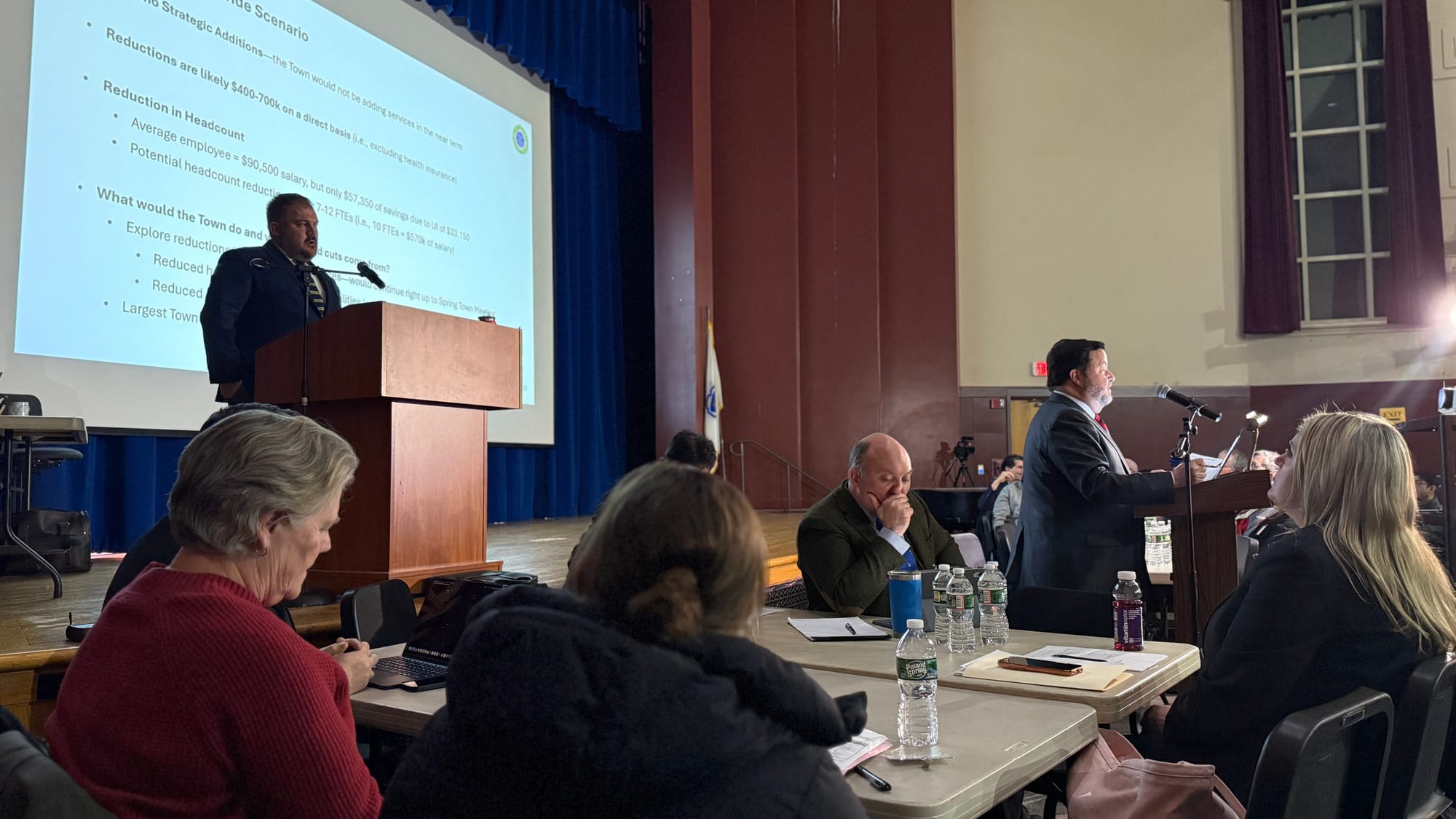
“We would be likely in a situation where we have delayed a feasibility study for the Muraco School,” Matthews said.
Finance Committee Chair Derek Ross framed the town’s finances as stable in the short term, but unsustainable without structural changes. He did not endorse a specific override amount, instead emphasizing that the size of any override depends on the level of services the town intends to maintain.
“The sky hasn’t fallen on our financial situation,” Ross said, before warning the town faces “a perpetual deficit every year” that cannot be absorbed indefinitely.
A town divided on how much to ask
Public comment during the Special Town Meeting and the Select Board’s subsequent public hearing revealed a sharp divide over how much the town should ask voters to approve.
Carol Savage, a Precinct 5 Town Meeting member, spoke in strong support of the process and an override at a level sufficient to fund the initiatives presented.
“We have what we have been looking for for a long time: a multi-year plan, with details, modeled, and tied to assumptions,” she said.
Savage emphasized the plan reflected months of volunteer work, cost savings and negotiated agreements.
“This work of this committee was substantial,” Savage said. “They identified meaningful cost savings in the school and town departments.”
She also spoke in support of the school investments: “I fully support the Tier II investments to help the struggling students that need the extra support.”
Resident Roger Wilson urged the Select Board to choose a smaller override, arguing the town’s problem is insufficient attention to costs rather than a lack of revenue tools.
“I would encourage you to pick the lowest possible number for the size of the override,” Wilson said. “I think it’s a bad idea to play chicken with the voter.”
Wilson warned that a $12.5 million override, combined with other increases already in motion, would represent a significant tax increase.
“That’s not chump change,” Wilson said. “People’s incomes are not going up at 10%.”
He argued the town needs a structure to address costs: “We can raise revenue at will. What we don’t have is a structure to address the cost side.”
Resident Shawn Macannuco, who no longer has children in the school system, spoke in favor of a larger investment.
“I feel the same passion that I’m hearing from the parents here in the room,” Macannuco said, adding she supported a “robust” budget that sustains school and community services.
A board aligned on timing, divided on size
Slides presented during both forums stated that the entire Select Board agrees fiscal 2027 is the appropriate time to pursue an override. A majority indicated support for a total override range of $12.5 million to $15 million, split between operating and capital components.
But two board members used Monday’s hearing to make the case for a significantly smaller figure.
Prior, who earlier in the evening had presented during the State of the Town overview, and Mike Bettencourt argued for an override between $8 million and $10 million.
Prior pointed to expected savings from declining health insurance rates, new tax revenue from housing developments projected to come online in fiscal year 2028 or 2029 and the likelihood that declining school enrollment will reduce staffing costs independent of any override.
Prior also grounded her argument in affordability. She cited data from the town’s Human Services Department showing a sharp increase in client appointments and in Recreation Department scholarships for preschool and after-school care, rising from about $5,000 in assistance in 2023 to $24,000 last year.
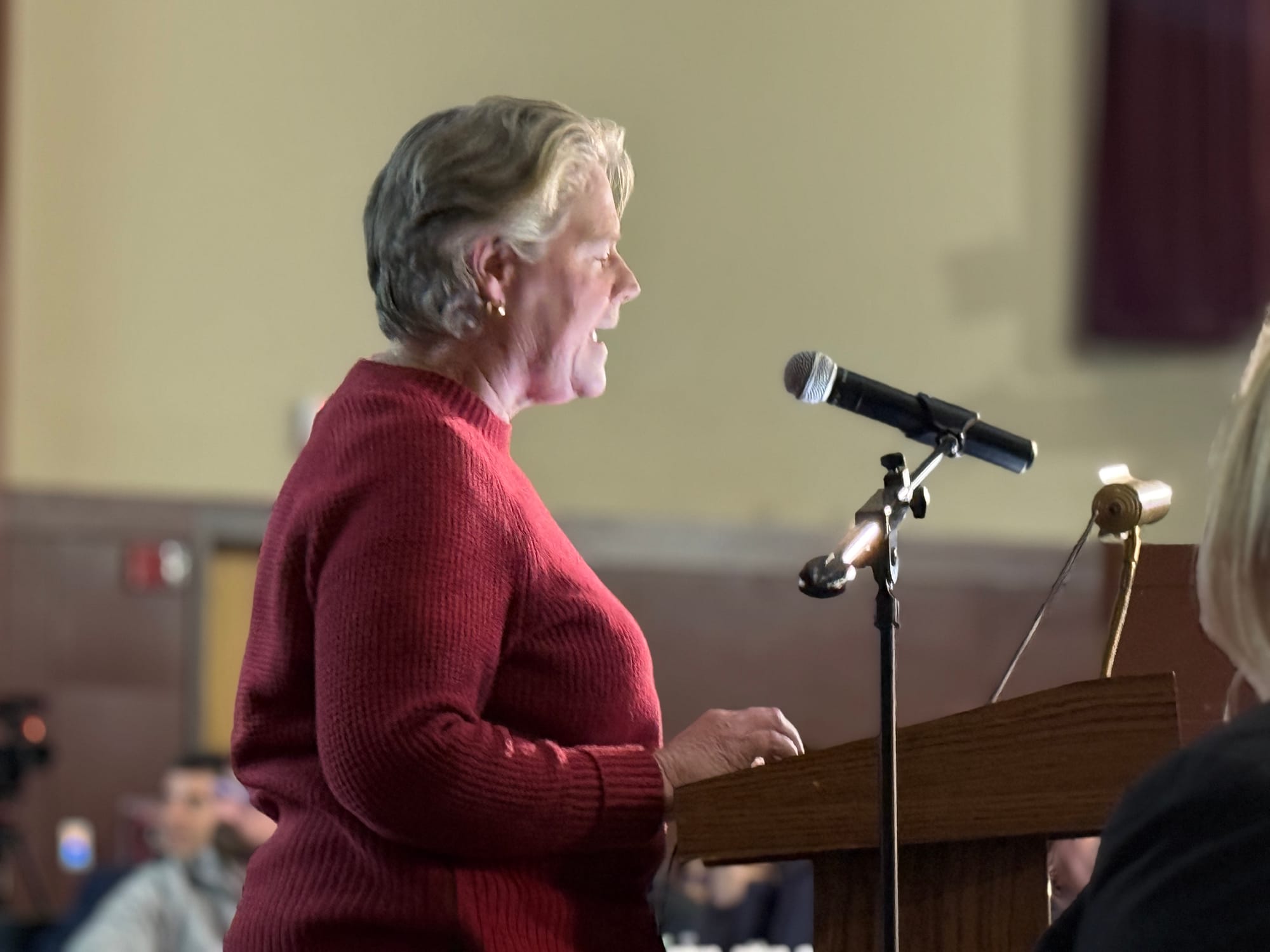
“I would ask the Select Board, and I will on Thursday, to consider override affordability to all of our residents,” Prior said.
She said a smaller override could sustain services for three to four years while the town waits for new revenue and clearer data on health insurance and inflation trends.
Bettencourt reinforced Prior’s position. He argued that an $8 million operating override combined with $2 million for capital would sustain the town through the end of the decade and cover all requested school additions.
Bettencourt also challenged the premise that a larger override is necessary to address the capital backlog, noting the town has spent more than $50 million on capital projects over the past decade and nearly $200 million in debt exclusions.
The materials presented Monday do not show how the remaining board members line up within the $12.5 million to $15 million range supported by the majority, or whether consensus exists on how long the override should last.
Slides labeled “The Big Question” asked, without answering, where each member stands on override size, operating versus capital splits and risk tolerance.
The Select Board is scheduled to meet Thursday, Feb. 12. How much of that question gets answered then will determine what, if anything, appears on the March 21 ballot.
Will Dowd is a Massachusetts journalist who covers municipal government and community life for Winchester News. He runs The Marblehead Independent, a reader-funded digital newsroom.