Table of Contents
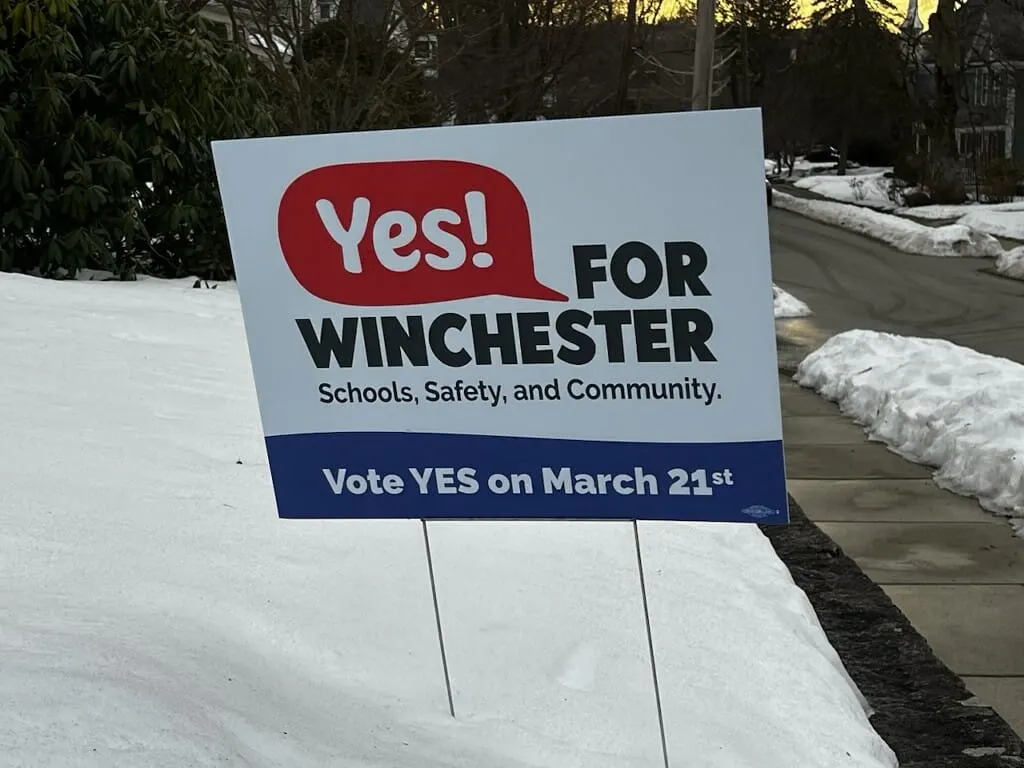
A volunteer campaign called Yes for Winchester is working to build community support for an $11.5 million override on the town’s March 21 election ballot, relying primarily on house parties, lawn signs and neighbor-to-neighbor outreach rather than traditional political infrastructure.
The campaign began preliminary planning before the Select Board established the final override figure, then accelerated after the board voted unanimously to support the plan.
The override, if approved by voters, would be split between $9 million in operating funds and $2.5 million for capital improvements, according to the Select Board’s Feb. 25 letter to residents.
Winchester faces a structural deficit exceeding $5 million entering fiscal year 2027, driven by rising health insurance costs, union contracts and limited revenue growth under Proposition 2½, which caps annual property tax levy increases, according to town documents.
The last operating override was approved in 2019 and was projected at the time to last three to four years; it has now been seven years since voters were asked to approve one.
Norah Cooney, a lead organizer for Yes for Winchester, said her path to civic involvement began with the debate over Winchester’s literacy curriculum, which drew her to School Committee meetings, Finance Committee sessions and Select Board hearings.
“If you had asked me three years ago, two years ago, what an override is — I wouldn’t have been able to tell you,” Cooney said. “I think that’s pretty instructive.”
Cooney said the campaign has no fixed membership and is instead encouraging anyone who supports the override to spread the word within their own networks. Attendees at campaign house parties have included longtime residents and people who moved to Winchester within the past several years, she said.
The opposition
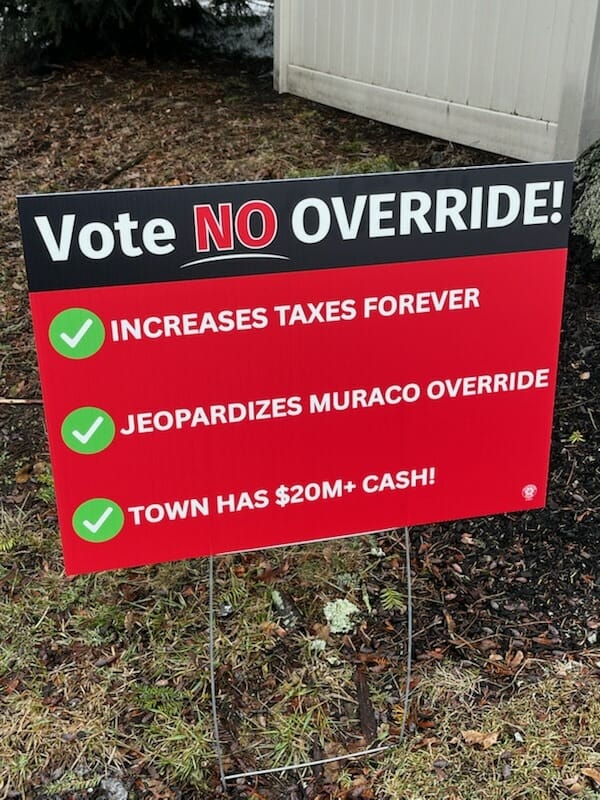
Concerned Winchester Neighbors, a ballot question committee organized March 3 to oppose the override, did not respond to multiple requests for comment from the Winchester News.
The committee filed a statement of organization with the Massachusetts Office of Campaign and Political Finance, listing fiscal responsibility and Muraco School funding as its primary concerns. Laura Glynn is listed as chair and Sally Regan as treasurer, both of Winchester.
Attempts to reach Glynn and Regan by phone and email for this article went unanswered, as of March 12.
A chance to fund underfunded programs
School Committee member Stefanie Mnayarji has participated in campaign events to answer resident questions directly. She said the override represents a chance to fund programs that have gone underfunded for years.
“We saw this override as an opportunity to expand those programs that we just never had a chance to invest in, because truly, we were just treading water and trying to keep the lights on,” Mnayarji said.
Among the concerns she most frequently encounters is a belief that the override could jeopardize the planned reconstruction of Muraco School, Winchester’s seventh school.
“A failed override jeopardizes a new Muraco, not a successful one,” she said. “It jeopardizes any funding sources. It jeopardizes our ability to move forward, and could result in delays.”
Mnayarji also said some residents have questioned whether town and school officials exercised sufficient fiscal discipline before settling on the override figure, and said the months-long State of the Town process was built around exhausting every alternative.
“There was nothing, no rock unturned,” she said. “We would always say that, because we wanted to look at all options and put them on the table.”
Deliberate steps to reduce override’s size
The State of the Town body included members of the Select Board, School Committee, Finance Committee, Capital Planning Committee and Planning Board, along with seven at-large residents — more than 20 people in total, according to the Select Board letter. The group met nearly 20 times between June 2025 and January 2026.
Select Board member Paras Bhayani, who chaired the State of the Town effort, said the process involved deliberate steps to reduce the override's size. The group began with an initial range of $12.5 million to $15 million before a combination of cost controls, union negotiations and new non-property tax revenue sources brought the figure to $11.5 million, he said.
Those steps included capping health insurance cost growth, increasing transfer station fees, pursuing solar energy revenue and expanding tax relief programs for seniors and veterans, according to town documents.
The Select Board has also indicated support for a residential tax exemption of between 5% and 10% of assessed value — a policy parameter under state law that shifts some of the tax burden away from lower-valued, owner-occupied properties without changing the overall levy. The materials do not provide per-household dollar estimates of that exemption’s impact.
Based on the town’s tax impact analysis, the owner of a Winchester home assessed at the average value of approximately $1.46 million would see an additional $719 on their fiscal year 2027 tax bill and an additional $737 the following year under the $11.5 million override.
Mnayarji urged residents with questions or concerns to contact officials directly.
“Misinformation is absolutely dangerous to any democratic process, so come straight to the source,” she said. “We have the good fortune of being in a small town. This is one of the benefits. I’m not far away from anyone.”
Cooney said the campaign’s answer to voters worried about the tax impact is that the override is paired with protections designed to cushion costs for lower-income residents — and that the services it funds most directly benefit those with the fewest outside alternatives.
“Finding those ways to absolutely make this so that nobody is taxed out of Winchester, I think, is critical,” she said.
Will Dowd is a Massachusetts journalist who covers municipal government and community life for Winchester News. He runs The Marblehead Independent, a reader-funded digital newsroom.