
Table of Contents
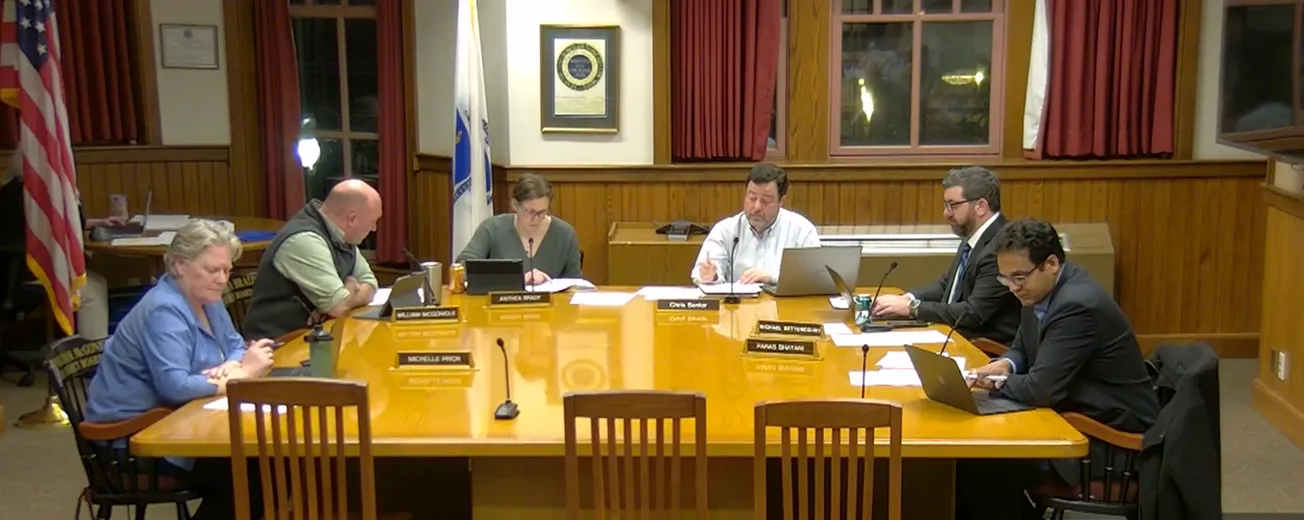
The Winchester Select Board voted March 16 to place a solar purchase authorization on the Spring Town Meeting warrant, advancing a roughly $6 million plan to install panels at five town-owned properties.
The board co-sponsored Article 14, which would fund solar arrays at Winchester High School, McCall Middle School, Vinson-Owen Elementary School, the Department of Public Works and the Transfer Station.
It also voted to remove Article 15, a backup article that would have authorized power purchase agreements for the same sites. The School Committee had previously endorsed only the purchase approach, according to Select Board member Paras Bhayani.
“I believe they only endorsed the purchase,” Bhayani said.
A preliminary consultant assessment presented at the meeting outlined approximately 1,471 kilowatts across eight configurations, with the high school receiving the largest share at 596 kW. The full package carries a preliminary price of approximately $6.155 million.
Under the purchase model, the projects would generate roughly $111,000 in first-year net savings and $4.185 million over 25 years. The funding mechanism has not been finalized, though officials discussed borrowing.
The case for buying
Sustainability Director Ken Pruitt said the financial case stands on its own.
“From a financial standpoint, even if you don’t care about solar, one way or the other, don’t care about the environment, if all you care about is the town’s finances, yeah, you would do these projects,” he said.
Pruitt said every proposed project would produce savings from the start.
“All of these projects have a positive net cash flow immediately and for the next 25 years,” he said.
Over the full term, he said, the return would exceed the investment.
“Yes, we’re putting $6 million down, and over 25 years, not only would we pay back that $6 million, we would generate an additional over $4 million in net savings to the town,” Pruitt said.
The expansion would mark a significant leap for a town that has built its solar portfolio incrementally. Winchester’s first three municipal arrays — rooftop systems at the high school, Vinson-Owen and the DPW totaling about 273 kW — were completed in 2021 as third-party-owned PPAs with an estimated $525,000 in savings over 20 years.
The town shifted toward direct ownership with Lynch Elementary School, which opened in 2025 as Winchester’s first all-electric, net-zero school. Pruitt called the 490-kW Lynch system the town’s largest single project.
“The biggest we ever went at one time is the Lynch Elementary School, where we put in … 490 kilowatts solar,” he said. “It’s enough to supply, you know, the entire school’s electricity need, which is also huge, because the school is all electric, so it uses quite a bit of electricity. It doesn’t burn any fossil fuels for heating.”
Lynch also brought parking canopy solar to Winchester for the first time.
“Lynch’s was really notable in that it was the first time we put in parking canopy solar anywhere in town,” Pruitt said.
Significant savings with a caveat
The ownership model was made possible by the Inflation Reduction Act, which extended the 30% investment tax credit to municipalities through elective pay.
“Before the Inflation Reduction Act, only private companies could take advantage of the 30% investment tax credit,” Pruitt said.
For towns using tax-exempt bonds, the net benefit is 25.5% of project costs, returned as a federal cash rebate. That credit is expiring, and Pruitt said projects must begin before July 4 to qualify.
“We would have to start the projects before July 4 of this year,” he said.
The April 27 Town Meeting is the only session that could approve them in time.
The deadline also shaped procurement. Winchester’s membership in Power Options, a nonprofit energy consortium, allows the town to sole-source work to Select Energy without a competitive bid.
“We determined we either take advantage of the sole source provision of our membership with Power Options to … design these projects and execute them with Select, or we’ll be able to do, you know, zero projects before the tax credit … phases out,” Pruitt said.
Not all sites may survive engineering. Select Board Chair Michelle Prior cited unknowns at some locations.
“We don’t know if there isn’t groundwater right beneath the surface, or it was formally used as a dump,” Prior said.
Bhayani agreed: “I think it’s guaranteed that some of them will not.”
The plan is to seek Town Meeting approval for the full slate, then have Select Energy perform initial engineering at the vendor’s risk.
Pruitt said he expects debate but recalled that the Lynch project passed with roughly five dissenting votes.
“I was very surprised, pleasantly surprised, when Town Meeting voted on the Lynch solar project because I expected, you know, some opposition potentially. And it was almost a unanimous vote,” he said.
Spring Town Meeting is scheduled for 7 p.m. on April 27 at the Winchester High School Auditorium.
Will Dowd is a Massachusetts journalist who covers municipal government and community life for Winchester News. He runs The Marblehead Independent, a reader-funded digital newsroom.