Table of Contents
The pattern broke.
For seven straight votes stretching back to 2017, Winchester voters had said yes to every Proposition 2½ question put before them — school buildings, operating budgets, capital needs. The Lynch Elementary School project passed in 2023 with 82.4% support, the highest for any school ballot question in town history.
Saturday, in the gymnasium at Winchester High School, they said no. Winchester’s $11.5 million override failed by 293 votes, or 52.5%, with 2,558 residents voting against the measure and 2,265 voting for it.
The result landed after months of State of the Town planning, a marathon Select Board negotiation that ran nearly three hours, dueling grassroots campaigns and a Saturday that brought 4,876 voters through the doors — a 32% turnout with all eight precincts voting under one roof at the high school.
The override had been designed to close a roughly $5 million structural deficit driven by health insurance costs that rose 18.92% in fiscal year 2026, escalating pension obligations and revenue growth capped under Proposition 2½.
The State of the Town Committee — 25 members working across 19 work streams — had been meeting since May 2025 to build the case. Initial modeling pointed to a range of $12.5 million to $15 million.
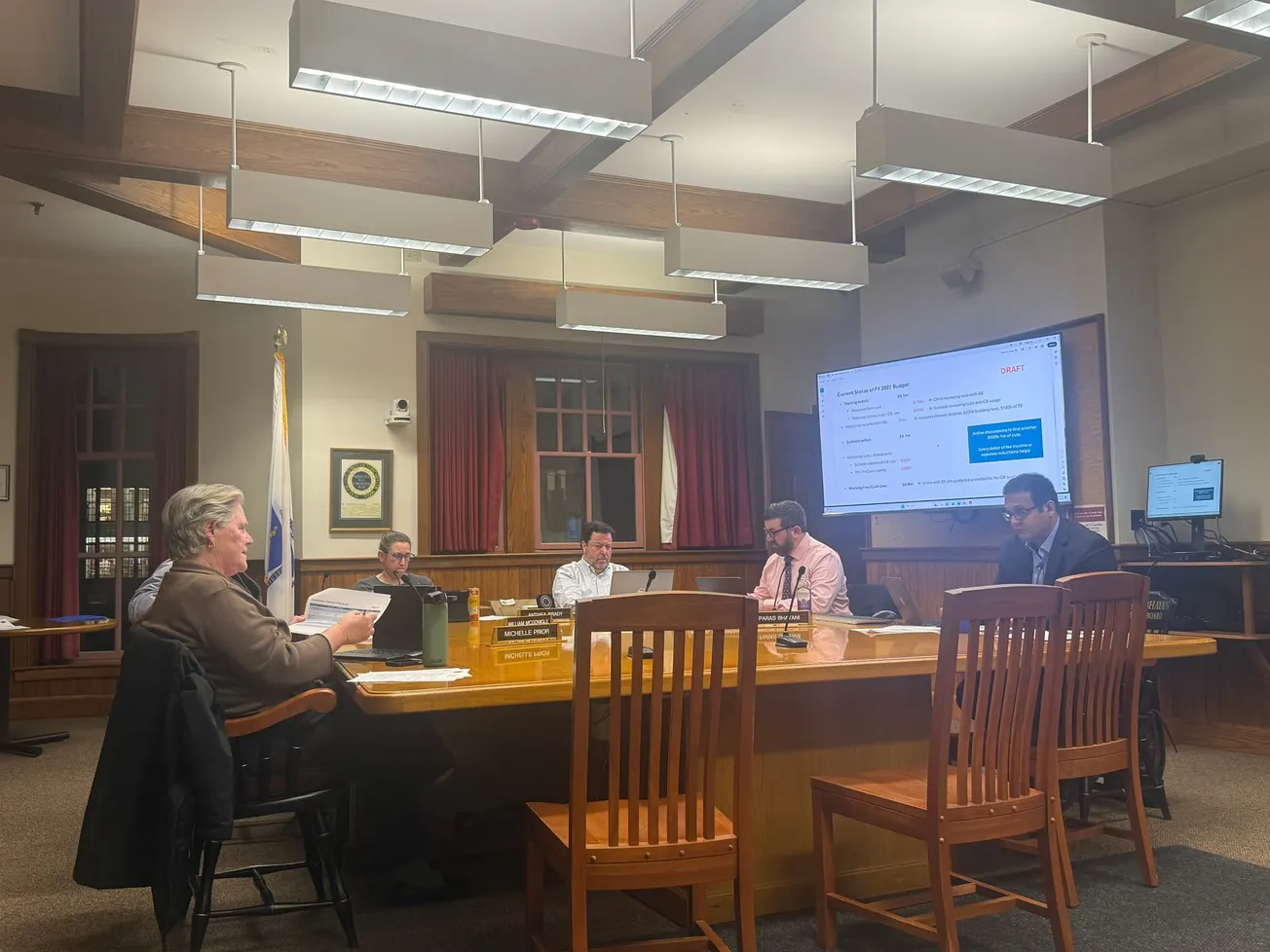
By the time the Select Board sat down for its final deliberation on Feb. 12, members had compressed that to $11.5 million — $9 million for operations and $2.5 million for capital stabilization — and approved it unanimously. The tax impact was projected at about $719 on the average single-family home in the first year and $737 in the second.
Five of eight precincts voted no. Precinct 5 delivered the sharpest rejection, 397 to 224. Precincts 1 and 3 carried the yes vote, but not by enough to overcome the margins elsewhere.
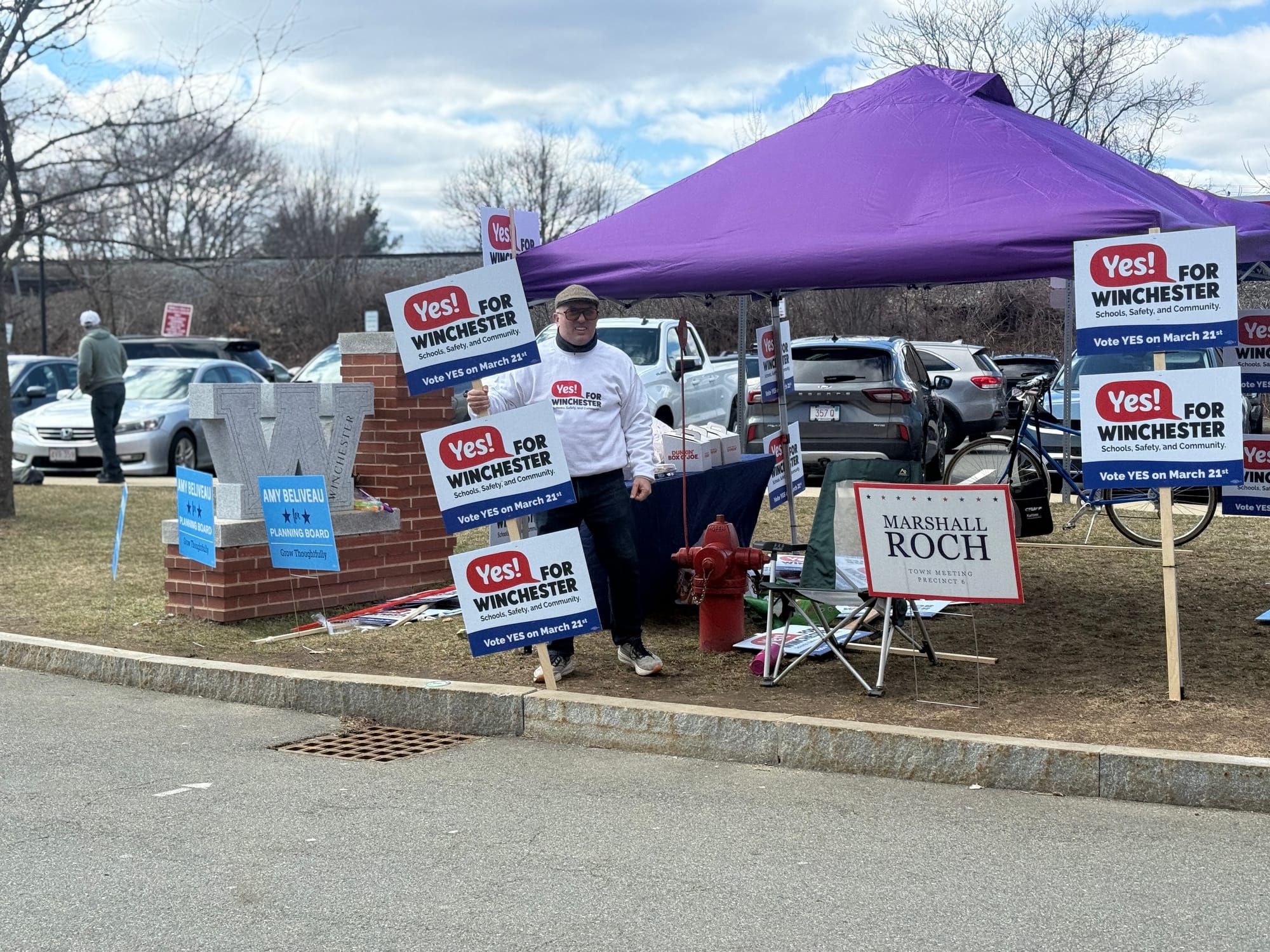
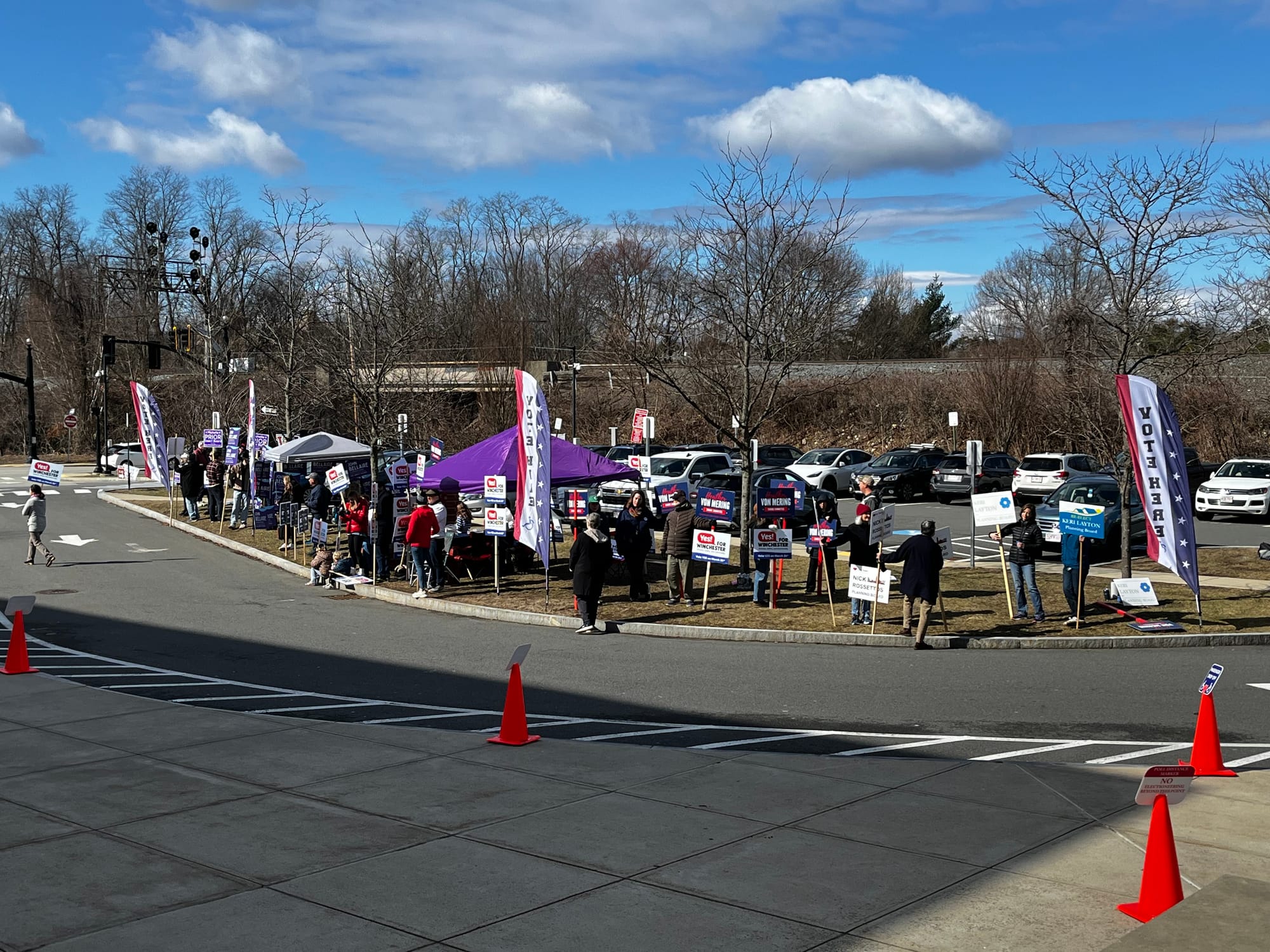
The Yes for Winchester campaign had relied on grassroots methods — house parties, lawn signs and neighbor-to-neighbor outreach — to build support. Concerned Winchester Neighbors, organized by Laura Glynn and Sally Regan, formed March 3 to oppose the measure.
Prior takes every precinct in landslide victory
In the Select Board race, it was not close. Michelle Prior, the incumbent chair, defeated challenger Shamus Brady 2,823 to 1,140, or 70.9%, carrying every precinct by wide margins.
Prior, a public-sector consultant with 35 years of experience who previously served six years on the Finance Committee, had emphasized deliberate process and consensus-building throughout her campaign.
Brady, a former School Committee member and current director of special education for Everett Public Schools, had pushed for urgency, visible dissent and new revenue streams.
Prior had raised questions during the campaign about potential Open Meeting Law complications of seating Brady alongside his wife, current Select Board member Anthea Brady, as well as possible conflicts of interest on votes benefiting individual households. Voters answered decisively, but Brady said candidates shouldn’t go unchallenged.
Bellaire defeats von Mering
John Bellaire won the School Committee seat vacated by Michelle Bergstrom, who said she wouldn't run after nine years to return to full-time elementary teaching. Bellaire defeated Heather von Mering 2,166 to 1,841 — or by 54%.
A Winchester High graduate and Brown University alumnus who works for the Bellwether education nonprofit, Bellaire had called for joining the METCO desegregation program — noting Winchester applied and was rejected in both 1967 and 1974 — developing a formal AI policy and reinstating teacher performance reviews.
Von Mering, a mother of five with 16 years in town government including stints on the Planning Board, Historical Commission and as town moderator, had argued the district should close its literacy and math gaps before taking on new commitments.
Both candidates agreed Winchester lacks a coherent technology policy — Bellaire cited data showing more than 80% of high school students nationally use AI in coursework — and both called for greater attention to student mental health, with one in four Winchester High students reporting overwhelming stress or anxiety.
Beliveau unseats Rossettos
On the Planning Board, newcomer Amy Beliveau unseated incumbent Nicholas Rossettos to claim one of two open seats. Keri Layton, the other incumbent, led the field with 2,306 votes. Beliveau finished second with 2,019 and Rossettos came in third with 1,838 — a margin of 181 votes.
All uncontested races proceeded as expected. Philip Frattaroli was returned as town moderator with 3,283 votes. Richard Michienzi won re-election to the Board of Assessors. Gregory Sawicki kept his Board of Health seat. Katherine Ho was elected to the Library Board of Trustees, though one of two seats remains unfilled. Brenda Kleschinsky won the Housing Authority seat.
Override rejection breaks streak
The override’s failure snaps a streak that had been building for nearly a decade. Between 1988 and 2009, Winchester voters considered 22 Proposition 2½ questions and rejected 15 of them. Since 2017, all seven had passed.
The turnaround had tracked with a shift toward standalone elections, moderate turnout and clearly defined capital projects. Saturday’s vote fit those conditions — a standalone election with 32% turnout — and the override still lost.
Thurman Smith, 83, said his vote was straightforward: He wanted a lower tax bill.
“The tax bill on my house is $27,000 a year,” said Smith on his way to the parking lot. “And keeps going up. And I see a lot of unnecessary spending.”
Smith, who has lived in Winchester for 15 years and has been through two overrides, said he was guided in part by a recommendation from the Republican Town Committee.
Others saw the override differently. Janet Nelson and Jack McCreless, a couple approaching 80, said they voted yes without hesitation.
“We need to maintain our quality of life here,” McCreless said. “It’s not free.”
Nelson added their daughter went through the Winchester schools, and it was a good experience.
“We should do something about that,” she said, acknowledging that for some residents the tax increase represents a real hardship. “It’s not hard for us, luckily.”
Kristie Miller said her vote was about all of the above — the override and the candidates. But she framed the moment in broader terms.
“I’m feeling like election voting is more important than ever,” she said. “This is a moment where we have to come out and make sure our voices are heard.”
Winchester is now left facing the structural deficit it spent months trying to plan around with no clear mechanism to close it. The town’s operating budget draws roughly 95% of its revenue from residential property taxes — compared with a statewide average of 85% — and the Capital Planning Committee has identified $85.6 million in projects over five years against $31.7 million in available funding, a $53.9 million gap.
Schools had already agreed to cap budget growth at 4.25%, down from a historical rate of roughly 5.5%. Without the override, the question becomes what gets cut — and how deep.
Democracy on hardwood
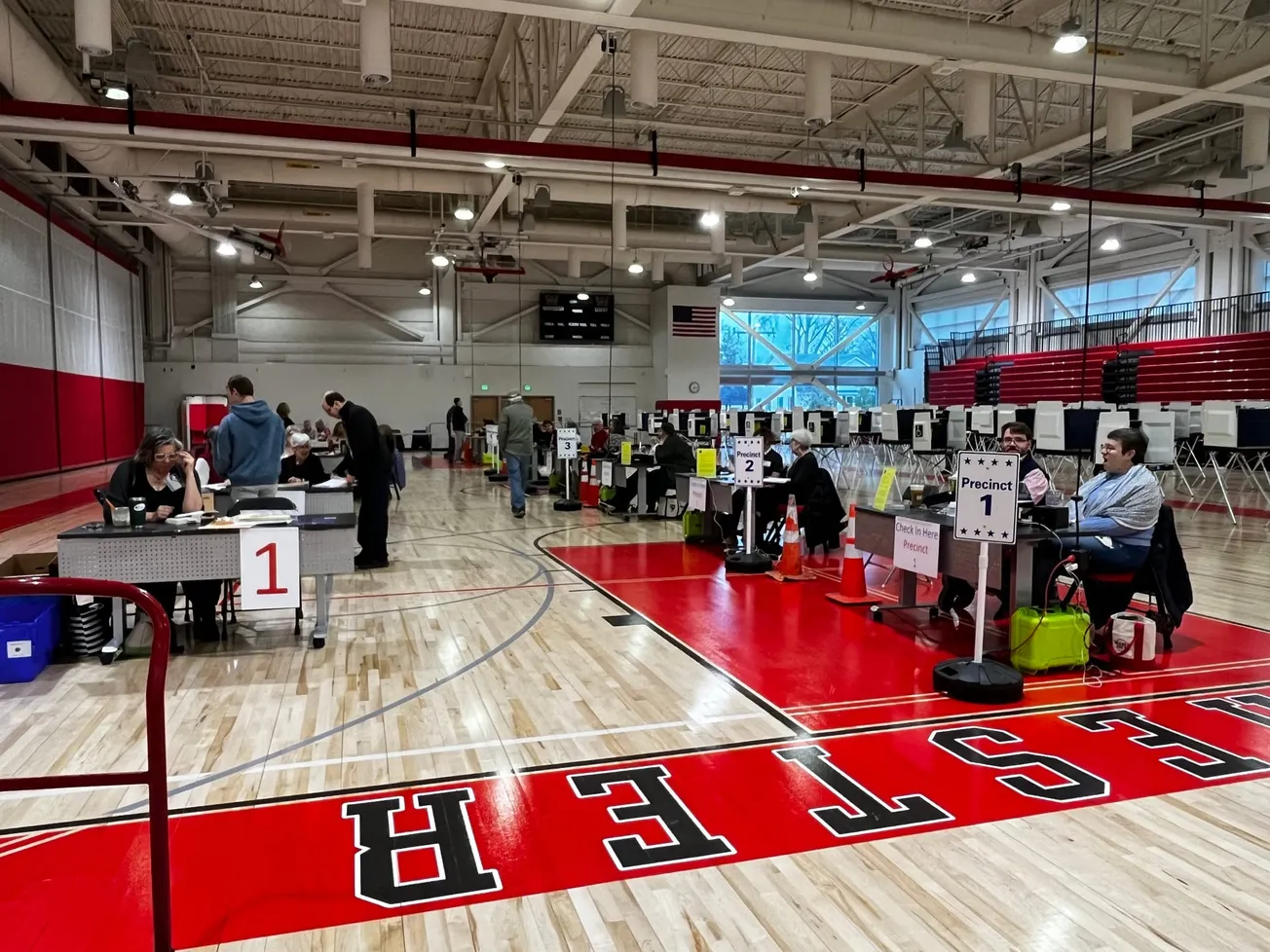
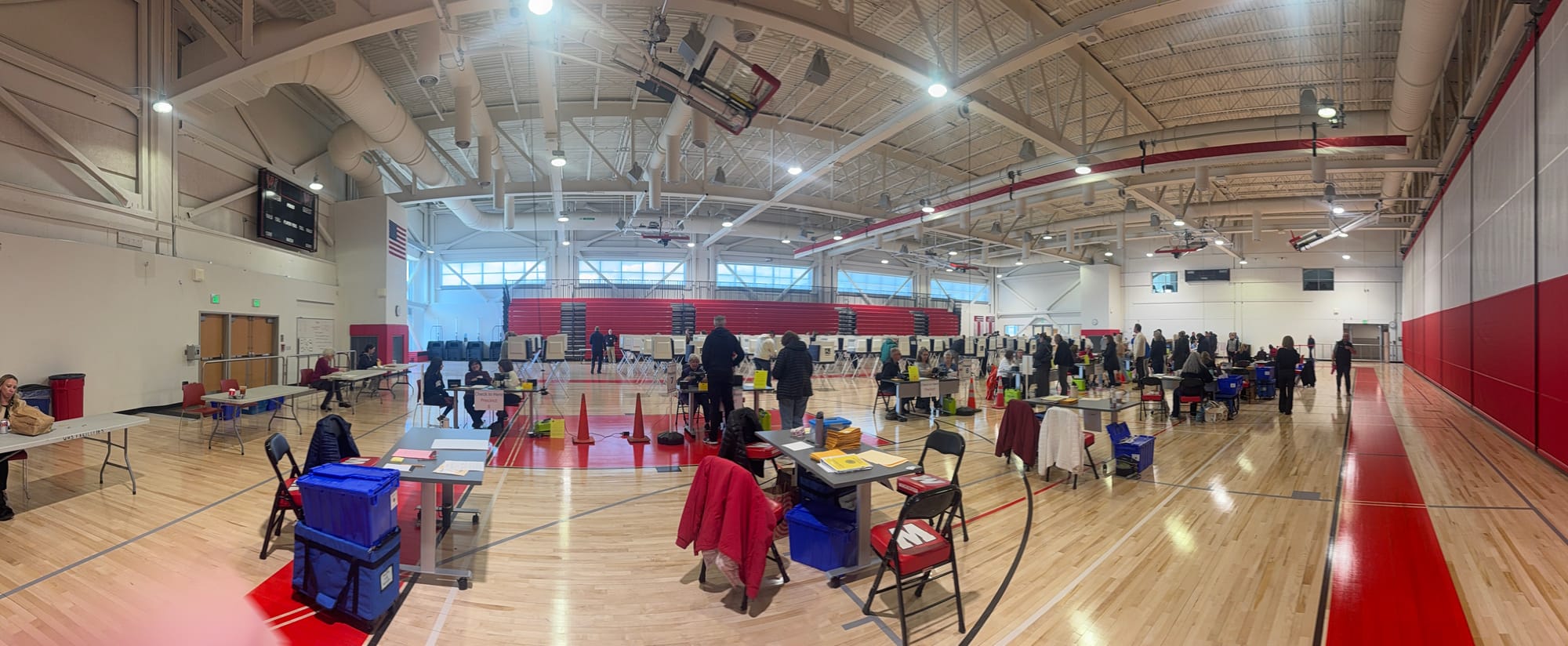
Inside, the gym floor doubled as a polling place, with check-in tables for each precinct arranged across the red-and-white hardwood beneath retracted basketball hoops. Poll workers staffed stations while families with strollers and young children filtered through.
Down the hallway, beneath the “Home of the Red and Black” lettering, Winchester High students Matthew Bees, Julia Coronella and Amrita Mondal sat with a “Vote Here” sign, directing voters toward the gym as National Honor Society volunteers.
Mondal, who said she came to see how an election works up close, was struck by what she saw.
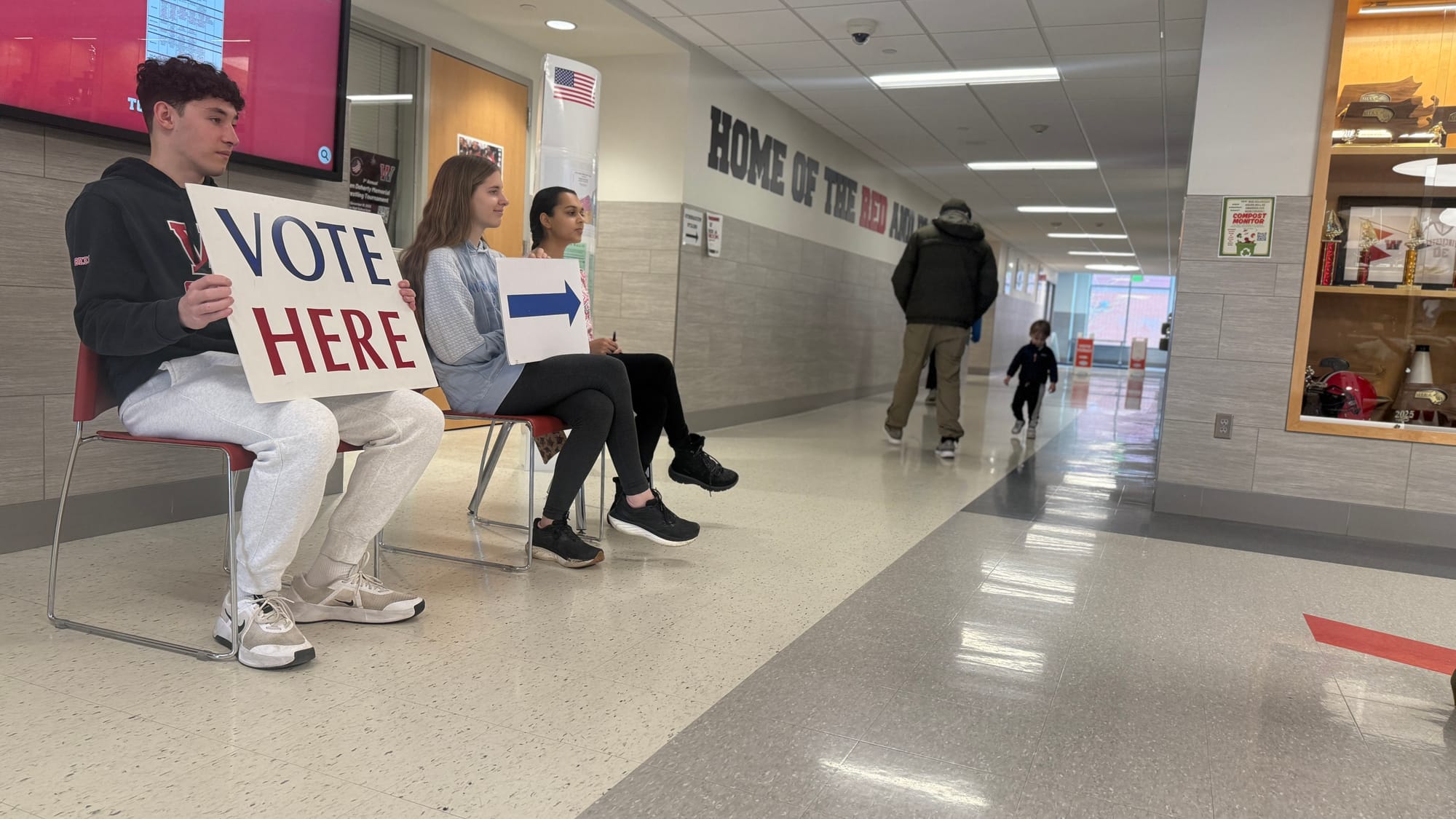
“Just being here and seeing how many people sort of came in and showed up for this election, it really just showed how much this town meant to people,” she said.
Bees agreed.
“It really just shows how much people care about the town,” he said. “They’re willing to take action and try to bring forward what they think is best.”
What Winchester does next with a failed override and a $5 million hole is now the central question of the spring — one that will follow the town into budget season, Town Meeting and whatever comes after.
The results are preliminary. Town Clerk MaryEllen Marshall is expected to certify the final numbers in the coming days.
Will Dowd is a Massachusetts journalist who covers municipal government and community life for Winchester News. He runs The Marblehead Independent, a reader-funded digital newsroom.