Table of Contents
More than 50 years ago, in the summer of 1973, I was transitioning from a rough-and-tumble junior high school in South Medford to the city’s gleaming new educational facility on Winthrop Street, which at the time accommodated over 3,500 academic and voke students stretching from the freshman to senior classes.
Despite the apparent upgrade, I failed to see how this move was going to elevate my school-going experience, which, through no fault of my teachers, had disimproved considerably after the elementary level.
What kept me distracted until my high school career commenced in September was the ongoing fallout from the Senate Watergate hearings, which were televised throughout the summer of ‘73 and culminated 15 months later in a singular event in American history.
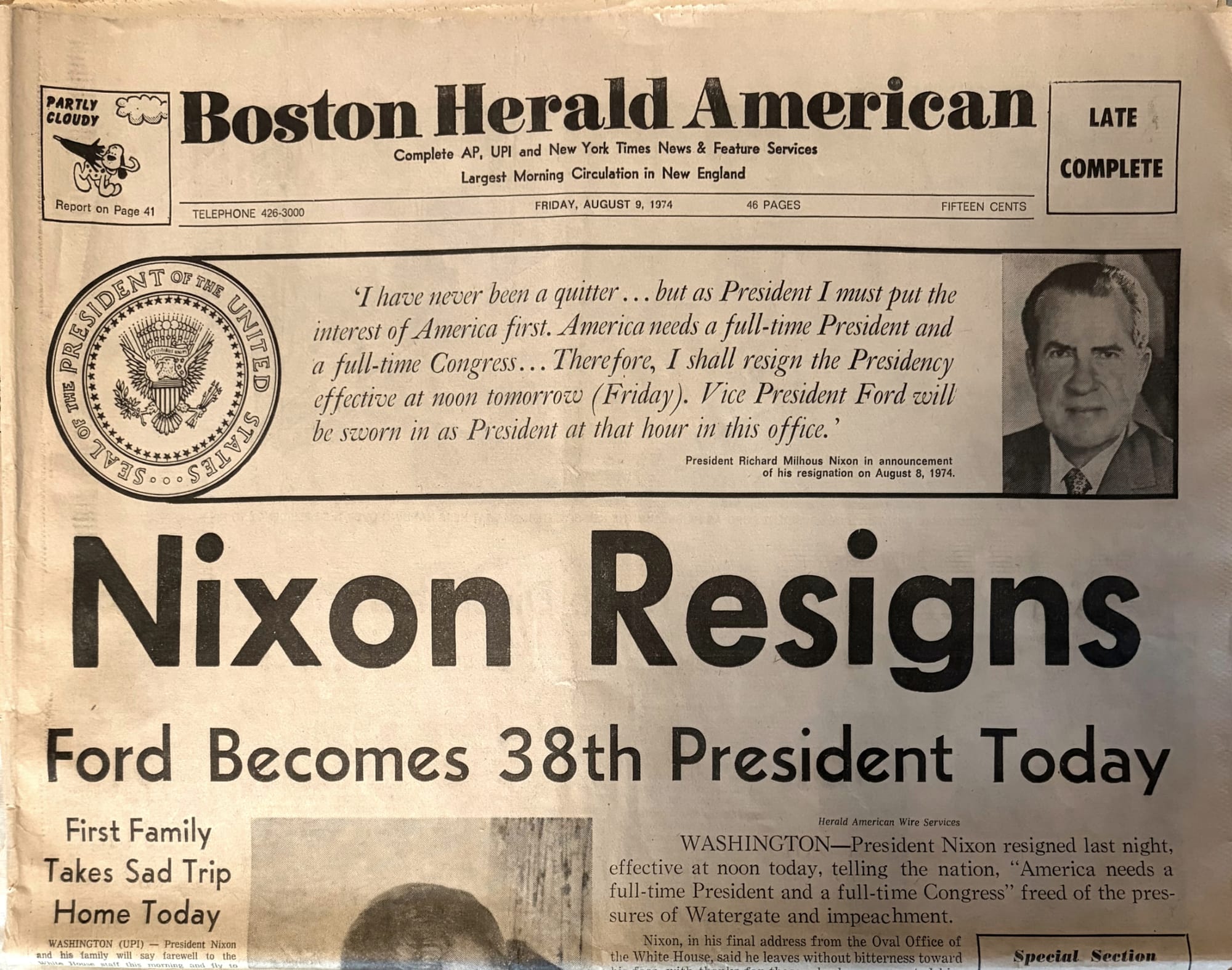
In fact, I became so enthralled by the whole ridiculous Watergate affair as it unraveled that I made sure to keep both editions of the Boston Globe from Aug. 9, 1974. The marquee headline of the morning paper that day – set against the opening lines of the U.S. Constitution – declared in bold type: NIXON RESIGNS / FORD TAKES OVER TODAY.
The afternoon edition featured a simpler banner above a large black and white photo of a traumatized Richard Nixon and his wife Pat: “Ford takes oath as 38th President.”
Apparently, I also went out and purchased a copy of the Boston Herald American, to commemorate this historic happening in triplicate, because that too is included in my unofficial archives.
On a recent visit home to Medford, I discovered these artifacts in a gray Samsonite briefcase my father had once obtained as a freebie from work. As it turns out, I was something of an aficionado of historic newspapers in the early 1970s, because the briefcase contained another edition of the Globe announcing the demise of an American original two weeks after Nixon left office.
“Lindbergh, first to fly Atlantic alone is dead” stated the headline from the Aug. 27, 1974 morning edition. (There was no comma after “alone”, by the way; inserting one would have pushed the header onto a second line.)
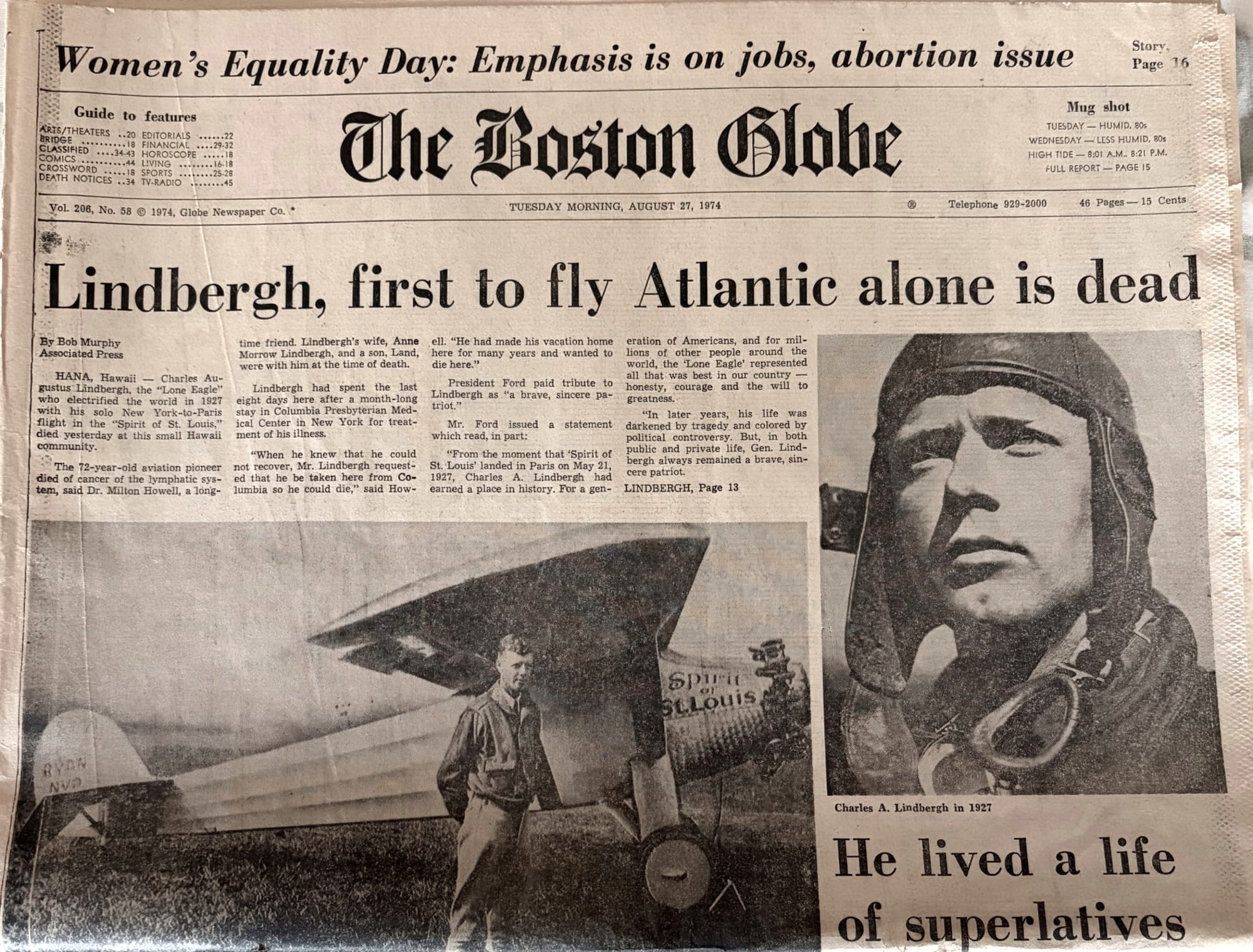
These papers make for fascinating reading on several levels. First, it’s interesting and fun to read contemporary assessments of controversial figures (what a pairing, Nixon and Lindbergh!) whom we’ve since been able to regard from different perspectives as various letters and archives have become available.
Also, the pre-digital layout design – with the paper appearing smudged and uneven in places like a bad photocopy – offers a window into a messier, more hands-on era in the newspaper business. As I lifted each brittle page, I could imagine a hassled layout editor on deadline having to physically manipulate each news report and syndicated feature.
But just as intriguing as the news items are the ads, which, as we’re finding to our cost today, remain vital to keeping a daily paper functioning at an effective level.
Remarkably, the Globe’s 24-page special section on the Nixon resignation was ad-free, crammed instead with stories from the paper’s three Washington-based reporters as well as accounts from other staff writers and commentators. (Nixon’s resignation speech was also printed in full.)
No such commercial restraint was deemed necessary in the paper that reported Lindbergh’s death. As a result, Globe readers in late August 1974 were alerted to the value on offer in Filene’s Automatic Bargain Basement, where Elkins leather shoes – “An Avant-Garde Collection of Past Season’s Surplus” – were available for $7.95, while Back-To-School Dresses for Girls – “New Fall Irregulars From Outstanding New York Makers” – ranged from $3.99 to $8.99.
A few pages later Globe readers were treated to an ad for another local retailer no longer with us. At J.M. Fields – “Our guarantee has no fine print” – you could buy among other items a Winchester 1400 auto load shotgun for $124.99.
Adjusted for inflation, this model represented slightly less value than the Stoeger M3000 Autoloading Shotgun that was listed for $549.99 on the Dick's Sporting Goods website before the chain discontinued the sale of firearms.
Of course, since a clean firearm is a safe firearm, J.M. Fields was responsible enough to offer a complementary shotgun cleaning kit at $3.49 – a savings of $1.
Plus, cigarettes remained an acceptable vice in 1974, resulting in a large green-tinted ad for Kools (“Announcing the only flip-open box with extra coolness inside”) as well as a more direct pitch for Old Gold Filters, again heralding the brand's tremendous new flip-top box – thus disputing Kool’s exclusive claim – but with “Valuable Gift Star Coupons, too.”
Now I’m not saying we’ll see a Constitutional crisis on a par with the Nixon resignation any time soon. But anything’s possible these days. So you might want to locate your nearest print newspaper distributor and be ready to closet away a few extra copies of your preferred daily.
Just in case.

Medford native Steve Coronella has lived in Ireland since 1992. He is the author of “Designing Dev,” a comic novel about an Irish-American lad from Boston who’s recruited to run for the Irish presidency. His latest paperback publications are “Entering Medford – And Other Destinations” and “Looking Homeward - Essays & Humor from a Misplaced American.”