

Table of Contents
The following column was submitted by Sen. Pat Jehlen:
Everyone agrees we need a lot more housing in Massachusetts. We’re spending billions of dollars and passing laws like the Affordable Homes Act and the MBTA Communities Act, hoping to create that housing.
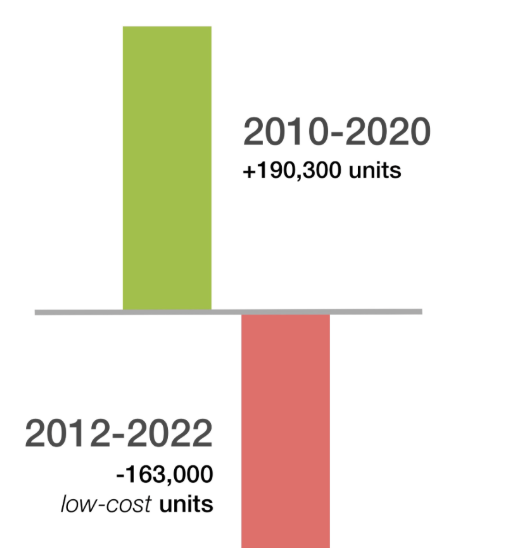
But at the same time, we’re losing housing for low and moderate income people. This chart compares data from the Healey administration and Harvard’s Joint Center for Housing Studies.
In A Home for Everyone the Healey administration adds, “We are at risk of losing the homes we have, especially the affordable ones…The availability of modestly priced homes and apartments is dwindling as they are acquired and upscaled by investors who sell or rent at a much higher price point.”
Nationally, we see the same trend: more total housing, but less housing for low and middle income people.
The New York Times reported that, “In cities that aggressively built housing in recent years, rents rose dramatically for low-income households and stabilized for wealthier ones. The new rental housing that was built was often luxury housing, with studios and one-bedrooms, units that targeted young, single professionals but were too small and too expensive for low-income households with children. New single-family homes for sale were larger than they were in the past, aimed at wealthier buyers, rather than cash-strapped, first-time home buyers.”
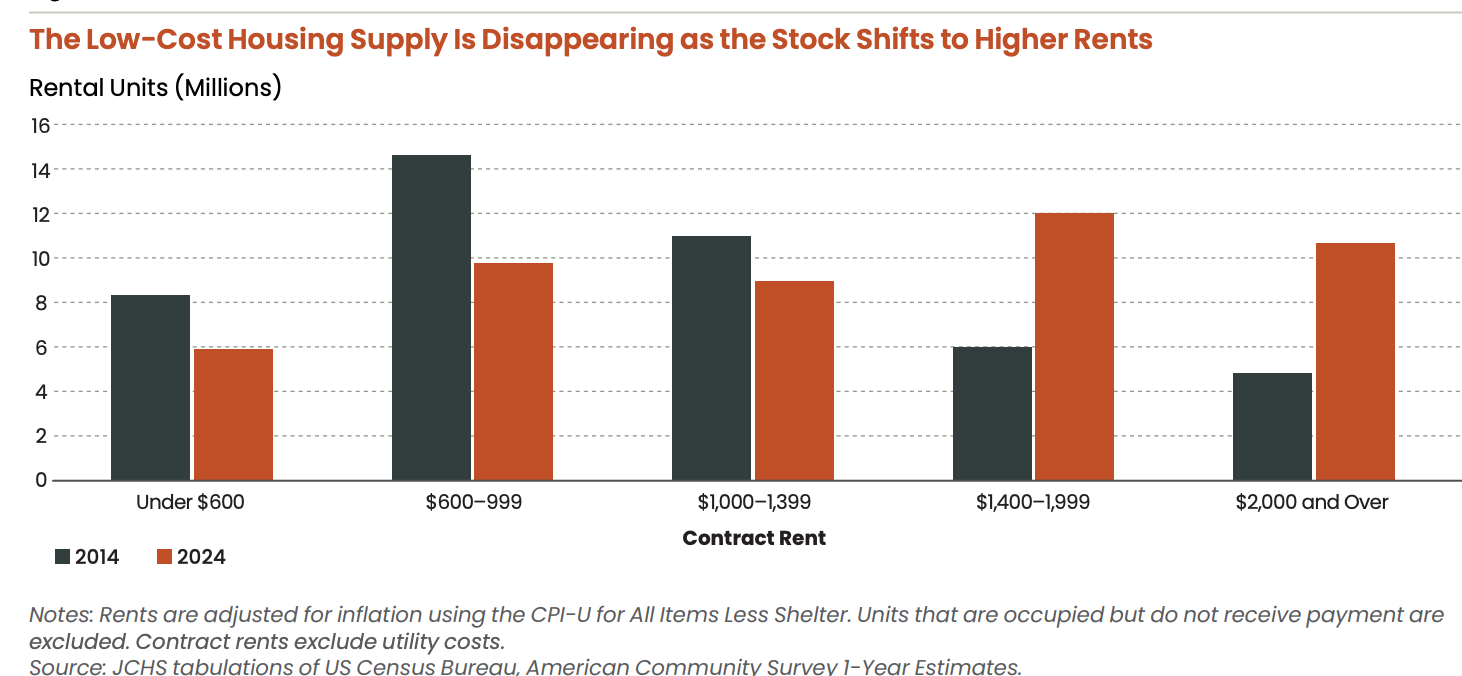
Harvard’s Joint Center for Housing Studies wrote in “The State of the Nation's Housing” that “rather than being replenished by units filtering down to lower rents, the existing stock of low-rent units is shrinking. (p. 3)”
This chart is from the report:
WE NEED PRESERVATION, NOT JUST BUILDING!
Chris Dwan, a Somerville writer, observed that “You can’t build old and cheap.”
The CEO of Massachusetts Housing Investment Corporation wrote in the Globe, “The state cannot build its way out of the current housing shortage. It must also prioritize purchasing existing affordable housing that is at risk of conversion to market-rate units. In many cases, acquisition costs are nearly half that of new construction.”
Naturally Occurring Affordable Housing is not the same as “affordable housing,” which is income-restricted and subsidized.
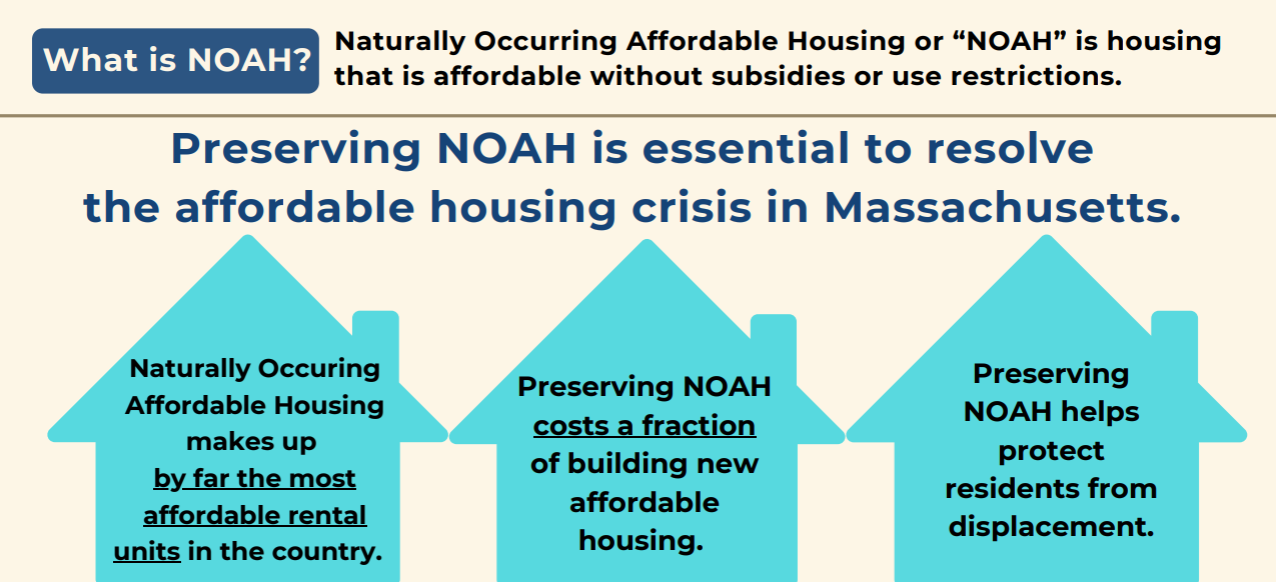
NOAH is rapidly being replaced by luxury housing in many communities. (Graphic from Homes for All)
ZONING CAN ELIMINATE MODERATELY PRICED HOUSING
One example of many: A multi-family in Somerville was sold two years ago for $710,000. Under current zoning, the buyer demolished it and built four condos by right, each selling for between $925,000 and $1,350,000. So there’s more housing, but fewer units available for people with modest incomes. (Want a tour of the new condos?)
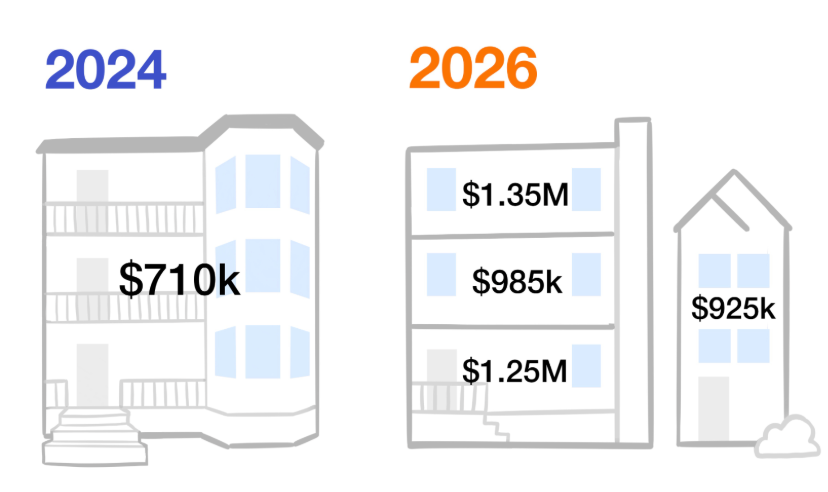
Moreover, upzoning can raise the market value of a property because of the opportunity to build more expensive units. Potential homeowners are outbid by corporations who can pay cash with no conditions.
The Metropolitan Area Planning Council report, Homes for Profit, Speculation and Investment in Greater Boston, reported that from 2004-2018 in East Somerville over half the three-deckers and almost 2/3 of 2-families were sold to investors. The situation is much worse now, but there’s no more recent data.
A recent opinion piece by a developer in Commonwealth Beacon made a similar point about upzoning in suburbs: Zoning “affects what land is worth. If an older $600,000 house sits on land that can suddenly support two more valuable homes, that property is no longer competing only as a $600,000 residence. It is competing as redevelopment land. A builder can pay more for it because the development rights are worth more. The existing house may become more valuable to demolish than to preserve.”
In earlier years, a three-decker could be a “starter home,” allowing a family to rent units to help pay their mortgage, or sharing with their extended family. This is no longer possible.
We need to preserve some naturally occurring affordable homes by removing them from the speculative market. Zoning should not create or increase incentives to demolish those homes and replace them with luxury units.
Sen. Pat Jehlen currently represents the Second Middlesex District in the Massachusetts Senate. She will retire at the end of December 2026 after 50 years of public service.