Table of Contents
Follow our live tally of results by clicking here.
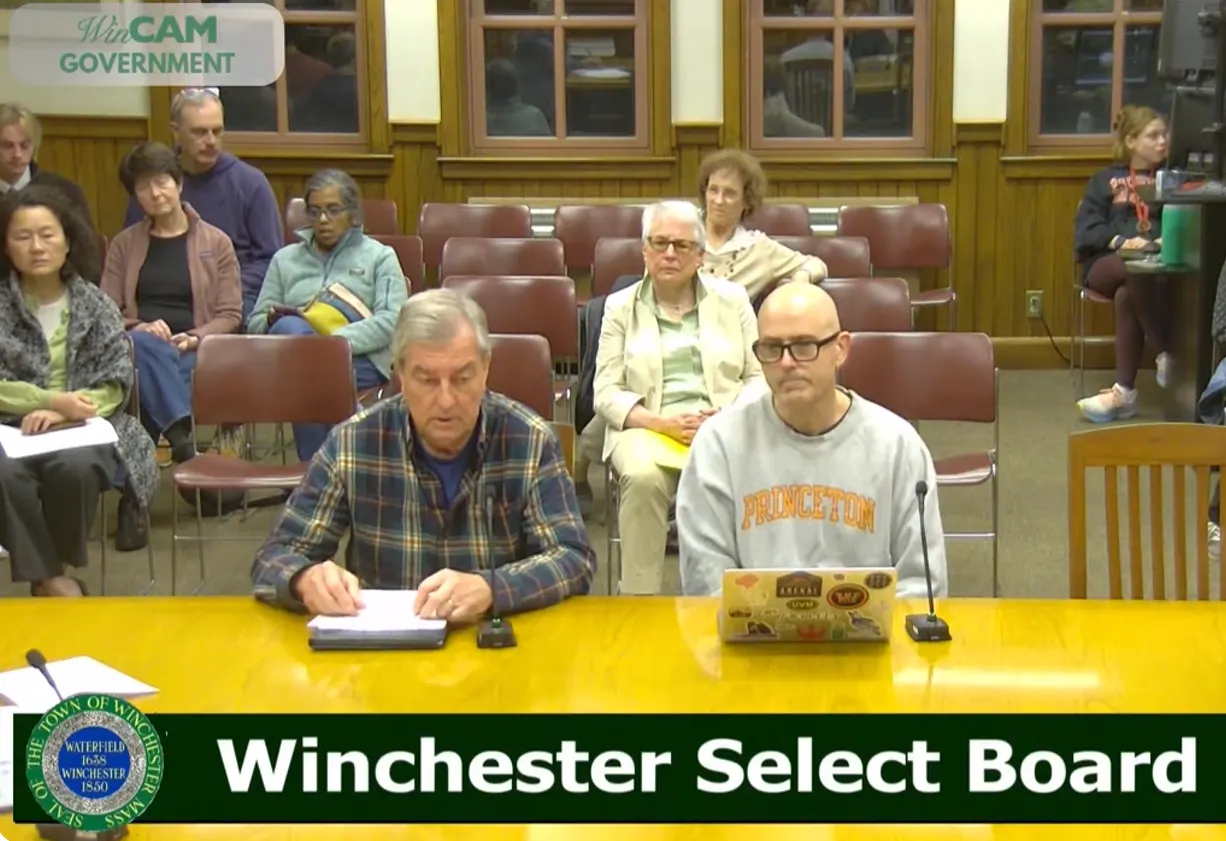
All eight of Winchester's precincts cast their ballots in the same building Tuesday, the gymnasium at Winchester High School, 80 Skillings Road. Voters who had shared that single room all day had just finished choosing among entirely different candidates, for entirely different Senate seats, depending on which line they had stood in.
Precincts 1, 2, 3 and 8 chose among three Democrats seeking to succeed Sen. Jason Lewis, the Winchester resident retiring from the Fifth Middlesex District. Precincts 4, 5, 6 and 7 chose among four Democrats seeking to succeed Sen. Patricia Jehlen, the Somerville-based Second Middlesex incumbent. Neither seat had opened this way before: the Second Middlesex was last vacant in 2005, when Sen. Charles Shannon died in office, and the Fifth was last vacant in 2014, when Lewis first won it in a special election.
No Republican filed for either seat, so whichever Democrat wins each primary enters the fall as the prohibitive favorite in November. Winchester, though, was never going to decide either race on its own. The town cast just 2,919 of the 55,810 votes in the Second Middlesex's last contested Democratic primary, in 2020 — about 5.2% — and 1,459 of the 21,666 votes in the Fifth's last primary, in 2022 — about 6.7%. Both winners will be chosen mostly by voters Winchester has never shared a ballot with.
By the time polls opened at 7 a.m., Winchester's mail and early ballots already numbered 2,364, or 13.7% of the town's 17,222 registered voters, according to figures released earlier in the day by Secretary of the Commonwealth William Galvin's office. Of those, 1,972 were Democratic ballots and 392 Republican, a lopsided split that ran through most of the district and one reason the Democratic primaries were the real contests all along. Statewide, the same report showed 555,525 ballots cast before polls opened, out of 5,184,354 registered voters, or 10.7%.
"The emphasis this year would seem to be federal in its orientation," Galvin said last week, a dry read on a day whose marquee draw was a U.S. Senate race between Ed Markey and Seth Moulton, not two open seats in the state Senate.
Four Democrats agreed on goals, clashed on method
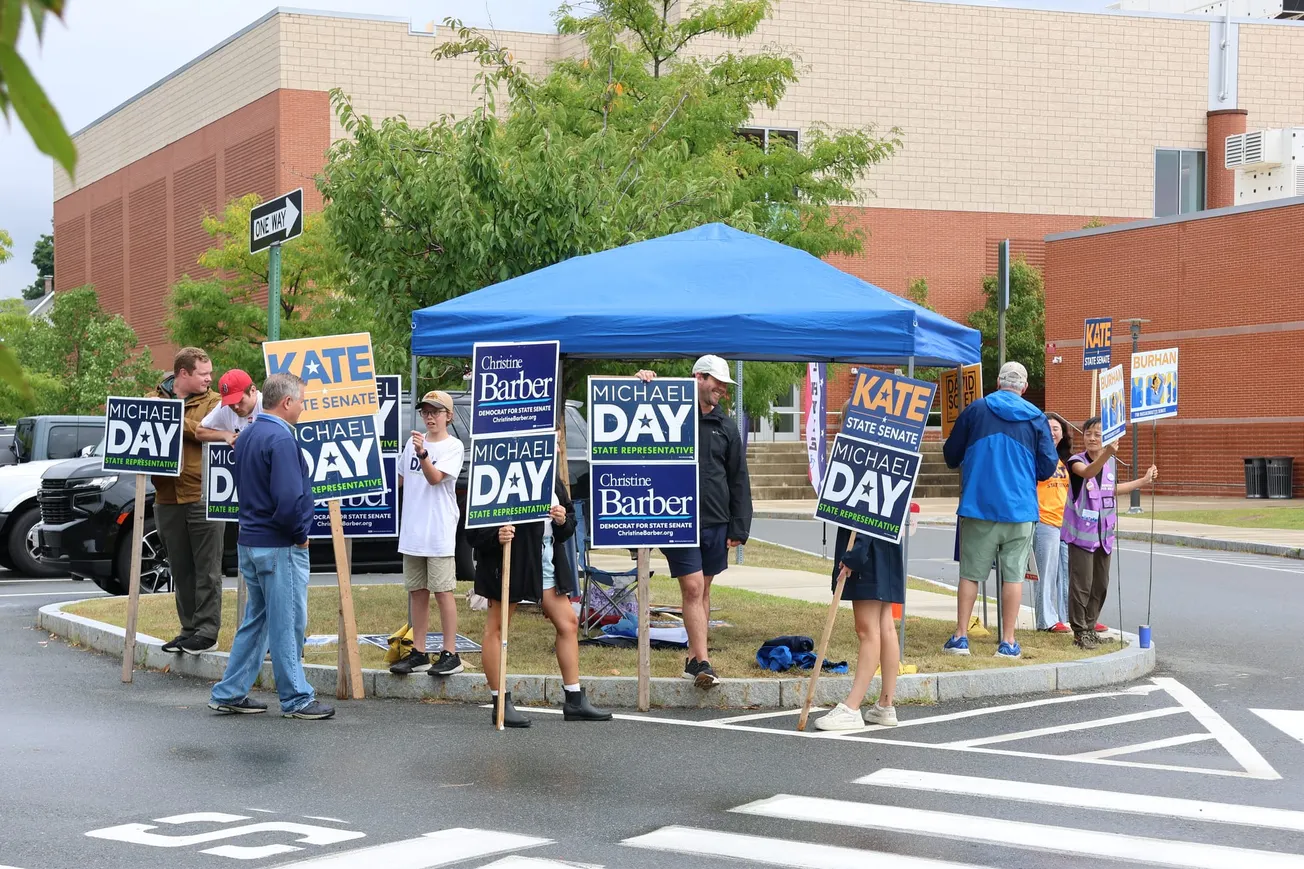
In the Second Middlesex, the four active candidates were Cambridge Vice Mayor Burhan Azeem, state Rep. Christine Barber, Somerville City Councilor Matt McLaughlin and state Rep. Erika Uyterhoeven. A fifth name, Thomas E. Hopcroft, remained on the ballot even though the Winchester School Committee member ended his campaign in late July, citing money and organization. Any votes he draws are name-recognition residue, not a live candidacy, and Winchester's Precinct 7, his home Town Meeting precinct, is the place to watch for it.
The four active candidates agreed on nearly everything — housing, transit, climate — and split mainly over how Beacon Hill should operate. Barber, a state representative since 2015 who chairs the Joint Committee on Environment and Natural Resources and sponsored the Work and Family Mobility Act letting undocumented immigrants get driver's licenses, ran as the continuity candidate and picked up Jehlen's endorsement in early August. Uyterhoeven, a self-described democratic socialist and former Bernie Sanders campaign staffer in her third term, built the race's largest war chest, $144,886 on hand as of June 30, with about 441 of her 689 itemized gifts, or 64%, at $100 or less. Azeem, 29, cofounded the nonprofit Abundant Housing Massachusetts and raised $138,478, more new money than anyone in the field. A political committee called Abundant Housing for Massachusetts spent about $93,000 backing him independently, with roughly $100,000 of its $111,155 in receipts — nearly 90% — coming from a single donor, William Saunders, who listed his occupation as an artificial intelligence researcher at Anthropic, according to the Harvard Crimson. McLaughlin, a seven-term Somerville Ward 1 councilor and Iraq War veteran who managed Jehlen's 2016 reelection campaign, took no PAC money and trailed the others in the bank.
"I worry about everybody," House Speaker Ron Mariano said in July of the primary landscape overall. "It's a very strange, very strange year. We have progressives running against more progressives. ... So we don't have the typical alignments that you'd get in a political year."
Divided Malden could still hand Melrose the seat
The Fifth Middlesex field was three Democrats: state Rep. Kate Lipper-Garabedian of Melrose, Malden City Councilor Carey McDonald, elected at-large, and Malden Ward 4 Councilor Ryan O'Malley. Two of the three came from the district's largest city, and that math sat at the center of the race.
Lipper-Garabedian, a Melrose representative since 2020 who chairs the House Ethics Committee, entered election night with the field's strongest bank account, $70,027 on hand as of June 30 against a combined $92,000 for both Malden councilors, plus Lewis's own endorsement and backing from more than 35 local officials across the district, including six in Winchester such as Select Board Chair Anthea Brady. She had said she would comply with a 2024 ballot measure authorizing an audit of the Legislature's own finances "within the confines of the Constitution," a more cautious position than her two rivals, who both backed the audit without qualification. Winchester's Precinct 1, its most Melrose-adjacent, was one local test of whether that institutional pitch could travel.
McDonald, Malden's first openly transgender elected official, chairs the City Council's Finance Committee and uses they/them pronouns. They raised $26,288 in itemized contributions, about $11,300 of it, or 43%, from out of state through a national Unitarian Universalist network where McDonald serves as an executive vice president; Malden itself gave $9,970. McDonald backed the audit without reservation and was the sharpest voice at the Aug. 8 candidates' forum in Stoneham against a federal immigration-enforcement agreement the state still maintains, known as 287(g).
O'Malley, a six-term Ward 4 councilor first elected in 2015 and the first openly gay member of the Malden City Council, is an affordable-housing attorney who centered his campaign on Chapter 70, the state's school-funding formula, and on requiring the Legislature to follow its own public-records and open-meeting laws. He had the Massachusetts Teachers Association's endorsement and, like McDonald, took no PAC money.
History shows the biggest city does not always win
There is precedent for a Fifth Middlesex winner losing Malden badly. In the 2014 special primary that first sent Lewis to the Senate, he lost Malden to Christopher Fallon 798 votes to 2,361 and lost Wakefield to Anthony Guardia as well, but he won more than half the vote in Melrose, Reading and Stoneham and took 963 of Winchester's 1,089 major-candidate votes — 88.4% — then finished with 4,439 votes districtwide, 43% of the 10,298 cast among the three candidates, for the win. The district's lines have shifted since then, but the lesson has not: a candidate can lose the biggest city by nearly three to one and still win the seat if two rivals split it.
Jehlen came up through Somerville politics, 16 years on the School Committee, then the House starting in 1991, before winning a 2005 special election after Shannon's death. She built a Senate career on aging policy, pay equity, the state's 2017 recreational marijuana law and 2018 criminal justice reform bill, and chaired the Committee on Elder Affairs. Lewis, a Winchester Town Meeting member since 2009, won his seat in an April 2014 special election after Katherine Clark left for Congress and has been unopposed in the Democratic primary every cycle since 2020. He points to paid family and medical leave, the state minimum-wage increase, the Student Opportunity Act and the 2022 Fair Share Amendment as his record, along with local projects such as the Tri-Community Greenway and the planned Winchester Center commuter rail station.
Neither successor inherits any of that. The Senate has 35 Democrats and five Republicans under Senate President Karen Spilka, and committee assignments run through chamber leadership, not campaign promises. Whoever wins each race will start at the bottom of a 40-member chamber in January.
Will Dowd is a Massachusetts journalist who covers municipal government and community life for Winchester News. He is also the founder and editor of The Marblehead Independent, a reader-funded digital newsroom.