Table of Contents
The Winchester School Committee on Jan. 5 presented a detailed budget proposal asking town leaders to support a four-year, $4.5 million tax override to fund curriculum improvements, student supports and equity initiatives across the district’s roughly 4,400 students.
The request — about $1,000 per student —aims to address persistent literacy gaps, inequitable access to learning opportunities among the district’s five elementary schools and the absence of structured intervention programs for students who need extra help but do not qualify for special education.
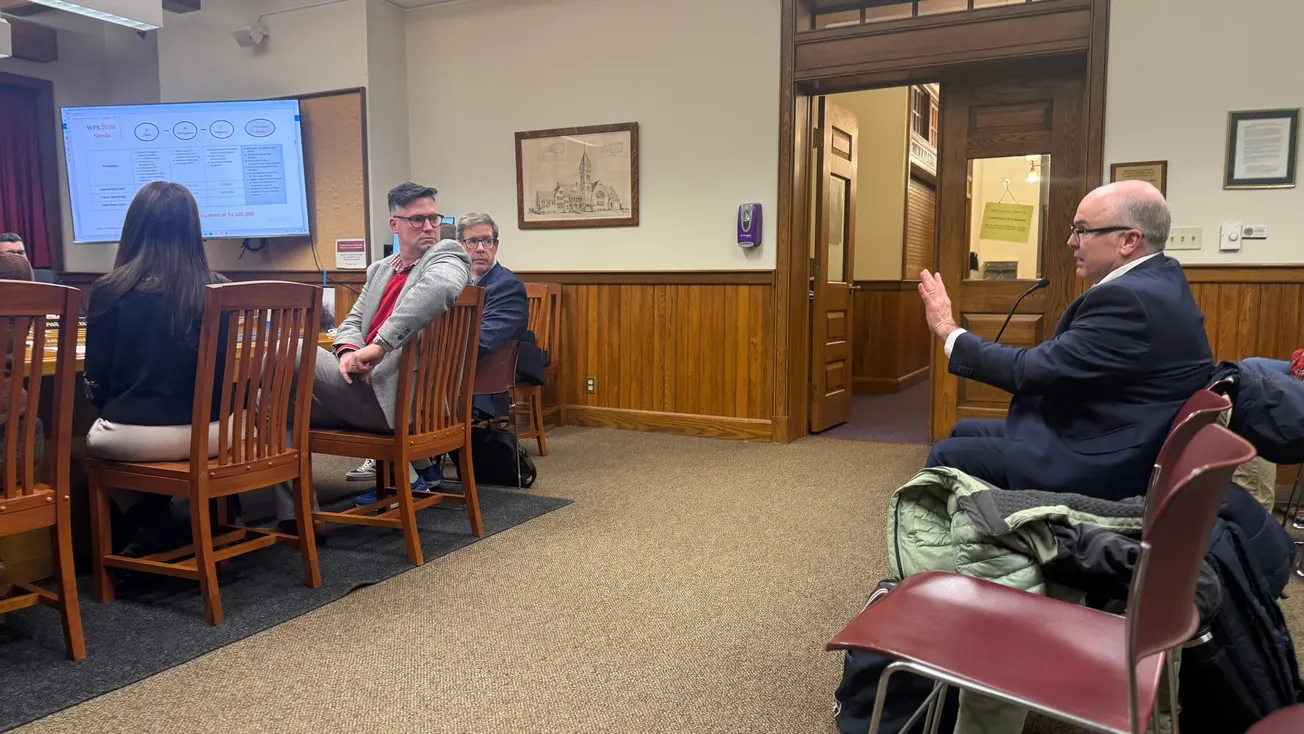
School Committee member Stefanie Mnayarji told the Select Board the proposal reflects “months of deliberation by the School Committee, the State of the Town Committee, consultant reports, feedback from parent associations, pilot programs, accountability data, MCAS data, youth health surveys, community surveys” and other sources.
The presentation came during a joint meeting of the Select Board and School Committee, part of a broader town effort to evaluate municipal needs and determine the size of an override question voters may face this spring.
Current performance and challenges
District leaders said Winchester schools continue to meet or exceed state standards across most grade levels, but post-pandemic recovery has lagged behind peer communities and literacy scores remain below 2019 levels.
Superintendent Dr. Frank Hackett and School Committee member Timothy Matthews pointed to data showing that students who were in Kindergarten during the March 2020 closures have experienced steeper learning loss than peers in districts such as Lexington, Belmont and Wellesley.
“The most challenging sort of results we have are with kids who were at really tender inflection points at the time of the pandemic,” Matthews said. “The kids who are in fifth grade right now are the ones who experienced, in some cases, very truncated pre-K experiences and then hit Kindergarten right when the pandemic had schools closed.”
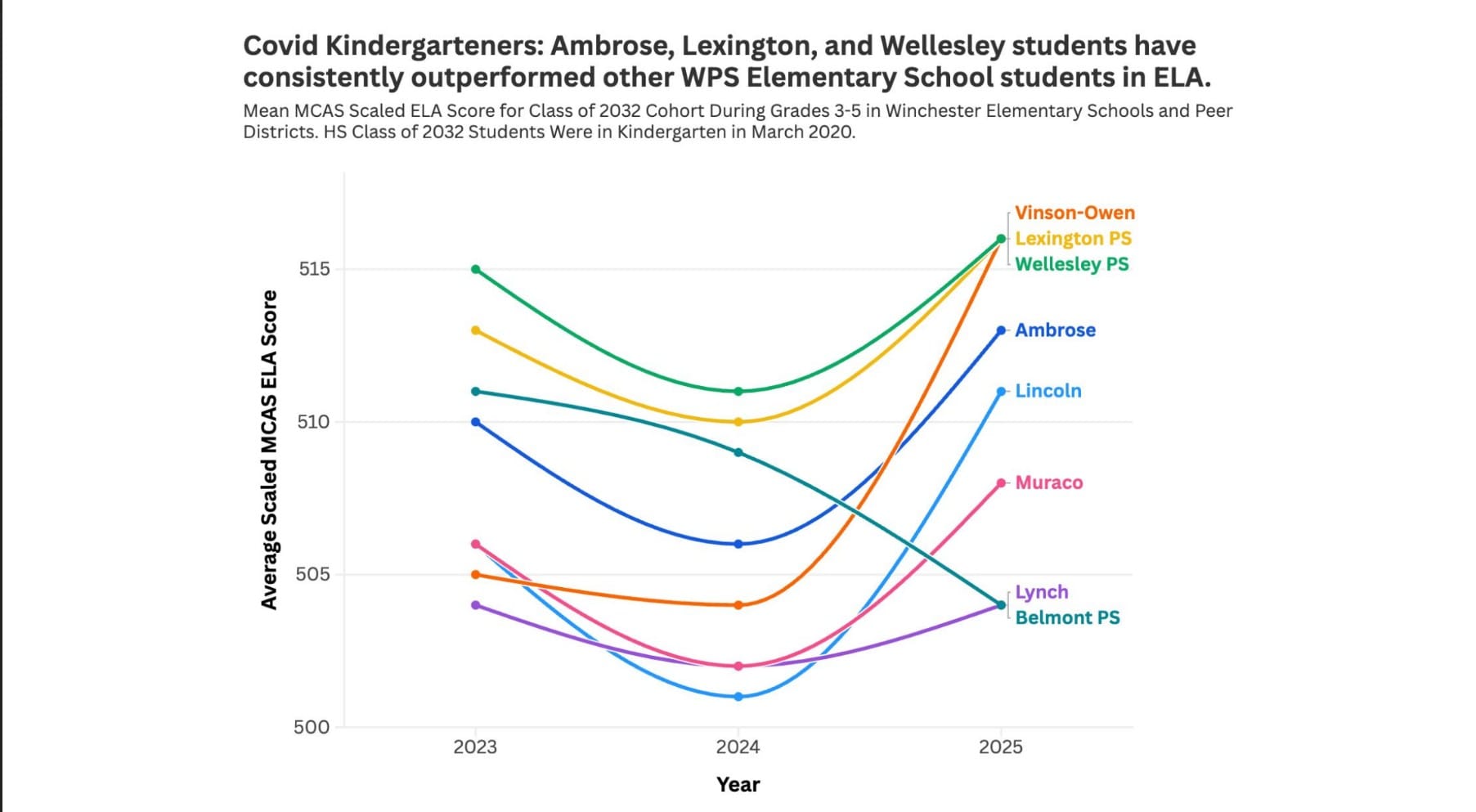
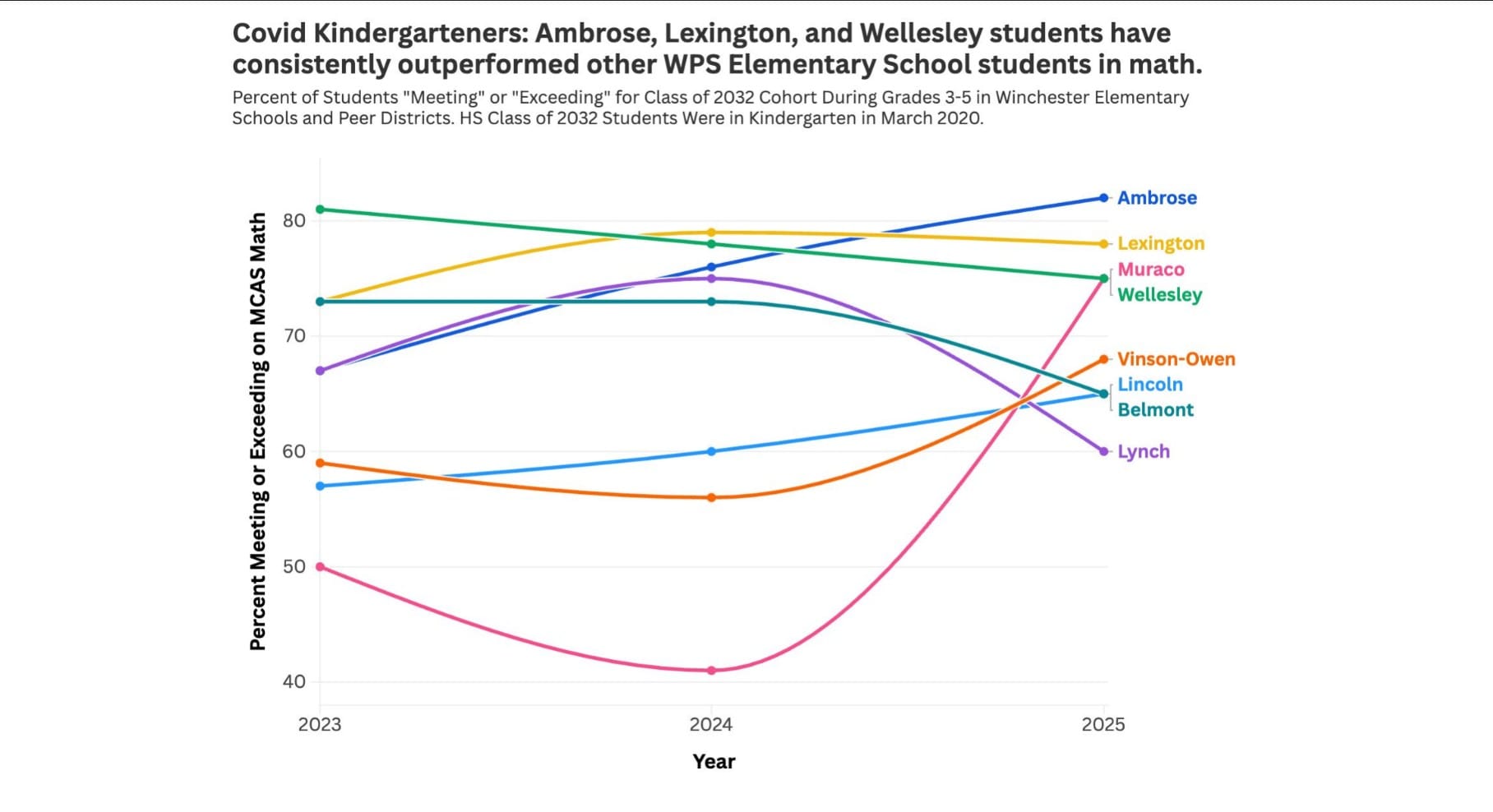
How are COVID Kindergartners doing now that they are in grades 3-5? A report by the School Department shows how students are doing in math and ELA. COURTESY PHOTO/WINCHESTER PUBLIC SCHOOLS
Matthews said the district identified significant performance gaps among Winchester’s elementary schools on English language arts assessments. Officials attributed some of those gaps to differing levels of parent fundraising and volunteer support.
“The increasing dependency on parent organizations and user fees have created vast inequities among the five elementary schools,” Mnayarji said.
Select Board member Anthea Brady said she was “legitimately shocked” to learn during a literacy review that the district lacked a multi-tiered system of supports (MTSS) — a framework many districts use to provide targeted help for struggling students before they require special education services.
Core investments and spending priorities
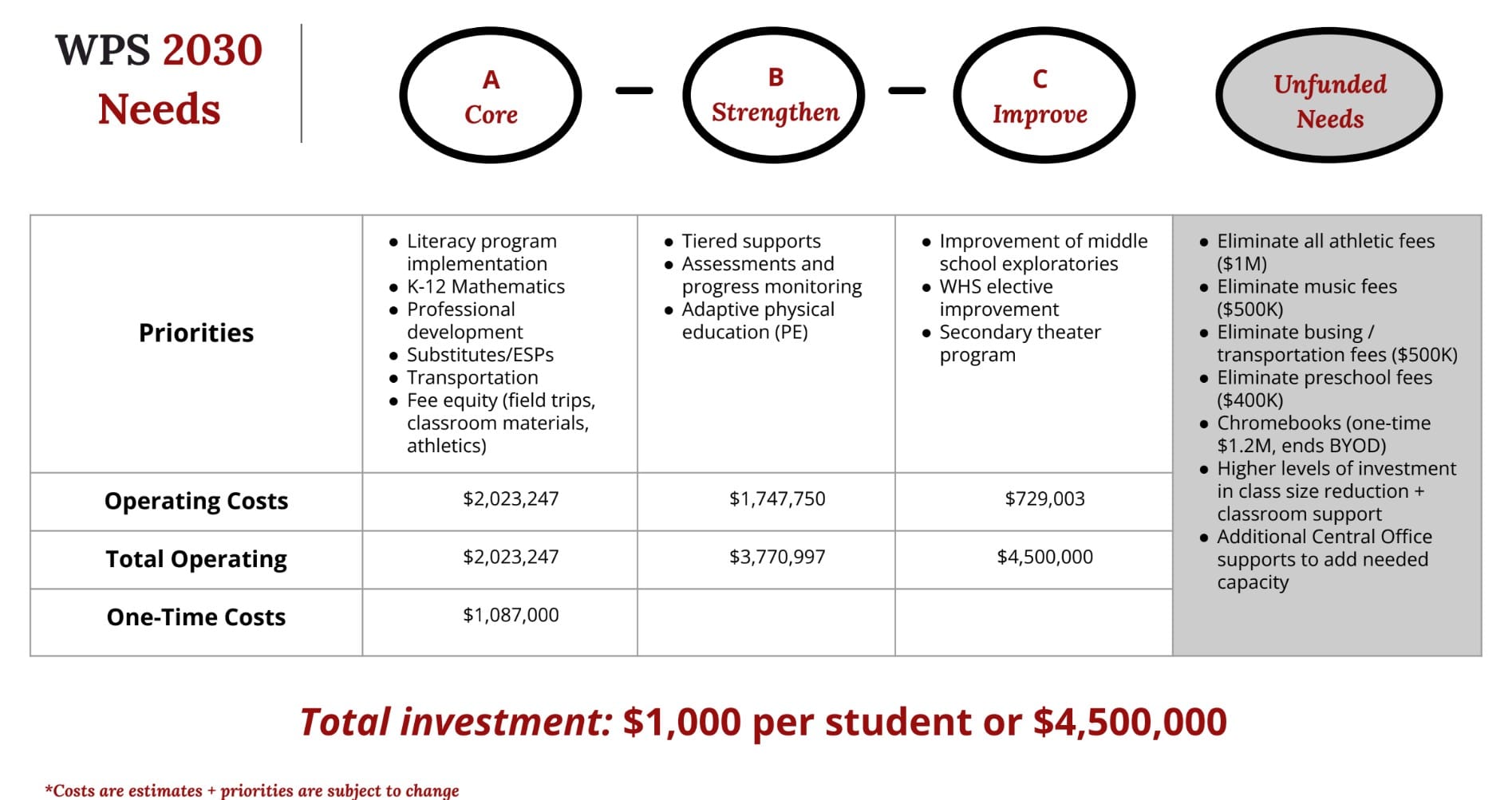
The School Committee divided its request into three categories: core investments of $2,023,247 in operating costs plus $1,087,000 in one-time expenses; strengthening investments of $1,747,750; and improvement investments of $729,003.
The core investments include completing a new elementary literacy curriculum slated to roll out in 2026, a comprehensive K-12 math curriculum review, professional development for teachers, substitute and educational-support staffing, transportation costs and fee equity initiatives.
The fee-equity line funds district support for field trips, classroom materials and a portion of athletic costs now paid through user fees. Winchester currently charges up to $400 per sport with a $1,450 family cap.
Hackett noted that field-trip access varies significantly among schools based on parent association fundraising, creating situations where “some schools are taking more field trips than others,” even though “we should be able to guarantee something as a school system for all of our kids.”
The strengthen category focuses on tiered student supports, including literacy and math interventionists, assessment and progress-monitoring systems and adaptive physical-education services.
Matthews explained that interventionists work with small groups of three or four students who need help in specific areas but do not require the comprehensive supports of an IEP.
Brady added that MTSS “is more targeted and effective in a specific area,” while an IEP “covers all subjects and the entire educational experience.”
The improve category funds new middle-school exploratory courses, high-school electives and a secondary-level theater program.
A separate unfunded-needs list includes eliminating athletic, music, transportation and preschool fees — roughly $2.4 million in total — as well as other items, such as replacing the bring-your-own-device policy with district-issued Chromebooks and adding central office staffing.
The School Committee did not request funding for those items in the override proposal.
Cost drivers and budget constraints
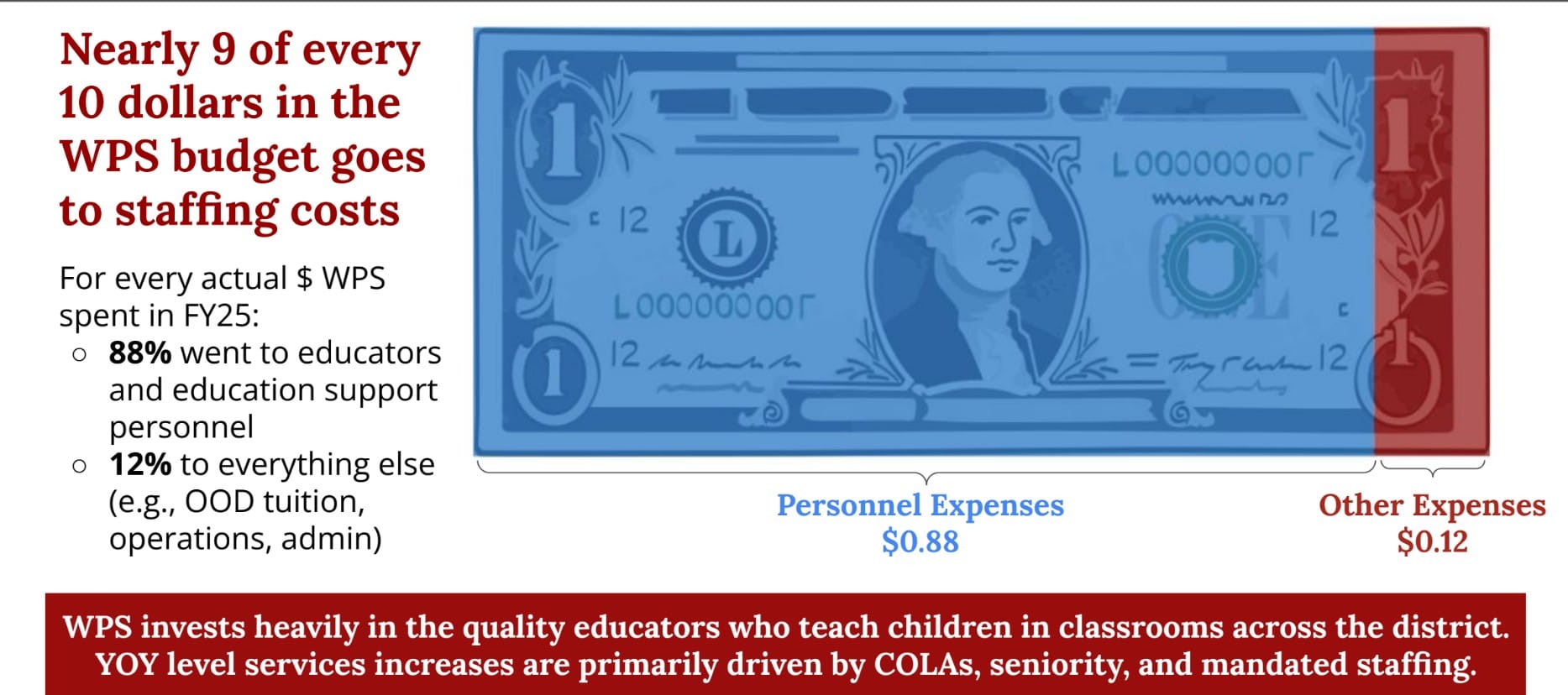
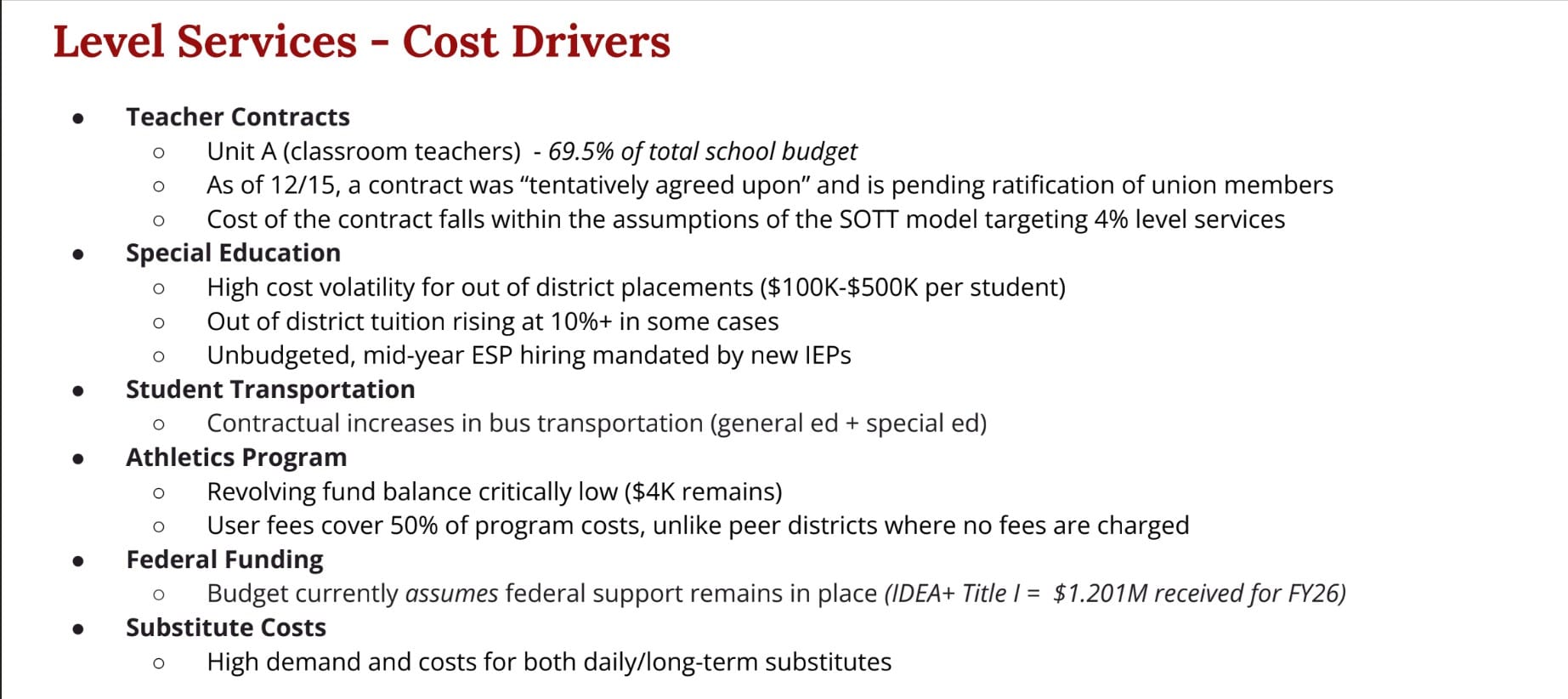
Officials said the district’s level-services budget — maintaining current programming without enhancements — has grown about 5.5% annually in recent years, driven largely by salaries, benefits, special education costs and transportation.
Mnayarji said the committee worked to bring the new teacher contract “within the Select Board assumptions for modeling the override targeting level services at 4%.”
Classroom teachers, represented by Unit A, account for 69.5% of the total school budget. The fiscal 2026 budget projects average total teacher compensation of $109,366, up from $91,131 in fiscal 2023.
Special education placements remain a major cost variable. Out-of-district tuition ranges from $100,000 to $500,000 per student, with some schools raising rates by more than 10% annually.
A district finance official told the board that of the $2,023,247 in core operating costs for the first year, roughly $1.3 million supports level-service initiatives such as transportation and educational-support staffing. Field trips account for about $225,000 spread across multiple years, and classroom materials about $35,000 annually. Most remaining transportation costs support special education services rather than general education busing.
Select Board response
Select Board member Bill McGonigle said school officials had clearly demonstrated the need for the investments.
“I told you guys to make real asks — to really come forward and tell us what we needed in our schools and what it was going to cost,” he said. “You’ve shown me through these presentations and the work over the summer that you’ve identified the problems and have a plan to fix them.”
McGonigle said he would support the full request and work to explain it to voters.
Select Board member Paras Bhayani thanked school officials for aligning the teacher contract and level-services growth with budget projections, noting that holding growth roughly a point below trend in a $70 million budget “created room for essential investments.”
He also praised the committee for prioritizing requests and leaving some items unfunded, saying that work “gives us a strong start for determining what we can finance.”
The Select Board took no formal action. Budget discussions will continue in the coming weeks as town leaders finalize the override amount for potential voter consideration.
Will Dowd is a Massachusetts journalist who covers municipal government and community life for Winchester News. He previously co-founded the Marblehead Current and now runs The Marblehead Independent, a reader-funded digital newsroom.