Table of Contents
The river restoration plan for the Aberjona River in Davidson Park has been revised using nature based techniques that can be installed with minimal disturbance to wetland resources.
It will include rock weirs to create step-like increases in the water level during typical flow conditions to counteract cascades resulting from man-made structures.
Weirs are channel-spanning rocks used to alter or create stream flows, provide fish passage by concentrating flows in flat bottomed channels to deeper channels, increase sedimentation along river banks, minimize river meandering by controlling flows and create a pool habitat.
The proposed five weirs will create a gradual slope, leading to the sewer main at the former pedestrian bridge at the center of the area, which will enable fish passage over the sewer main crossing during typical flow conditions.
Bank construction will make use of woody debris to direct water flows away from side channels into a single main channel. The design will allow sediment and organic material to accumulate in the areas, helping re-vegetation.
The new design will include bank stabilization in the uppermost 800 feet of the river in the park. It will also include natural materials to repair erosion and minimize scouring, which is erosion caused by swift flowing water. Boulders will be placed on the bank to create a solid foundation for reinforcing materials.
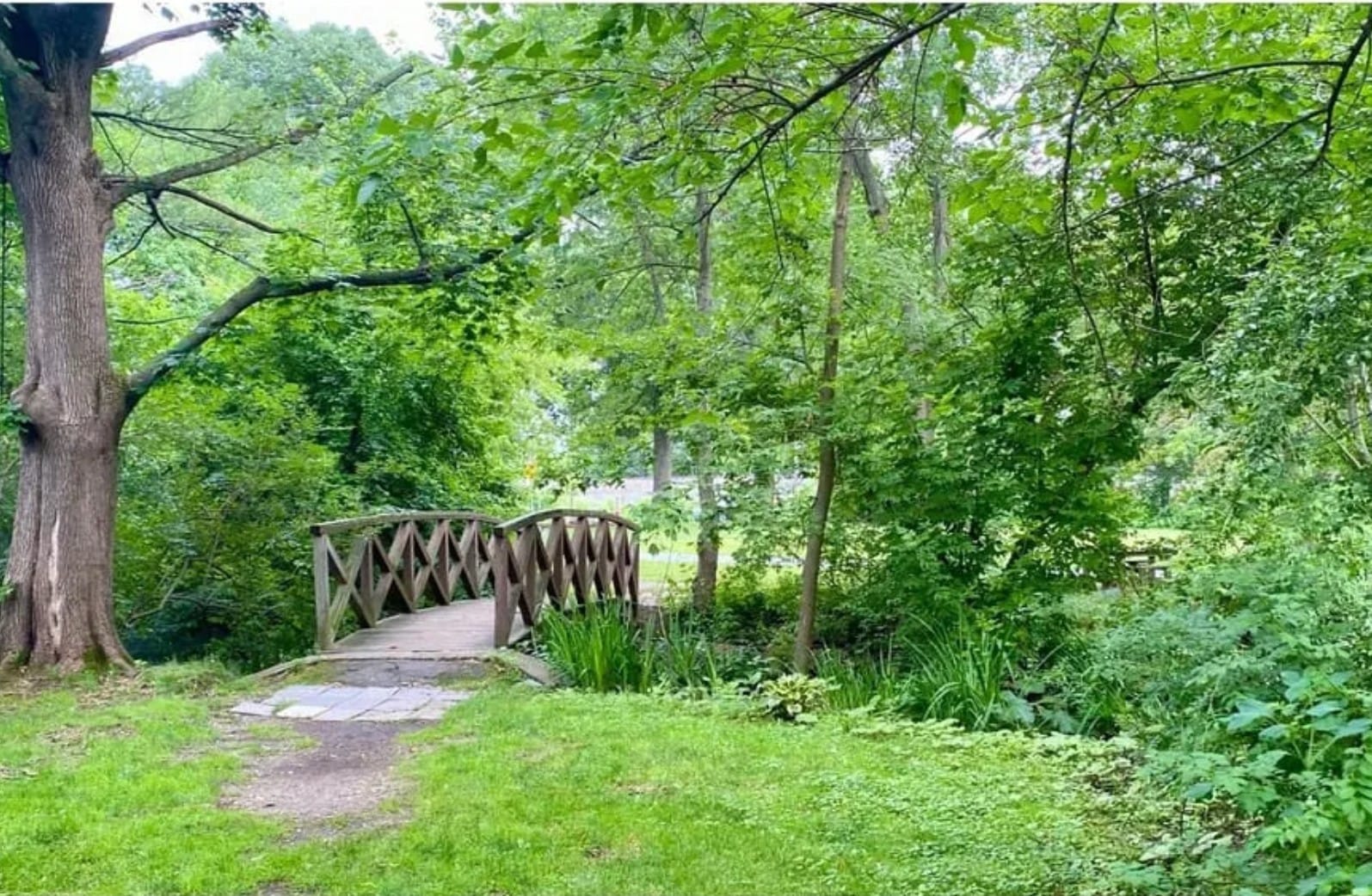
“Sections of the banks would be stabilized to reduce erosion,” Town Engineer Matthew Shuman said, of the project. “In other areas, woody debris would be placed along the banks to keep normal flows within the channel and restore the natural floodplain. Rock weirs (dams) would be placed in still other sections of the stream channel to improve fish passage.”
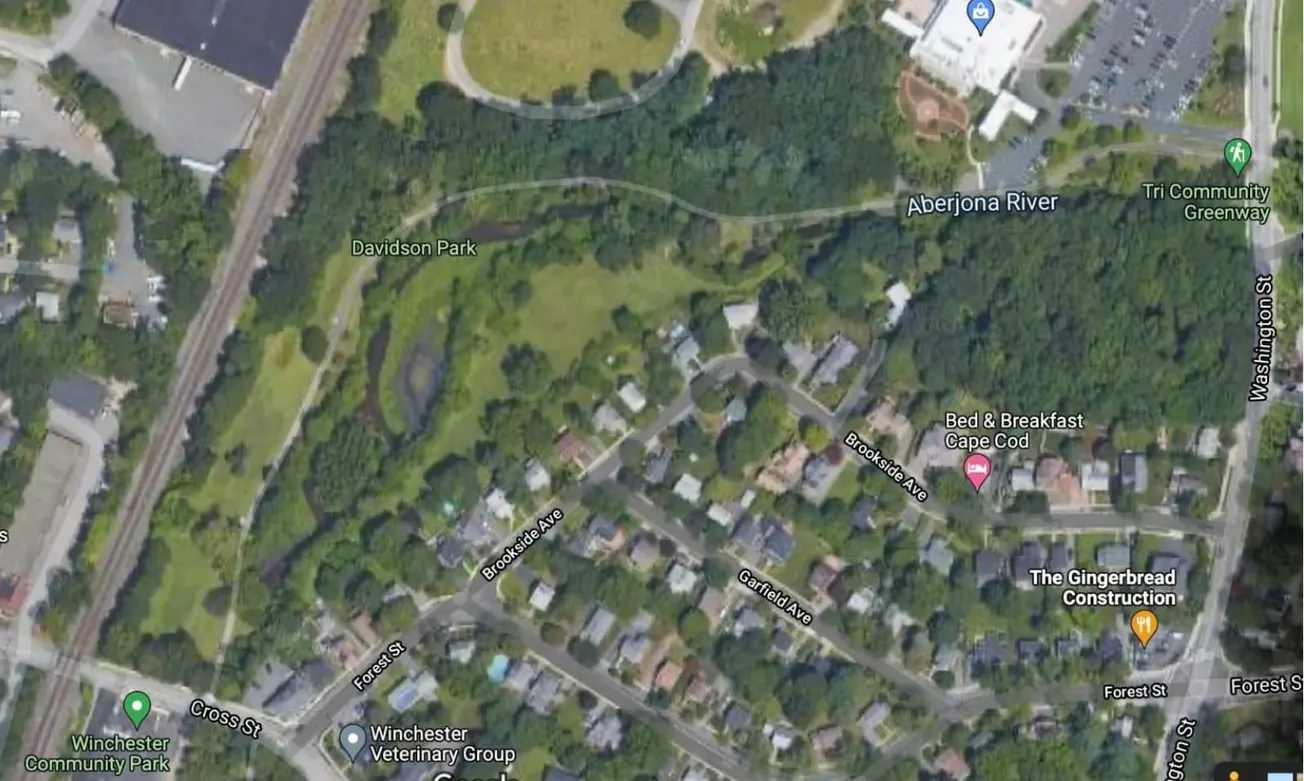
In the late 1800s, the Aberjona’s course was changed to accommodate development of the Brookside Avenue neighborhood on its west side. Faster flowing water led to erosion of its bank, which has been exacerbated in more recent years by losses of porous land. The more impervious cover, in the form of roads and sidewalks, the more water runs off and gets into the river faster.
Davidson Park was created in the early 1930s by interrupting the flow of the Aberjona River with a large, dredged pond and converting surrounding wetland areas into landscaped park upland areas. Maintenance dredging occurred periodically during the park’s early decades but ceased over the latter decades of the twentieth century.
Since the 1970s, the pond has gradually accumulated sediment, as shallow ponds in river systems naturally do, and invasive species have spread.
According to the MyRWA project website, “Davidson Park is a public green space that is owned by the Town of Winchester. It is 10 acres and currently has 0.4 miles of public trails. The Aberjona River, a tributary of the Mystic River, flows through the park.
Plans of one kind or another, including some with provisions to restore a bridge in Davidson Park, have been circulating since 2013. In June 2022, the Select Board voted to endorse an ecological restoration project for the Aberjona through Davidson Park that mimics the original riverine environment.
Plans to dredge sediment were downgraded to bank restoration when only $500,000 was made available through grants from the Industri-Plex Natural Resource Damages (NRD) Trustee Council overseeing environmental remediation in Woburn and surrounding communities.
“With the stipulation it be a habitat restoration project as opposed to a park-centric project,” Horsley Witten hydrogeologist Neal Price said during a video-conference informational forum on the Davidson Park Stream (Aberjona River) Restoration Project update in December. “That ended discussion of the dredging and brought us to the river design,” which is to use logs and wood debris to restore banks.
He added the plan “will eventually train the river to go where you want it to go.”
The plan was put together with the help of the Horsely Witten Group and the Mystic River Watershed Association, and will cost $485,000, with $130,000 for site preparation and erosion control, $25,000 for rock weirs, $40,000 for woody debris, $150,000 for boulders and vegetated walls and $140,000 in contingency funds.
A Horsely Witten memo describes it as scaling “back the restoration design to achieve project goals of restoring riverine function and ecological habitat through simplified restoration approaches that can be completed within the limits of available NRD funding.
“The proposed restoration design concept described in this memorandum serves as a more simplified, feasible project than the alternative designs developed in the previous phase of this Feasibility Study,” the memo continues. “Pending town approval, the design concept presented here will be updated to the 30% Conceptual Design Level and presented to NRD for their approval as a culmination of Phase 2 of the Project. Pending NRD and town approval, future Project phases would advance the Project through permitting, final design, and eventually construction.”
“After careful consideration of community priorities and budget constraints for the phase, the project team has decided to move forward without including the reconstructed bridge discussed at a recent meeting,” Mystic River Watershed Association Climate Engagement Associate Shannon Collins said. “The remainder of the proposed design will move forward with slightly more bank restoration.
The next steps are presentations of the proposed design to the Conservation Commission and Select Board for review.
“It will go before the Conservation Commission for a final review with a Notice of Intent,” Conservation Coordinator Elaine Vreeland said. ”Abutters will be notified.”
Shuman said the matter will come before the Select Board sometime this spring.
Neil Zolot has been a freelance journalist more than 40 years. He has worked for newspapers on the North Shore and in the Boston area.