Table of Contents
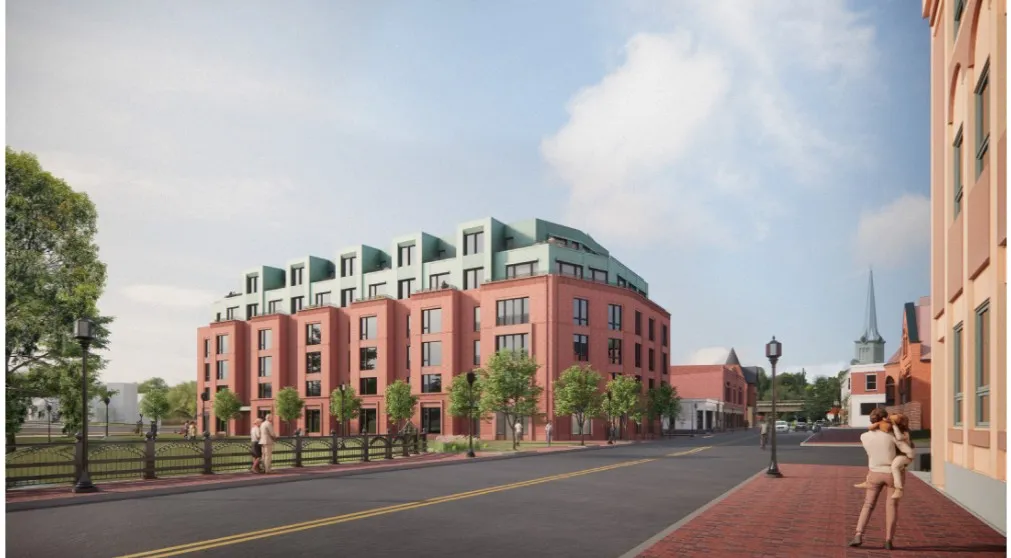
The size of a proposed residential building at 10 Converse Place/33 Mt. Vernon St. continues to be a major sticking point in the deliberations of a Special Permit by the Planning Board.
“Six stories is too far,” member Keri Layton said at a meeting Jan. 13. “It doesn’t fit the aesthetic of the town. Four would have sealed it, though, but two more is one past the appetite of the town. If we can get it to five…”
Layton said she feels design changes, which shrank the footprint of the building to allow for open space adjacent to Mill Pond, “meet the appetite of the town. The preservation of vistas and natural resources has been met.”
Chair Brian Vernagila reminded Layton the Planning Board granted a height waiver to allow 69 feet in November 2025 and even at five stories “it would still be larger than all the surrounding buildings,” but agreed “the vistas are protected.”
Vernaglia added five stories “seems like something we could approve. It’s approvable.”
Developer Paul Obgibene, of Urban Spaces, said eliminating the 6,900-square foot, three-unit top floor would result in a loss of revenue greater than the money saved by not building it.
“How do you make it up?” he asked rhetorically.
One solution is to convert commercial space planned and wanted on the ground floor to residential space, but Ognibene said he was told having a commercial component was important to the town.
The other option, which he called “a difficult choice,” is to reduce the number of affordable units from the planned six to two.
The original plan for the building was to have two units classified as workforce units for people making 120% of the Area Median Income (AMI) and four affordable units for people making 80% of the AMI.
The five-story plan would allow only two affordable units in the development and Ognibene paying $100,000 to the town to help establish affordable housing somewhere else.
Ognibene pointed out that only the affordable units count towards the town increasing its Subsidized Housing Inventory (SHI).
He assured Vernagila the rest of the design would remain unchanged, except it would shrink in height.
Exactly where the $100,000 would go is unclear because, as Layton pointed out, “we don’t have a comprehensive affordable housing plan for the town.”
She also pointed out the placement of the affordable units would have to be approved by the state Executive Office of Housing and Livable Communities to comply with regulations, such as the affordable units having to be comparable in size and amenities to market rate units.
This fact was confirmed by Housing Partnership Board (HPB) Chair John Suhrbier.
Suhrbier said $100,000 wouldn’t be enough to provide equitable affordable housing at another site. He also said waiving the requirements for affordable housing would “negate 20 years’ worth of work and sends a message to developers inclusionary housing is optional.”
Consulting environmental law and land use attorney Kathleen Connolly said the Planning Board can approve the five-story plan if it, as the granting authority, “determines it is in the best interest of the town and affordable units would render the project unfeasible.”
During the public commenting period at the end of the meeting, resident Dennis Dale said he considers the six-story plan a ploy or a bargaining chip to get a five-story building approved because the design is “top heavy.”
He added four stories would be appropriate and five the maximum that should be allowed.
Other residents added three or four stories would be sufficient for the development.
The Planning Board will once again take up the issue on Jan. 27 at 7 p.m.
Neil Zolot has been a freelance journalist more than 40 years. He has worked for newspapers on the North Shore and in the Boston area.