Table of Contents
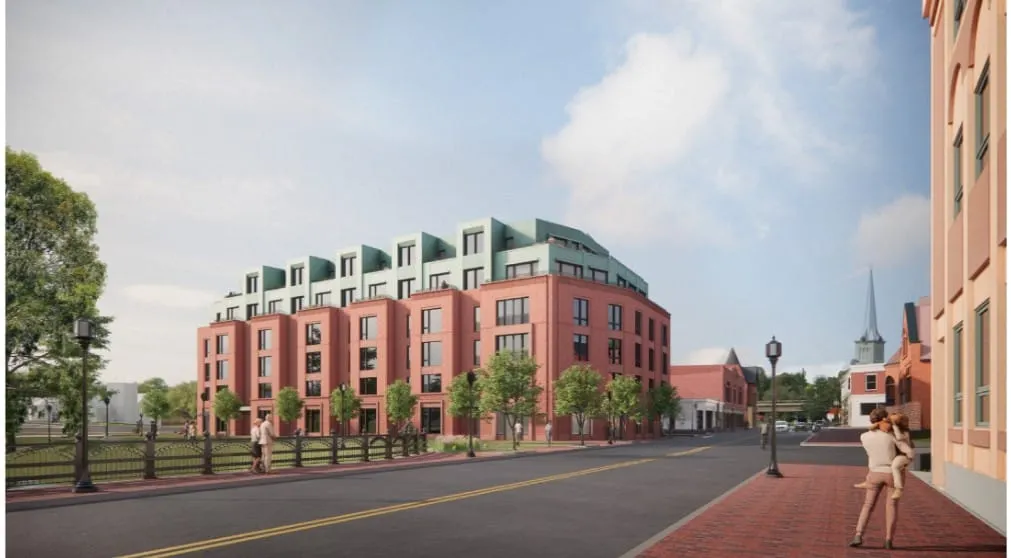
The Planning Board unanimously approved tentative plans for a five-story residential building at 10 Converse Place/33 Mt. Vernon Street — with a number of issues still needing to be resolved.
“This seems to be the direction this thing is going,” board member Nicholas Rossettos said, referring to the original plans for a six-story building that board members and many people in town didn't want. “I’m not hearing we want to go back to six stories.”
The Planning Board has been discussing the project for months, but seemed to reach a decision during the ongoing public hearing on Feb. 10.
“I was fine with six, but I’m fine with this,” Chair Brian Vernaglia said. “It knocks a story off and makes a lot of people happy. If we can make what was outlined a reality, this is the direction we should go. I don’t believe there’s a big difference between five and six, but if we can maintain affordable housing units and commercial space, I feel like this might just thread the needle.”
Still work ahead
Threading that needle will involve a lower number of affordable and/or workforce units, payments to the town by developers Urban Spaces in lieu of units being on the site and the economic feasibility of the project at five stories.
Additionally, many of the particulars of the plan approved for a six-story building will have to be re-approved for a five-story building. Even though many elements will not change, such as the status of open land between the building and Mill Pond, a five-story plan is legally different than a six-story plan.
A major issue still on the table is the number of and location of affordable units, defined as being intended for people making 80% of the Area Median Income (AMI) and workforce units for people making up to 120% of the AMI.
The six-story plan called for four affordable units and two workforce units. That, however, will be downgraded to just four affordable units.
Affordable and workforce units are supposed to be comparable to market rate units in terms of location, size and quality. They’re also supposed to be spread out in a building, not clustered on the ground floor or near elevators, staircases or loading bays.
That, said Urban Spaces developer Paul Ognibene, will not happen in the five-story building.
“They’re not as spread out as you’d normally see,” he said. “As we’ve fine-tuned the project, the whole unit mix and square footage has changed in order to come up with the affordable units. There’ll be slight differences in unit configurations and sizes, but it’s all within the same envelope. We’ve been successful in finding a way to take the sixth-floor off and have a five-story building with four affordable units.”
Ognibene referenced remarks he made at the Jan. 13 meeting that only two affordable units were viable.
To ensure the economic feasibility of the project, he’s also looking for the town to waive its building permit fee.
“It’s not a small consideration waiving a permitting fee as a cost sacrifice, but the tax revenue this will generate will make that back in a year,” Planning Board member Keri Layton said.
Other concessions the town might make to ensure the economic viability of the project — some of which were discussed at meetings of a citizen Working Group convened by the Planning Board and including members Layton and John Cortizas — are the possibility of increasing the 120% AMI units to 150% units to help feasibility while still providing access to housing at below market pricing.
The group also discussed targeting an under-addressed portion of Winchester’s market, a new concept for funding a payment in lieu of providing additional affordable units based on a formula for sharing in the project’s revenues above certain benchmarks and a reduction in the purchase price of the land and/or having the town buy the 150% units.
Working Group member and Affordable Housing Trust head Marty Jones said she doesn’t want to see zoning requirements for inclusionary, i.e. affordable housing, dropped for 10 Converse/33 Mt. Vernon “because the next person who comes in will not have to meet the requirements as well.”
“We need to use inclusionary zoning as a way to increase affordable housing because we don’t have a lot of available land or excess town property other communities are able to use,” Jones said.
State needs to weigh in
All of these issues will have to be worked out to the satisfaction of the state Executive Office of Housing and Livable Communities (EHOLC) and Department of Housing and Community Development (DCHD).
“All of this should be established before issuance of a Special Permit,” Town Counsel for the Planning Board environmental law and land use attorney Kate Connolly advised.
It won’t be easy.
“The Planning Board has the discretionary authority to approve a reduction in affordable units and approve a payment in lieu of providing affordable units based on proof of economic feasibility or infeasibility and how payments would be in the best interests of the town,” Connolly said. “You’d need specific findings of both to withstand a challenge. This might be OK, but you still don’t have proof of economic feasibility or infeasibility. We’d need some additional information on economic feasibility.”
Town Planner Taylor Herman agreed.
“You’d need to do a finding it’s better for the town and be very detailed as to why,” Herman said. “Just wanting it to be smaller isn’t enough.”
“We don’t want to vote on something that would be easy to strike down,” Vernaglia added.
Connolly also said payments in lieu of providing affordable units on the site have to equal the value of providing other units in other places. Jones called the $100,000 Ognibene has mentioned “a long way from what’s required.”
Ognibene is optimistic, however.
“We’ll need your cover with DHCD, but my guess is they’ll be supportive,” he said.
Cortizas is also cautiously optimistic.
“I think what we have is reasonable,” he said.
Herman said more work needs to be done.
“We don’t know yet,” Herman said. “We need to do more work and have discussions about this. I have no doubt what was offered is being offered in good faith, but the totality of the proposal in matching the bylaws is still up in the air.”
Neil Zolot has been a freelance journalist more than 40 years. He has worked for newspapers on the North Shore and in the Boston area.