Table of Contents
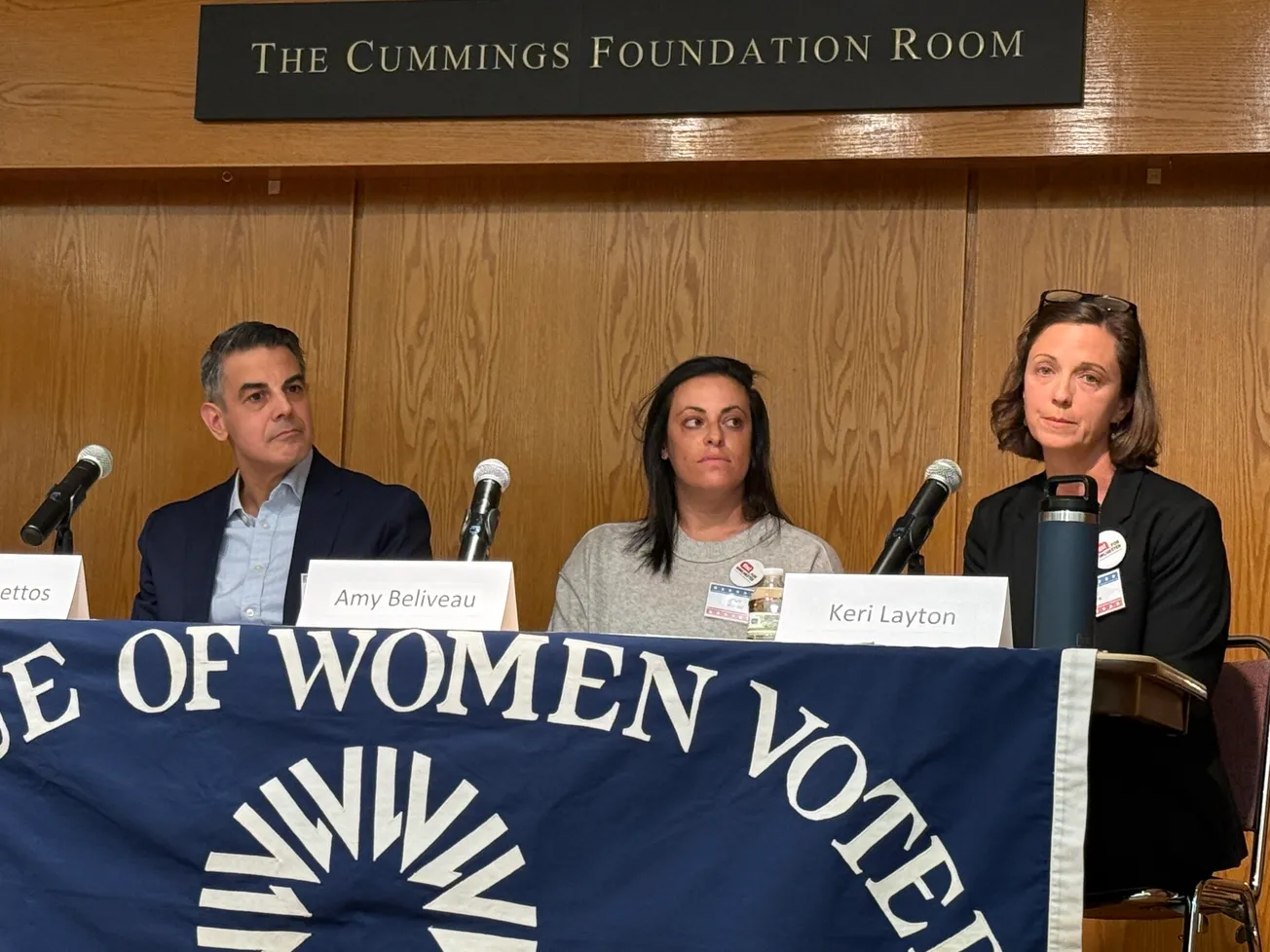
Three candidates for two open seats on the Winchester Planning Board debated housing production, zoning reform and growth Feb. 26 at a forum sponsored by the League of Women Voters of Winchester.
Incumbents Nicholas Rossettos and Keri Layton were joined by challenger Amy Beliveau at the Jenks Center, moderated by Nell Forgacs. WinCam broadcast the forum. The candidates are competing for two three-year seats.
The candidates largely agreed Winchester must add housing, but differed on approach. Rossettos, liaison to the Design Review Committee and the Historical Commission, centered his campaign on preserving downtown character.
“Growth and Preservation are not mutually exclusive. However, achieving both requires experience, judgment and sustained effort,” he said.
He added that while collecting nomination signatures, residents asked him whether North Main Street would become “a futuristic Canyon” or “look like Route 1 Saugus.”
Beliveau, a six-year resident and Town Meeting member representing precinct seven, said she brings real estate industry knowledge the board lacks.
“I don’t believe that you need something to be small to be historic, and I don’t believe that you need something to be big to offer the wealth of housing opportunities,” she said.
Layton, who chaired the board during the North Main Street rezoning and is seeking a second term, pointed to her Conservation Commission and Master Plan steering committee experience.
“I love the work. It is hard, it is interesting, and it is all of the best people, even on the worst days,” she said.
On the town’s progress toward the state-required 10% subsidized housing inventory threshold, Layton offered the starkest figures.
“We were about 550 units short. We’re still about 400 units short,” she said, adding that building roughly 40 units per year over a decade could close the gap.
The transcript did not provide Winchester’s total housing inventory, so the 10% target cannot be translated into an absolute figure.
Rossettos cited the Waterfield mixed-use affordable housing development, which the board unanimously approved; a completed Chapter 40B development on Cambridge Street; the Washington and Swanton 40B proposal; and a push for inclusionary units at 10 Converse Place.
“We wanted to be a cornerstone example of what beautiful 40B development can look like,” he said of the Washington and Swanton design process.
He also floated unspecified ideas, describing “some more wacky outside of the box” possibilities such as “multi unit houses that look like beautiful, single family historic homes.”
Layton responded warmly to that suggestion.
“I would love to hear Nick’s wacky suggestions. We’re all a little curious,” she said, before urging creative thinking about distributing housing across the town rather than stacking density in a few corridors.
Beliveau urged the town to look beyond transit-oriented corridors targeted under the MBTA Communities Act and consider interior conversions of large homes in single-family neighborhoods.
All three praised the North Main Street rezoning. On attracting developers to other areas, Layton said the board must set expectations early.
“If we’re inviting someone to come to develop the CBD, we need to have a pre-application meeting where we’re saying, these are our affordable housing requirements. This is the esthetic we’re looking for. This is the maximum height capacity,” she said.
Rossettos said “some of our zoning regulations are very complicated. Some of them are confusing.”
On fiscal impacts, Rossettos drew on his work as a consulting chief financial officer for life sciences companies.
“Developers love residential developments because they’re very profitable,” he said. “The town needs a combination.”
Layton said mixed-use projects expand the commercial tax base without adding students to schools.
Beliveau said the town should examine whether bylaws block businesses residents want, citing a would-be dog grooming facility that hit regulatory obstacles.
All three endorsed a comprehensive overhaul of the zoning bylaw. Layton said funding would come through an override vote.
Rossettos recounted a resident unable to replace a deteriorating garage for a vintage Packard automobile, calling the situation “ridiculous.” Beliveau, who acknowledged she is “still learning all 184 pages of the zoning bylaw,” said updates should ease the process for homeowners while maintaining guardrails.
On design review, Beliveau said clarity matters most.
“Developers don’t want to guess as to what Winchester wants and what Winchester will approve,” she said.
Layton said the pre-application process in the North Main Street zoning works but noted the Center Business District lacks equivalent steps.
Rossettos said delays arose because the Design Review Committee received information too late.
On community education, Layton said engagement tends to be reactive.
“People care when it’s next door to them,” she said.
Rossettos agreed and said the board must do better outreach because “most people have no idea” what it does.
Asked about climate and walkability, Layton listed 12-foot sidewalks, required tree plantings, rain gardens and electric vehicle charging stations. Rossettos described a compromise on the first North Main Street project, where the board accepted casement windows because they supported passive-energy performance. Beliveau called for more bike racks, benches and a shuttle to reduce car trips.
In closing, Layton asked voters to judge her record.
“If we take a tree down, if we plant a tree, if we put a building up, we’ve changed the town,” she said.
Beliveau pledged to bring industry experience and historically appropriate, design-driven development. Rossettos declared himself “the real historic downtown character candidate” and cautioned that losing experienced members could stall work in progress.
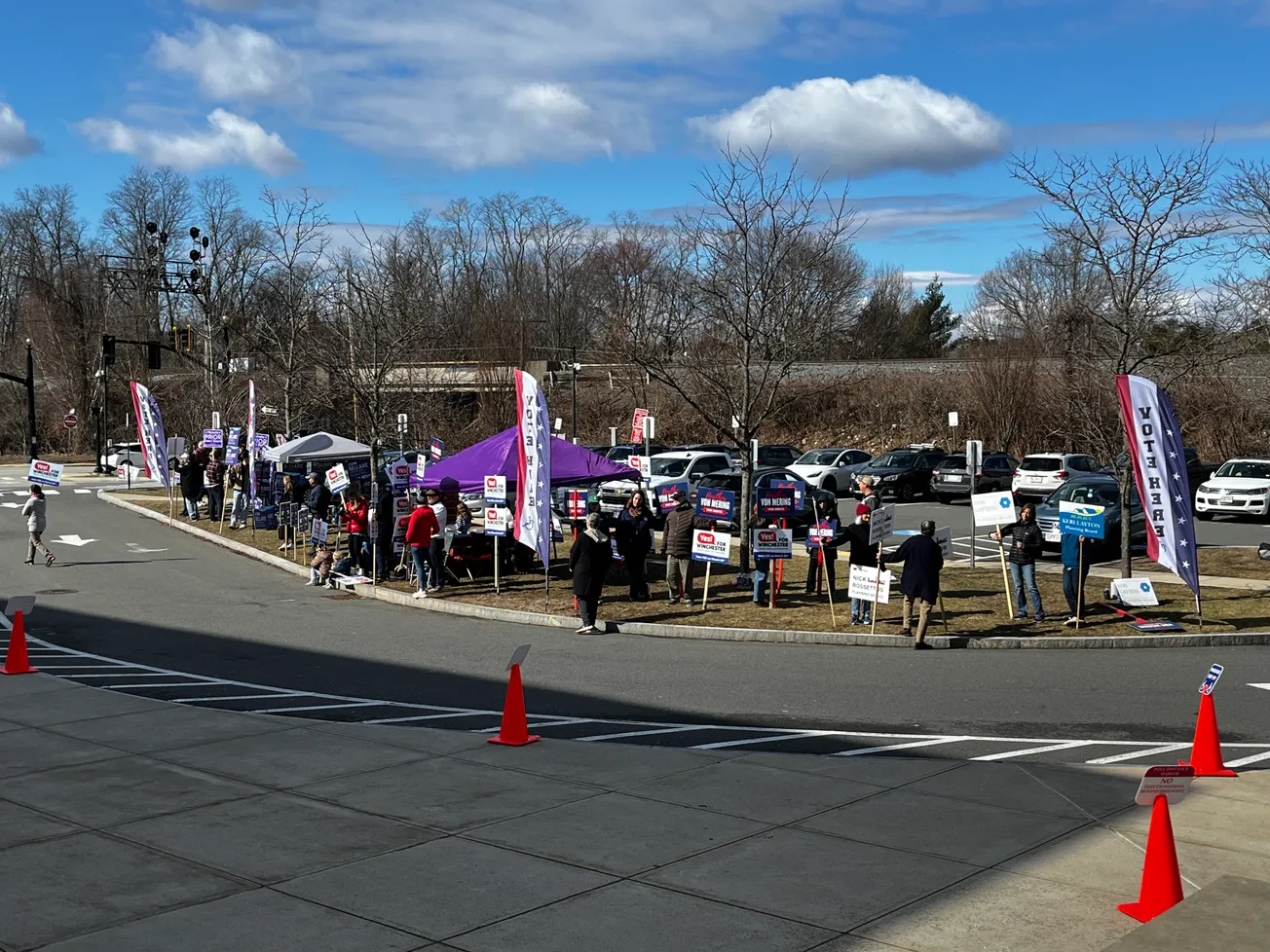
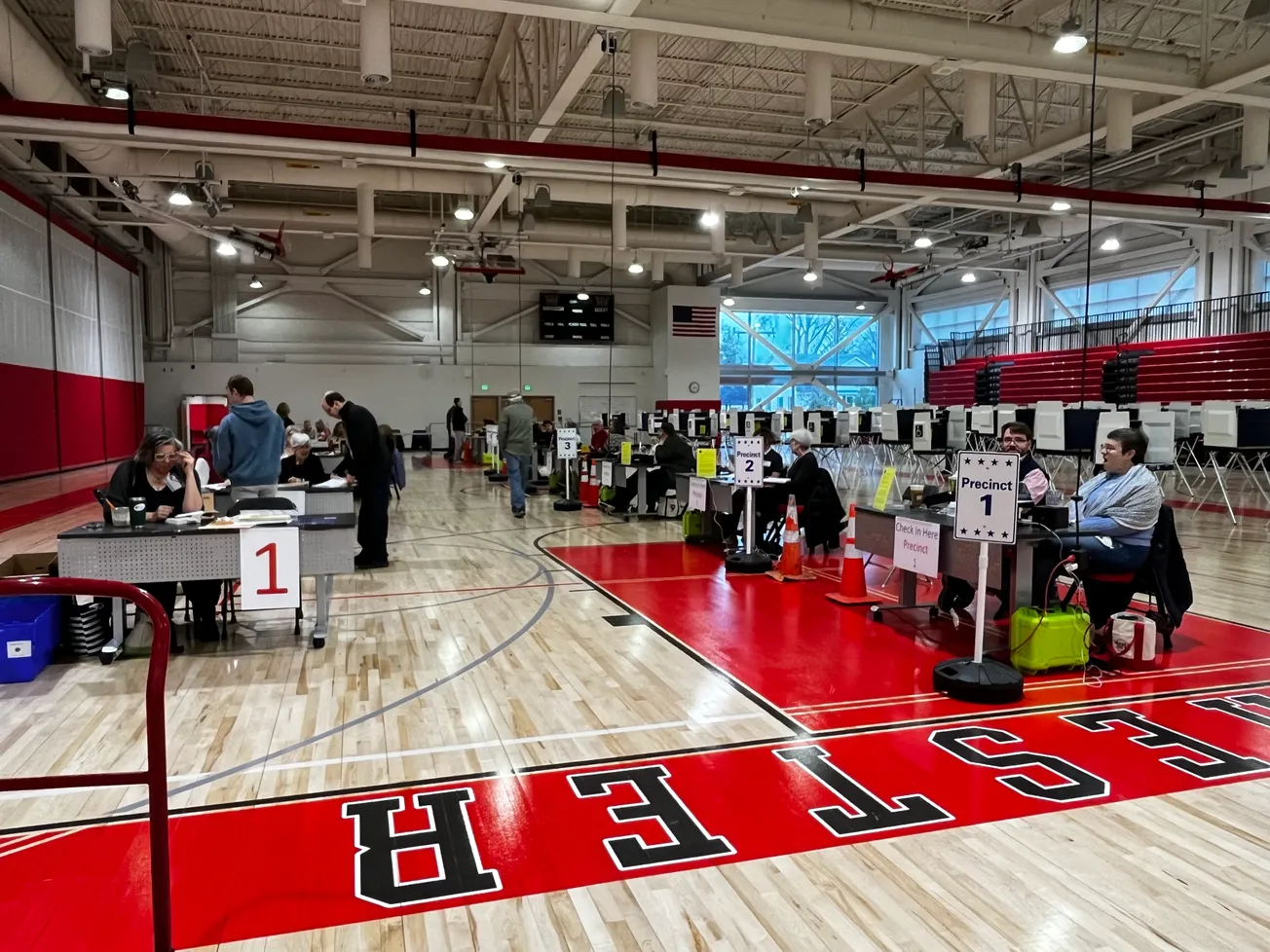
Winchester’s annual town election is Saturday, March 21. Polls will be open from 7 a.m. to 8 p.m. at the Winchester High School gymnasium, 80 Skillings Road, which will serve as the polling location for all eight precincts.
Contested races also include seats on the Select Board and the School Committee.
Candidate profiles are available at lwvwinchester.org and winchesternews.org.
Will Dowd is a Massachusetts journalist who covers municipal government and community life for Winchester News. He runs The Marblehead Independent, a reader-funded digital newsroom.