
Table of Contents
Two candidates for Winchester’s School Committee will face voters at a forum as the district navigates a new literacy curriculum, budget pressures and questions about student mental health.
Heather von Mering and John Bellaire are competing for an open seat on the School Committee, which oversees a budget von Mering described as more than $70 million.
Michelle Bergstrom decided not to run for re-election for the seat earlier this year.
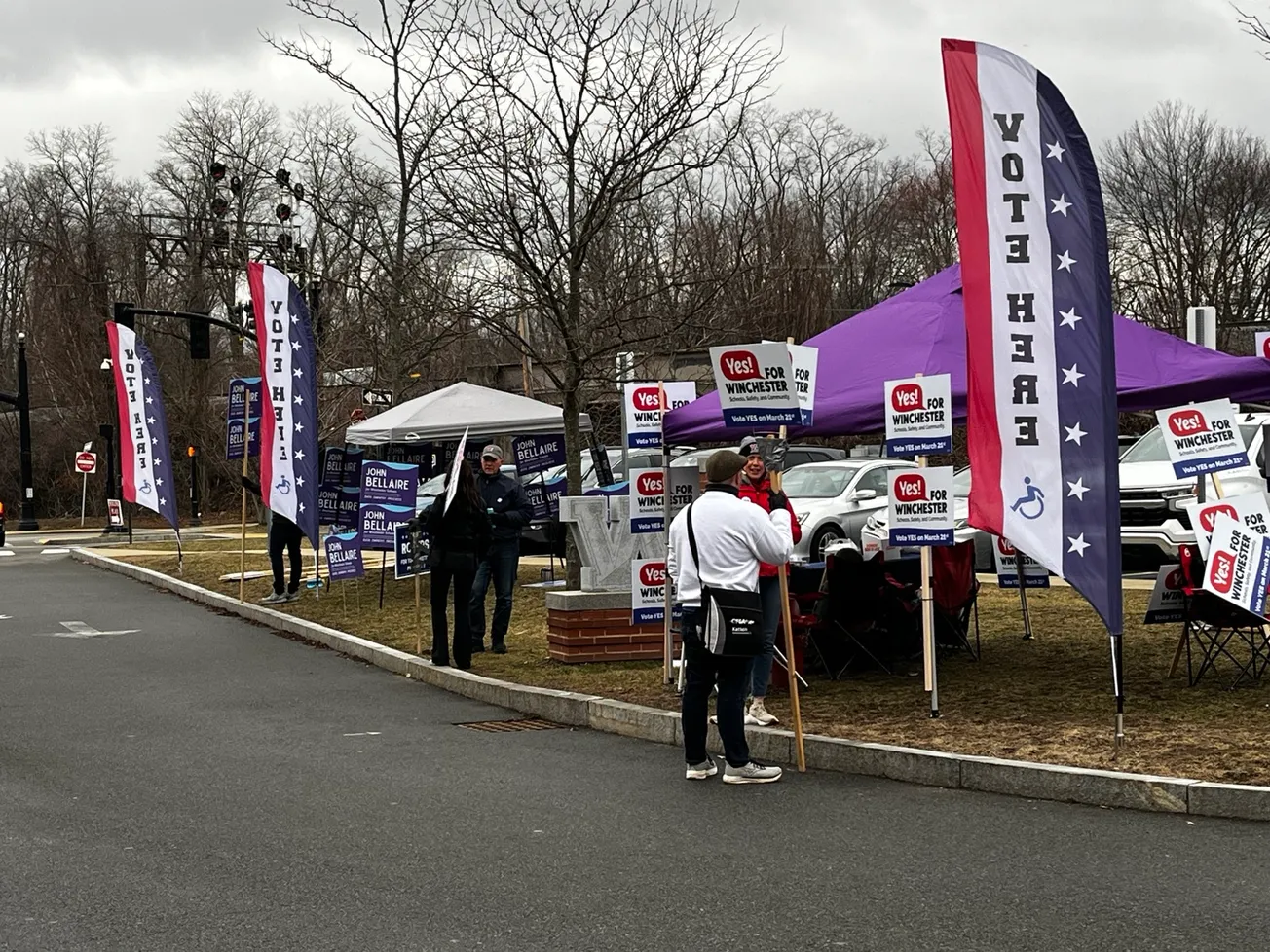
Von Mering and Bellaire will appear at a League of Women Voters forum on March 5, beginning at 6:15 p.m. at the Jenks Center. Voters head to the polls March 21.
Von Mering, a mother of five with a background in architecture and construction, has spent 16 years in Winchester town government, serving on the Planning Board, the Historical Commission and as town moderator. She moved to Winchester in 2009 and has children at Winchester High School and McCall Middle School.
Bellaire, 22, graduated from Winchester High School in 2021 and Brown University, where he studied education and public policy. He works full time for Bellwether, a national education nonprofit focused on state school finance.
Asked what the biggest blind spot is when policy professionals move into local governance, von Mering said: “It’s what the end users experience is. For the children and the families you really need to have that hands-on experience.”
Von Mering also acknowledged limits to her expertise in some policy areas. Discussing artificial intelligence in schools, she said the School Committee should rely on outside expertise rather than attempting to craft policy alone.
“I am not an expert,” she said. “Me writing policy on technology when I am not is inappropriate.”
Bellaire framed public education broadly.
“My answer is that every student should have the opportunity to develop into their best selves,” he said. “So whatever the futures that students want to build and envision for themselves, I want to support them in achieving those goals.”
Literacy, special education challenges
The district is piloting a new literacy curriculum, and both candidates expressed support — though they described the path ahead differently.
Von Mering, who was part of the leadership team for United for Literacy and said she has advocated for curriculum changes since at least 2017, cautioned that district-wide data will be unreliable for the first three years.
She described bringing together families of children with dyslexia during the pandemic.
“As a special education parent, you are very isolated, and so you only know what you know,” she said. “And by us being able to bring everyone together and start having these conversations, we were able to identify that children weren’t being identified with dyslexia.”
She said the district had no children identified with dyslexia in kindergarten through third grade for a period and was not using DIBELS, a literacy measurement tool.
Bellaire said Winchester has been “behind the curve and a bit delayed” on literacy. He pointed to Mississippi, which passed a literacy-based promotion act in 2013 and went from 49th in the nation in fourth-grade reading to the top 10.
He said the percentage of Winchester students not meeting grade-level expectations as measured by MCAS has more than doubled since 2019, from roughly 5% to 10%.
Bellaire cited budget data showing about 30% of the recommended School Committee budget goes toward special education and that 18% of students are classified as having disabilities.
“If something is small and we can address it and support students in first grade, that would be a lot better than having to wait, have that student continue to fall behind,” he said.
Von Mering made a similar argument from her experience as a special education parent.
“If you teach children how people with dyslexia are taught, the majority of all children will learn,” she said. “If you catch a child early, as early as you can, the cost to support them decreases significantly. The longer you wait, the more expensive it is.”
Asked what she would protect first if an override fails, von Mering said: “My first focus will always be what directly impacts the classroom instruction and student outcomes.”
She said core instruction in literacy and math and tier two supports should be protected before new enhancements.
Bellaire said he supports the strategic additions proposed as part of the override and would push the district to elevate high-impact tutoring — in-person, small-group sessions of 15 to 20 minutes multiple times per week.
Mental health, school culture
On student mental health, Bellaire said that last school year, “one in four Winchester High School students found their stress and anxiety to be overwhelming most or all of the time. That’s over 350 kids, like an entire grades worth of kids at the high school who feel constantly overwhelmed by stress and anxiety, and that can’t continue.”
He said the answer is not lowering standards but building school culture so students feel belonging through arts, athletics and friendships. He recalled the high school as more competitive than his later experience at Brown.
Von Mering said the committee’s role is to ensure the right staffing.
“We need to bring the school psychologist to the School Committee table,” she said. “We need to bring the counselors, because the college process is stressful. There’s nothing the School Committee can do to change how you get into college, right? But we can give resources and supports to help children do that process.”
METCO priorities
The candidates diverged most clearly on the Metropolitan Council for Educational Opportunity, a voluntary desegregation program that sends Boston students to suburban schools.
Bellaire listed joining METCO as a top priority, noting peer districts including Lexington, Wellesley and Arlington participate. He said Winchester applied in 1967 and 1974 and was rejected both times.
“It’s a transformational opportunity that doesn’t just benefit the students in Boston, but benefits the students in Winchester, in Lexington, and these communities that participate,” he said.
Von Mering said the district is not ready.
“Winchester does not have core literacy. They do not have core math, K through 12. We are struggling with transportation for special education students,” she said. “I could never sign that form, knowing that we do not have tier two. We do not have tutoring in our district.”
She said once those gaps are addressed the conversation could become valid, but “we are a long way out from that conversation.”
Technology plan?
Both candidates said Winchester lacks a coherent approach to technology. Bellaire said more than 80% of high school students nationally use AI in coursework and that Winchester has no formal AI policy.
“AI is transforming the global economy, and we need to prepare our students to use it,” he said, but added that it is “perhaps more important that we continue to emphasize those critical thinking skills, so that when students are in high school and they’re learning how to write an essay, they’re not just uploading the prompt to ChatGPT.”
Von Mering proposed a technology advisory committee and said she has seen technology used in place of direct instruction.
“I want to make sure that every child learns to read and write independent of technology,” she said.
Planning strategies
On governance, von Mering said the district’s goals need sharper structure.
“I like to call them wicked smart goals, because they need to be specific, strategic, measurable, action oriented, realistic, results oriented, timed and tracked,” she said. She said vague goals cause committee members to panic and overstep.
Bellaire said the committee needs both “a collaborative relationship” with the superintendent and “collaborative and helpful tension and accountability.”
If elected, he said he would be the only graduate of Winchester Public Schools serving on the committee — “a different voice” that “could help the School Committee have more productive disagreement.”
Asked how they would handle pressure from supporters, von Mering said: “I will always put the children first. And if I believe that something is going to be wrong for our children, I will not do it,” she said. “I’m the one who has to go to bed and put my head on my pillow at night, and I want to feel good about what I’m doing.”
Bellaire said he would lead with transparency, adding: “No one’s going to agree with me on everything.”
Will Dowd is a Massachusetts journalist who covers municipal government and community life for Winchester News. He runs The Marblehead Independent, a reader-funded digital newsroom.