Table of Contents
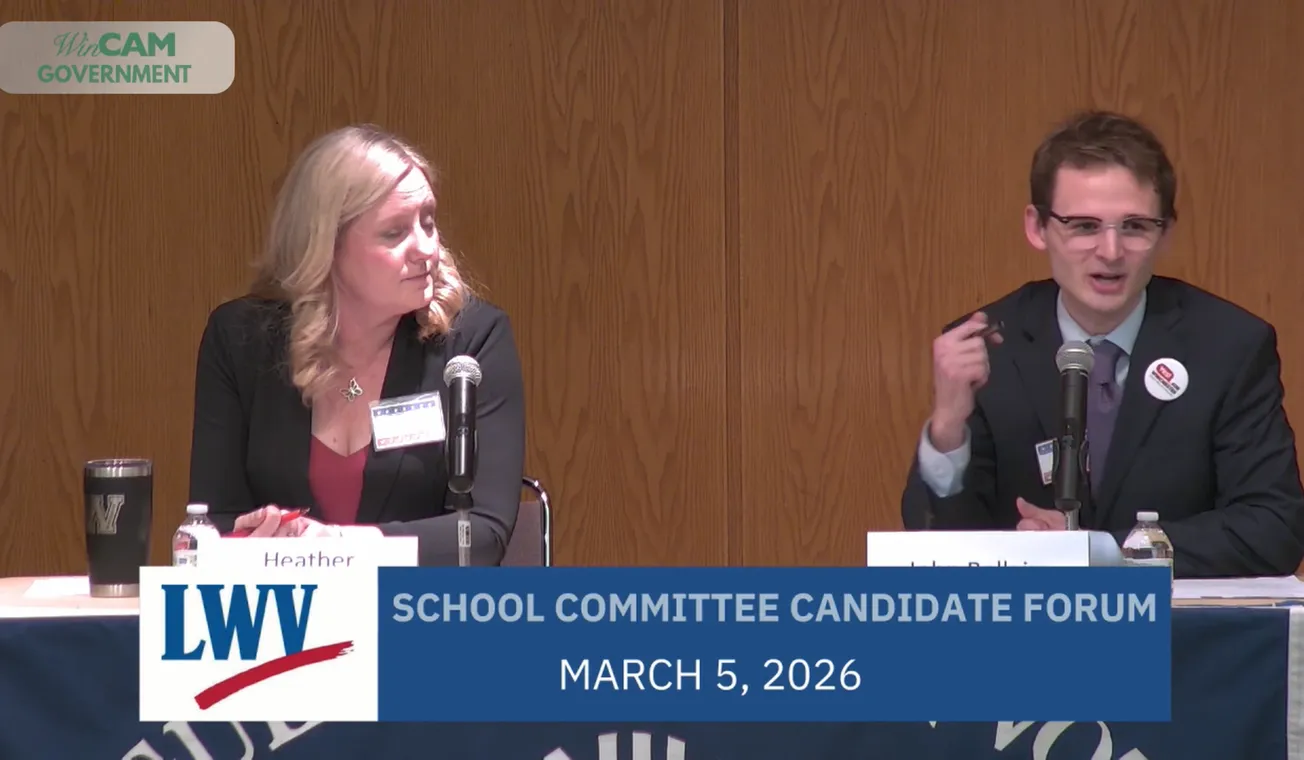
John Bellaire and Heather von Mering outlined competing visions for the town’s public schools at a candidate forum, clashing over technology in classrooms, special education access and teacher accountability ahead of the March 21 election.
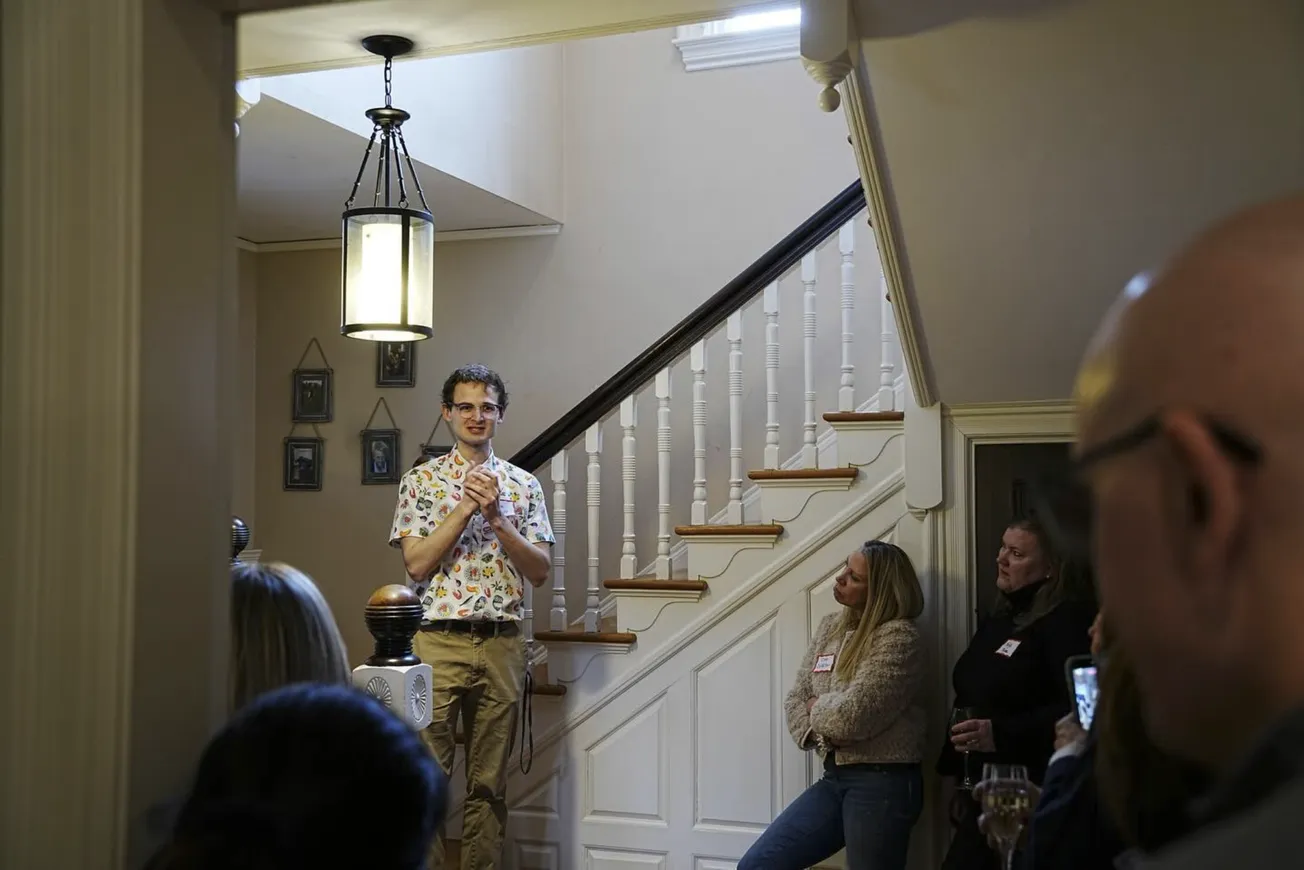
The two are vying for one three-year seat on the Winchester School Committee. The League of Women Voters of Winchester organized the debate at the Jenks Center, with Nell Forgas moderating. WinCam broadcast the event.
Bellaire, who works full time for a national education nonprofit focused on school improvement and funding, is a graduate of Muraco Elementary, McCall Middle School and Winchester High School. He said his professional experience sets him apart.
“Helping schools get better is literally my job. Understanding school funding is literally my job,” Bellaire said in his closing statement.
He added that if elected, he would be the only committee member working full time in education and the only graduate of the district serving on the board.
Von Mering, a working mother of five and former Town Meeting moderator who has served on the Historic Commission and Planning Board, emphasized her advocacy for students with dyslexia, ADHD and language-based learning challenges. She chaired the town’s master plan of 2030 for the Planning Board.
“I believe Winchester schools should be places where every student is seen, heard and supported to thrive,” von Mering said.
The sharpest exchanges came over the role of technology and artificial intelligence. Bellaire said more than 80% of high school students nationally report using AI to complete some coursework and warned that Winchester has no comprehensive policy to address it.
He recalled his own experience as a Muraco fifth grader in 2013, when technology amounted to an hour a week with a rolling laptop cart, before the district introduced a one-to-one screen environment the following year.
“Currently, Winchester Public Schools has no comprehensive policy whatsoever to help deal with AI, and that’s left teachers kind of, you know, coming up with innovative solutions to their classroom,” Bellaire said.
Von Mering called AI a small piece of a larger problem and recommended a technology advisory committee of parents, students, experts and staff.
“If we don’t develop critical thinkers, we will not be able to use AI to the best and highest potential, because we need to be able to be independent thinkers of it,” von Mering said.
Both candidates agreed schools should rebalance computer-based and paper-based resources. Von Mering pointed to studies showing technology is hindering foundational skills in grades K-5. Bellaire described a Minnesota school visit where students drew numbers on laptop trackpads instead of solving equations with pen and paper.
On special education, Bellaire said he spoke with a parent who tried three separate times to get services for her child and was denied each time. He championed the override’s investment in tier-two supports at the elementary level, targeting 15 to 20% of students who need additional help in literacy and math.
Von Mering described the tier-two model as a structured pathway where students are assessed on foundational skills and supported in the classroom first, then moved to short-term interventions. She said that after six months without progress, special education testing should begin automatically.
The candidates diverged on measuring school performance. Von Mering said teacher reviews existed before 2020, but were lost during the pandemic and have not been reinstated. She called for restoring them as policy, including 360-degree reviews of the superintendent and principals.
Bellaire said the district’s biggest gap is coherence, arguing that teachers in 20 different classrooms across seven buildings would likely give 20 different answers about the schools’ goals. He proposed a public data dashboard on the district website.
On student mental health, Bellaire cited district data showing one in four Winchester High School students found their stress and anxiety overwhelming most or all of the time last school year and two in three reported fewer than eight hours of sleep on an average school night. He called the ratio of more than 1,400 students to two adjustment counselors “unacceptable.”
Von Mering said helping students manage college anxiety should start in 9th grade with structured conversations rather than waiting until 11th grade.
Both candidates voiced strong support for building a new Muraco Elementary. Bellaire, who attended from 2009 to 2014, said the override includes funding for a feasibility study. Von Mering said every child deserves the same resources available at the recently built Lynch Elementary.
The election is March 21, with early in-person voting beginning March 14.
Will Dowd is a Massachusetts journalist who covers municipal government and community life for Winchester News. He runs The Marblehead Independent, a reader-funded digital newsroom.