
Table of Contents
Winchester employees who are eligible to retire now have a date to plan around.
Under a policy the Select Board approved Aug. 10, an employee who retires on or before June 30, 2027, keeps the town’s reimbursement of Medicare Part B premiums in retirement. An employee who retires after that date will not receive it.
What that is worth is a figure the board set in June: $200 a month toward a retiree’s Medicare Part B premium. An employee who works past June 30, 2027, forgoes that reimbursement for the rest of retirement.
In the same June 15 motion, the board moved existing and future retirees to a 50% premium sharing level, meaning retirees pay half the premium cost of their town health coverage.
The reimbursement covers a share of the monthly premium a retiree pays the federal government for Medicare Part B. The town is not changing anyone’s Medicare eligibility, and the vote does not touch pension rules, the years required to vest in the retirement system or when an employee may retire. What it changes is whether Winchester will keep paying part of that federal premium for people who leave after next June.
Retirement Board data included in Town Manager Christopher Senior’s Aug. 7 memorandum put the potential decision-making pool at 88 based on age and length of service. Of 407 active members in the town’s retirement system — municipal employees and eligible school staff — 164 are vested.
Senior’s memo cautions that being eligible to retire does not mean an employee is likely to do so. No one has estimated how many of the 88 will act on the deadline, and no forecast was presented to the board.
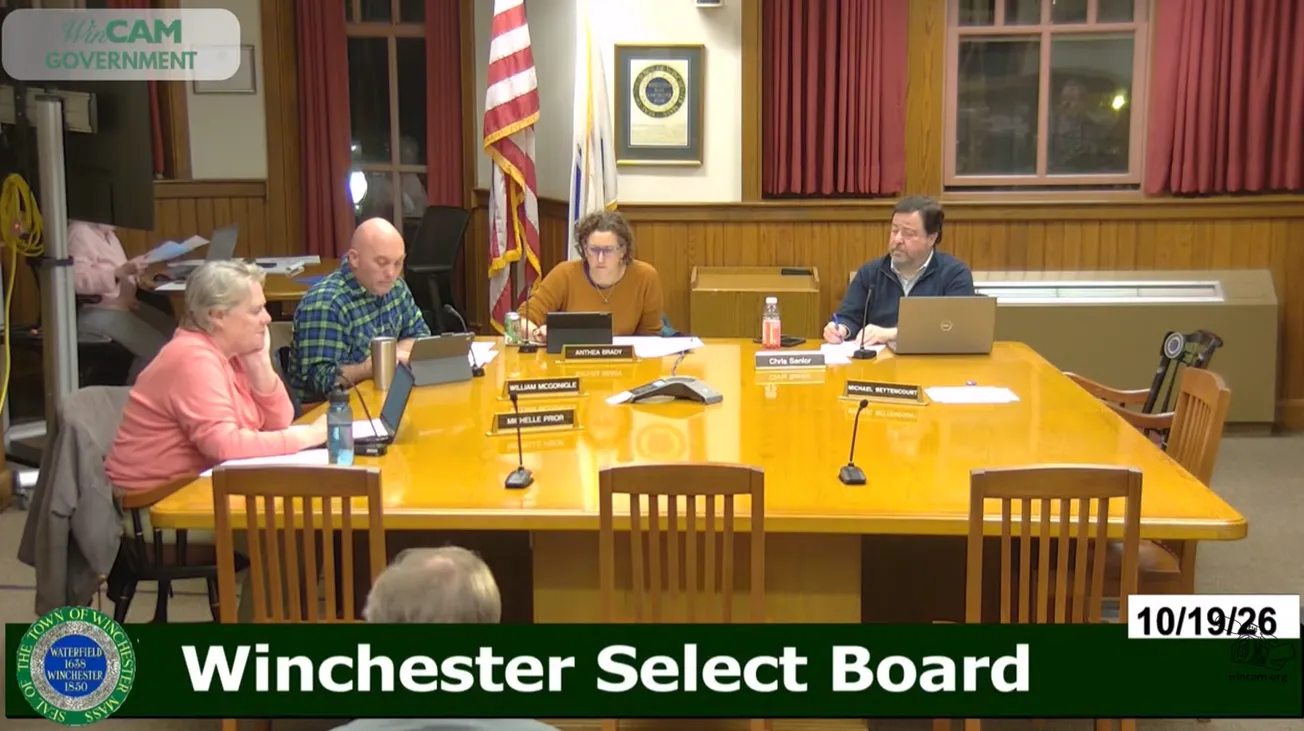
The four Select Board members participating in the Aug. 10 meeting voted in favor. Chair Anthea Brady, Vice Chair William McGonigle, Michael Bettencourt and Michelle Prior all voted yes.
The date is the outer boundary the board set for itself a month earlier. The June 15 framework would have cut off Part B reimbursement for anyone retiring after Aug. 1, 2026 — a matter of weeks.
On July 13 the board rescinded that cutoff, saying employees needed more than a few weeks to make a decision of that size and that the town did not have a clear picture of how many people might leave or what that would mean for departments.
The board kept Jan. 1, 2027, as the effective date for the retiree-health plan-design changes in its motion, left the retirement cutoff to be set later and specified it could be no later than June 30, 2027. On Aug. 10 it took the latest date available to it.
Senior recommended June 30 after meeting with department heads, employees and union leaders and reviewing Retirement Board figures. His memo says the date gives eligible staff time to review their options and gives departments time to plan for possible retirements and develop succession plans.
He told the board the town hopes to sponsor an informational session so employees can see how the various benefits fit together, with outside presenters brought in “not to recommend people retire or not retire.” He said he had run similar sessions in a previous community in New York.
The choice will not turn on $200 a month alone. Employees are weighing a spouse’s situation, family circumstances, health coverage and how many more years of service they want, Senior said, and a pension can reach as much as 80% of an employee’s final average salary depending on age at retirement and length of service — meaning more time on the job can carry financial value of its own.
“Everyone takes this very individually,” he said.
Departments face their own timeline. Replacing or transitioning away from an experienced worker — Senior cited a Department of Public Works supervisor or a department clerk — takes time to make sure the necessary skills are covered.
Senior also asked that employees planning to retire by the cutoff give the town written affirmation of that intent by Feb. 1, 2027, on a form to be developed with the Comptroller’s Office, Human Resources and labor counsel. That request is a planning tool, not a condition of the benefit.
Senior’s memo says the notice would help build the fiscal 2028 budget and plan staffing, and that an employee could rescind it if circumstances changed.
The distinction matters, and Comptroller Stacie Ward said so directly.
Administering the cutoff is straightforward if it runs off retirement dates, she told the board: the town pulls an export from its insurance carrier, identifies who retired on or before the date and processes the Part B payments at the end of June. Requiring notice in order to qualify is another matter.
“Then that gets a little bit tricky,” she said.
Prior pressed on what a concentration of retirements would do to the current year’s budget. Retiring employees can be owed accrued compensation, and she asked whether sick-leave buyback and unused vacation had been modeled, what the town has paid out for employees who have already retired and whether Winchester might need to adjust its budget at spring Town Meeting.
Senior said the amounts vary by employee, bargaining unit and length of service, that there are caps on what workers can carry and that the sick-leave buyback depends on the contract.
February notice, he said, would give the town time to run those calculations and make a budget adjustment in the spring if one is needed. He also flagged a timing wrinkle: if an employee retires June 30, the payout lands in the current fiscal year while any savings from the vacancy show up in the next one.
Ward said vacation, not sick time, is the larger exposure.
“Usually the bigger hit is the vacation buyback,” she said.
A long-serving employee reaches five weeks of vacation and earns the full five weeks each January, she said, and can be paid for eligible time not taken. Collective bargaining agreements differ. “They will come with a budget impact for sure.”
After approving the cutoff, the board took a second vote, on Prior’s motion, asking the chair and the town manager to communicate the change to their counterparts in the School Department and School Committee. Prior said the earlier, much shorter timetable had already reached school staff.
“I got a note from a school employee who was concerned about having to make that decision in July,” she said.
Bettencourt seconded, and the participating members approved it. Brady said the town would work through the School Committee and superintendent to get the information out.
The Part B cutoff is one piece of a broader review of retiree health costs the board has been conducting since spring, aimed at slowing growth in what the town pays each year and putting its long-term obligation on a more sustainable path.
Winchester’s most recent actuarial valuation, for the reporting date June 30, 2025, put the town’s total liability for other postemployment benefits — non-pension benefits, principally retiree health coverage — at about $137.3 million, offset by roughly $8.1 million in plan assets, for a net liability of about $129.1 million.
That is a long-term measure, not a bill due now; the report listed the town’s fiscal 2025 pay-as-you-go cost at about $5.5 million and projected about $5.6 million for fiscal 2026.
No official analysis has assigned a savings figure to the June 30 cutoff itself.
Before voting, Bettencourt said he still wants information he asked for at an earlier meeting: which departments the 88 retirement-eligible employees work in.
Will Dowd is a Massachusetts journalist who covers municipal government and community life for Winchester News. He is also the founder and editor of The Marblehead Independent, a reader-funded digital newsroom.