Table of Contents
EDITOR’S NOTE: We stumbled upon Patrick’s story while carrying out Sept. 11 coverage on Friday.
Helen Currivan Redden had a standing arrangement with her older brother: if she ever heard from David Smith, his Boston lawyer and closest friend, Patrick was in trouble.
Smith’s wife drove him to Logan International Airport on the morning of Sept. 11, 2001. Smith waited seven hours, until it was confirmed Patrick was aboard, before calling Ireland.
In an Irish Times interview in 2004, Helen described spending that morning in Rush, north of Dublin, telling her husband, Martin, she didn’t feel right. Martin Redden saw the second plane hit on Sky News.
“They’re gone mad in America, they’re crashing aeroplanes into skyscrapers,” he told her.
They knew Patrick was in Boston. They did not know he was in the air.
Crumlin, Synge Street, Trinity
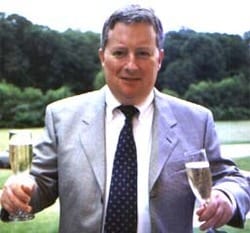
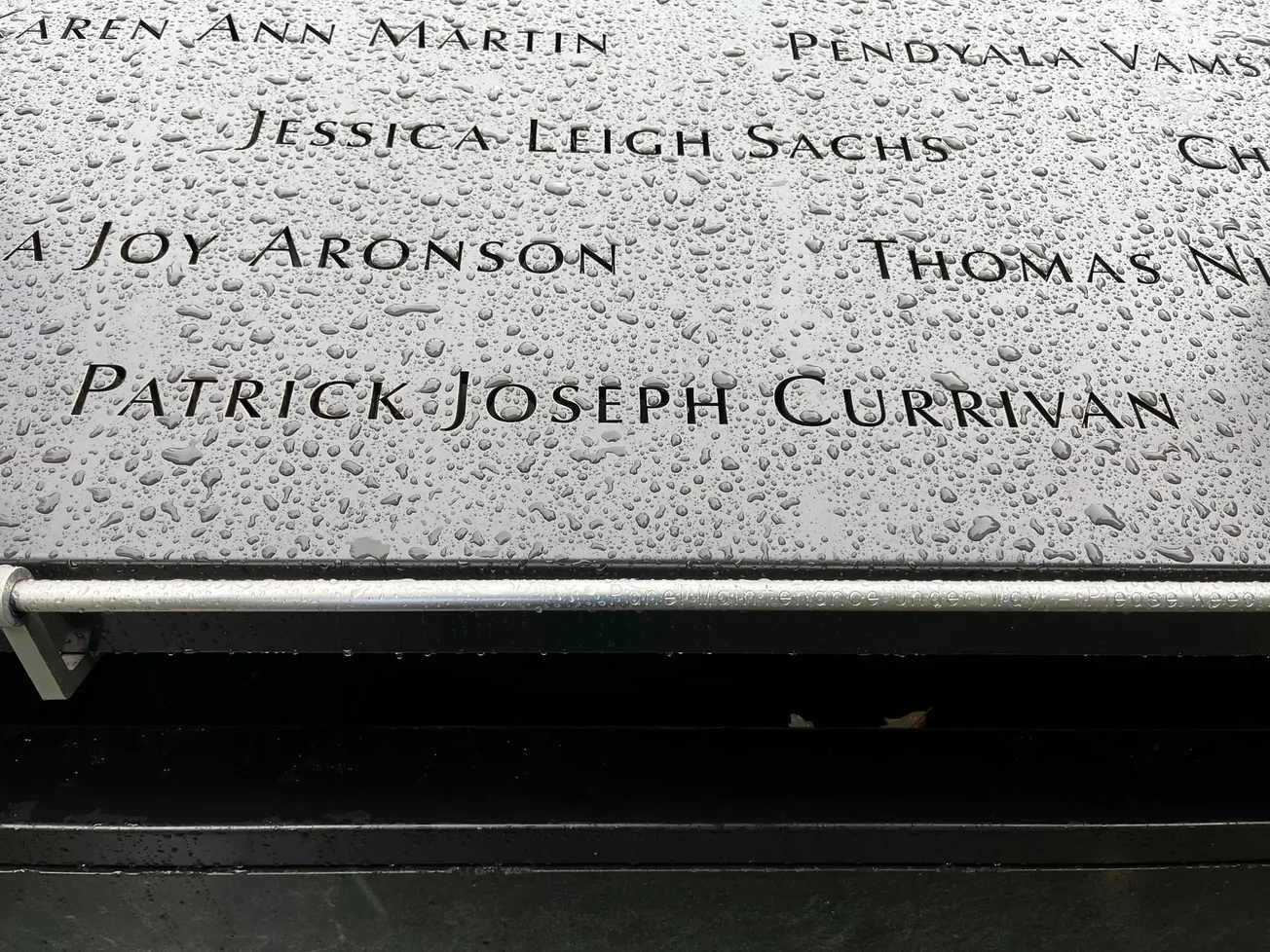
Patrick Joseph Currivan, 52, was the only Winchester resident killed that day. He had no wife, no children and no family in America. He left behind a house here and a Legacy.com memorial page collecting messages since Sept. 24, 2001.
The most recent arrived Sept. 11, 2026.
Born in Dublin on Sept. 28, 1948, Currivan was the eldest of three. His parents ran a pharmacy in Crumlin, and he and his brother Dan went to the Christian Brothers’ School on Synge Street.
He graduated from Trinity College Dublin in 1971.
Deaglán de Bréadún, the schoolmate who conducted that 2004 interview, remembered him as short in stature, serious but not solemn, highly intelligent and a straight talker.
Their parents died while his sister, eight years younger, was still a girl, and he became a kind of surrogate father — bribing her with chocolate to do her homework, and sending £20 for her birthday from his first job, lecturing at St. Andrews in Scotland.
Then Paris, for about 20 years.
The Boston Globe’s obituary traced it: Honeywell Bull, Bull Integris in Billerica until 1994, then Shaw Data, where he rose to senior vice president of technology. He quit in 1999 to travel and joined AtosEuronext in 2000. His last business card read senior vice president of the clearing business unit. The company’s 2001 annual report never mentions him.
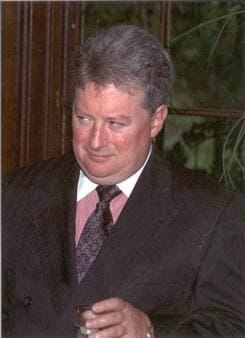
His neighbor Marcia Russell, who had known him since about 1991, wrote it down on the page in January 2002: the cooking, the marvelous parties, skiing in the Alps, an annual weeklong ride on horseback across France. He researched a place's history before going, then came home and neighbors gathered to hear what he had found.
“And I KNOW that he was falling in love with America,” Russell wrote. “He dreamed of settling here.”
Kathy Marshall, a neighbor who traveled with him in Egypt, told The New York Times in 2002 that he quizzed everyone he could.
“And if you were smart, you stood around and waited to hear the answers,” she said.
He had traveled the Silk Route and in Syria, spending years trying to understand societies most people around him saw only on the news.
Row 10
Currivan flew from Paris to Boston a few days early to see friends from the Trinity College Dublin alumni branch he had once led, before a conference in Los Angeles.
He had considered routing through Dublin and ruled it out: the cost, and a plan to meet Helen, Martin and Dan in Valencia, Spain, on Sept. 28, his 53rd birthday.
Monday night he telephoned Anne McMonagle, a Dublin woman in Boston, to ask how the alumni association was going.
“He was all enthusiastic. He was in fantastic form,” she told The Irish Times that week.
It is the last conversation of his life anyone recorded.
By the 9/11 Commission’s account, Flight 11 left Logan at 7:59 a.m. with 81 passengers, five of them hijackers. Just before 8:14 a.m, it reached 26,000 feet, everything normal.
At 8:41 a.m., flight attendant Madeline Sweeney reported passengers in coach believed there was a medical emergency in first class.
Currivan was in row 10.
At 8:46:40 a.m., the plane hit the north tower.
“I like to think maybe he was asleep,” his sister said.
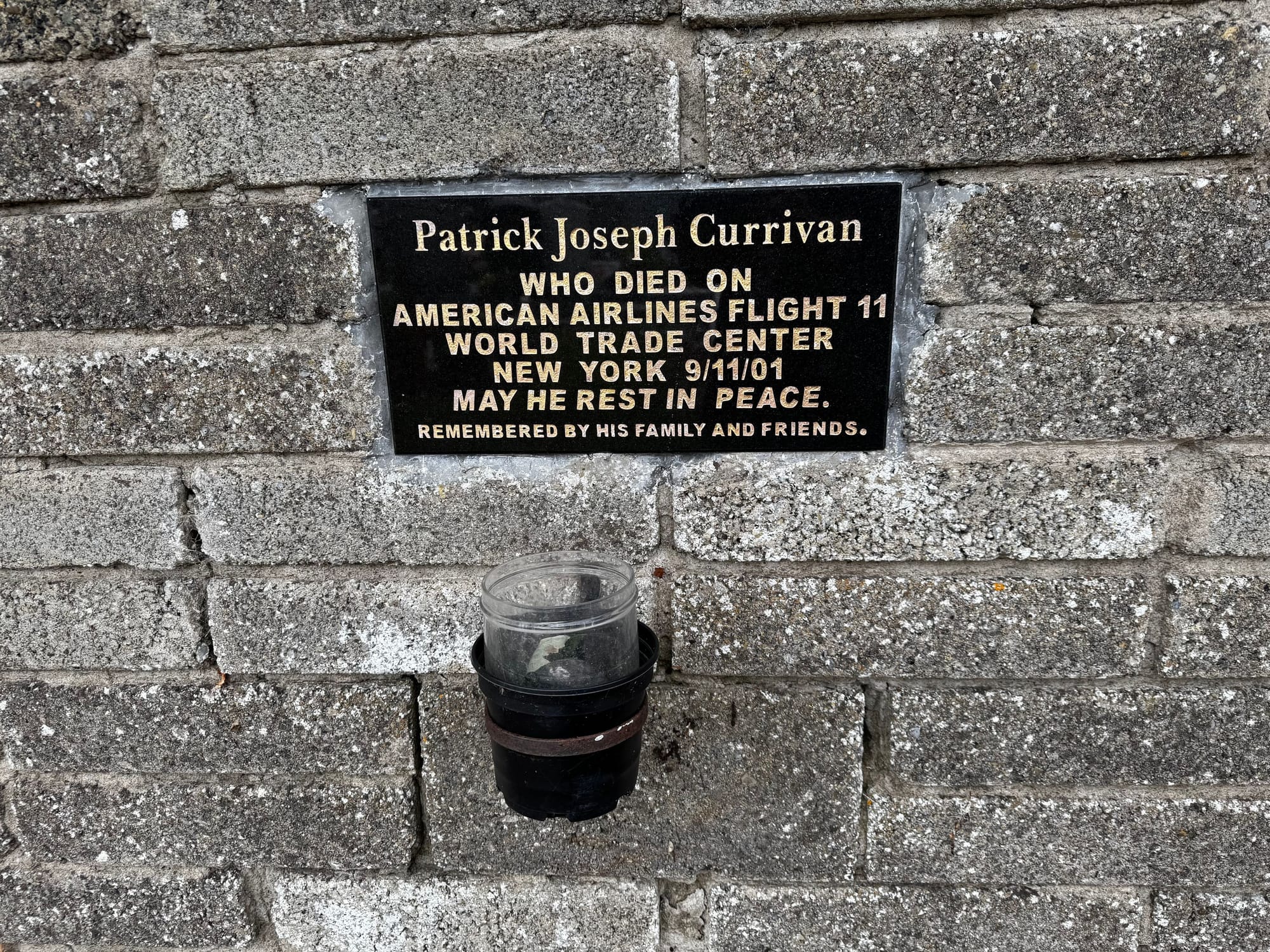
The Globe announced a memorial Mass for 7 p.m. on Sept. 28, 2001, at St. Eulalia Church. The people who mourned him in Winchester were neighbors and friends, not relatives. In Ireland, his sister was told she could not buy a cemetery plot without a body, so she had a plaque made and set into the cemetery wall.
Sen. Edward M. Kennedy arranged an American flag for the family, flown over the U.S. Capitol; Martin Redden answered the phone and recognized the voice before the name.
Three years later, the family was told some of his remains had been identified, and flew to Boston to scatter them near a pond.
“It was no more than a thimble of salt,” Martin Redden told The Irish Times this month.
They did not believe it was him, and found the ceremony consoling.
Page fills, year after year
Pat Wilson, who never met him, got a bracelet for Christmas 2001.
“The name on it is Patrick Currivan, AA #11. I have worn it proudly every day,” Wilson wrote that December.
Ten months later Darren Peck rode in an Arizona parade of more than 7,200 motorcycles with the same name on his wrist.
His sister posted on his birthday. In 2006, she wrote that she, Dan and Martin marked the date with champagne: “I know you would approve.” A year later: “Patrick, Today 28th September would have been your birthday,” recalling the 50th, “where the champagne never ran out.” The same day, Doug Abraham posted two words. “Happy Birthday!!!”
On Aug. 20, 2010, Marie-France Colombelli began, “Ce n’est qu’aujourd’hui que j’apprends que Patrick nous a quittés le 11 Sept. 2001” — It is only today that I learn Patrick left us on Sept. 11, 2001.
She had worked with him at Bull in the 1970s and ‘80s, and posted again in 2011, and in 2021.
On Sept. 10, 2011, Clem McGann, who had known “PJ” at Synge Street and Trinity, sent his sympathy to Helen and Dan. Helen Currivan Redden had died in 2008. Dan Currivan died in 2016.
The next day, Cliff Youse wrote: “I am watching the reading of the names. Patrick was my boss at SunGard.”
In 2013, a former colleague signing “M R” remembered a lunchtime when most people had gone out to eat and Currivan walked into their offices, joking, “mais il n’y a personne qui travaille?” — is nobody working?
On the page he is Patrick, Pat, Paddy, PJ and, from J.M. López, who in 2010 had only seen his photograph, “Bye Mr. Currigan.”
In 2025, Valérie C. wrote that she met him on a trip in Syria and learned of his death years later by searching his name.
On Sept. 11, 2026, Joshua Rumage wrote, “You will never be forgotten!”
Will Dowd is a Massachusetts journalist who covers municipal government and community life for Winchester News. He is also the founder and editor of The Marblehead Independent, a reader-funded digital newsroom.