
Table of Contents
The first unofficial returns in Winchester’s two Senate primaries are in, and they read very differently depending on which race you’re watching — and how much of it has actually been counted.
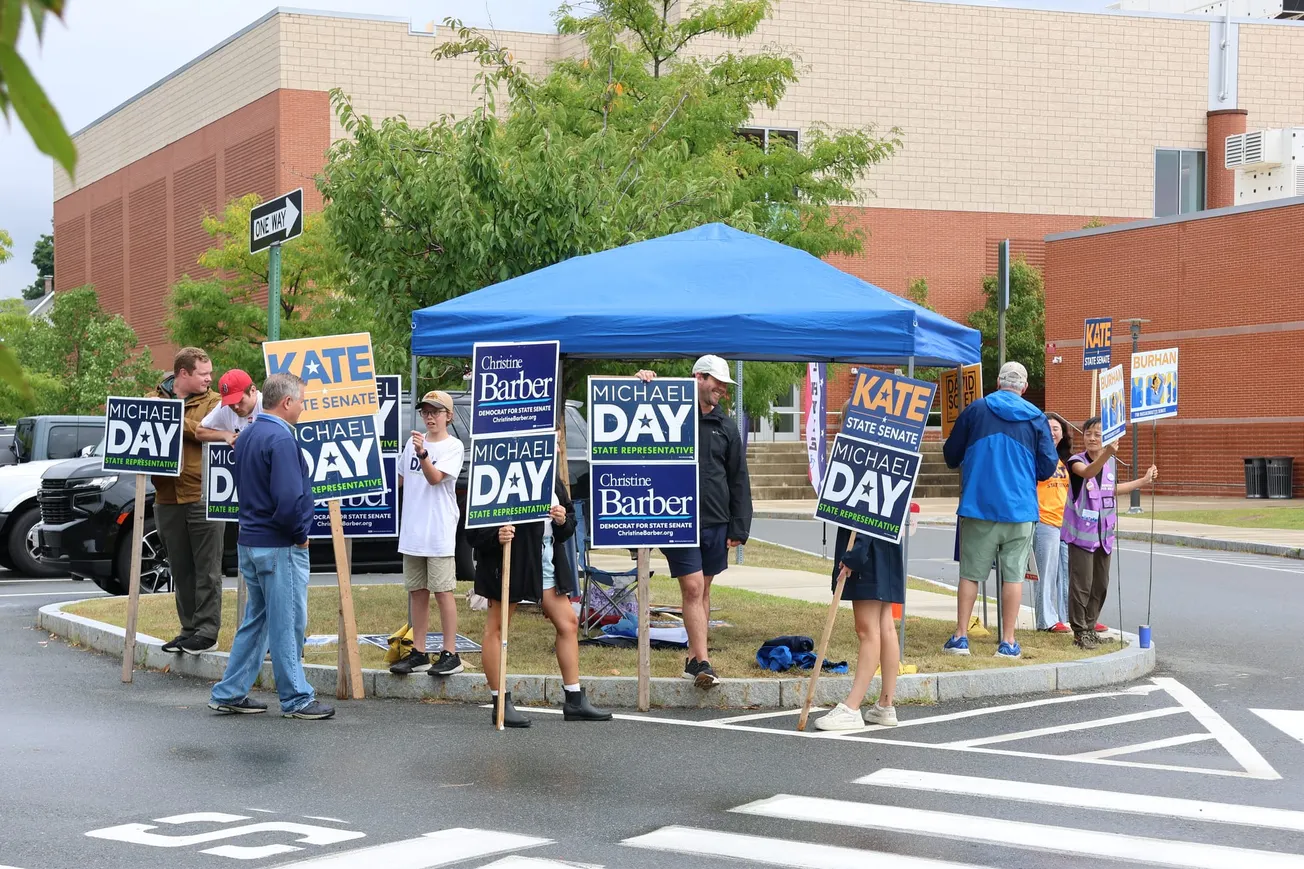
In the Second Middlesex, Christine Barber leads Erika Uyterhoeven by fewer than 400 votes with only two of six communities reporting. In the Fifth Middlesex, Kate Lipper-Garabedian is running past 70% of the vote in three of six communities. Neither number means what it looks like it means yet.
Barber narrowly leads Uyterhoeven in the two Second Middlesex towns counted
With unofficial returns posted from Medford and Winchester — two of the Second Middlesex District's six communities — Barber has 4,068 votes, 35.9%, to Uyterhoeven’s 3,693, 32.6%.
Matthew McLaughlin and Burhan Azeem are essentially tied for third, with 1,540 votes, 13.6%, and 1,531 votes, 13.5%, and Thomas Hopcroft, who withdrew from the race in July but remains on the ballot, has drawn 506 votes, 4.5%.
That’s 11,338 votes counted so far, combined from the two towns and not broken out individually.
Still outstanding: Somerville and Cambridge. In the last contested Second Middlesex primary, in 2020, Somerville alone cast 45.6% of the district’s vote and Cambridge’s four in-district precincts cast another 21.7%.
Somerville is also home turf for three of the four active candidates — Barber, McLaughlin and Uyterhoeven all live there — while Cambridge is Azeem’s base, and the one bloc he’s expected to carry outright. His fourth-place standing right now says nothing about Cambridge, because Cambridge hasn’t been counted yet.
Lipper-Garabedian’s lead comes entirely from outside Malden and Melrose
With unofficial returns in from Reading, Stoneham and Winchester — three of the Fifth Middlesex District’s six communities, totaling 8,430 votes — Lipper-Garabedian has 5,899 votes, 70.0%, to Carey McDonald’s 1,454, 17.2%, and Ryan O'Malley’s 1,077, 12.8%.
None of those three towns is Malden or Melrose, which together are expected to cast close to half the district’s vote; Malden alone was 24.5% of the district’s ballots in the 2024 general election, and Melrose 18.5%.
Malden is home to both of Lipper-Garabedian’s rivals; Melrose is her own base.
A 70% share built entirely on towns where none of the three candidates has a hometown edge is a striking number, but it hasn't been tested yet against either of the district’s two largest cities.
Somerville, Cambridge and Malden hold most of the votes still to come
Wakefield, a fourth Fifth Middlesex community, also hasn’t reported; Lipper-Garabedian represents part of Wakefield in the House, giving her a claim there too.
Combined, Malden, Melrose and Wakefield account for roughly 60% of the district’s historical vote — more than the share already counted.
In the Second Middlesex, Somerville and Cambridge together account for roughly two-thirds of the district’s historical vote, also more than what's been counted so far.
Both races are, functionally, too early to call. What’s posted tonight is unofficial, partial and, in the Fifth Middlesex especially, drawn from towns that don’t decide it.
Will Dowd is a Massachusetts journalist who covers municipal government and community life for Winchester News. He is also the founder and editor of The Marblehead Independent, a reader-funded digital newsroom.