Table of Contents
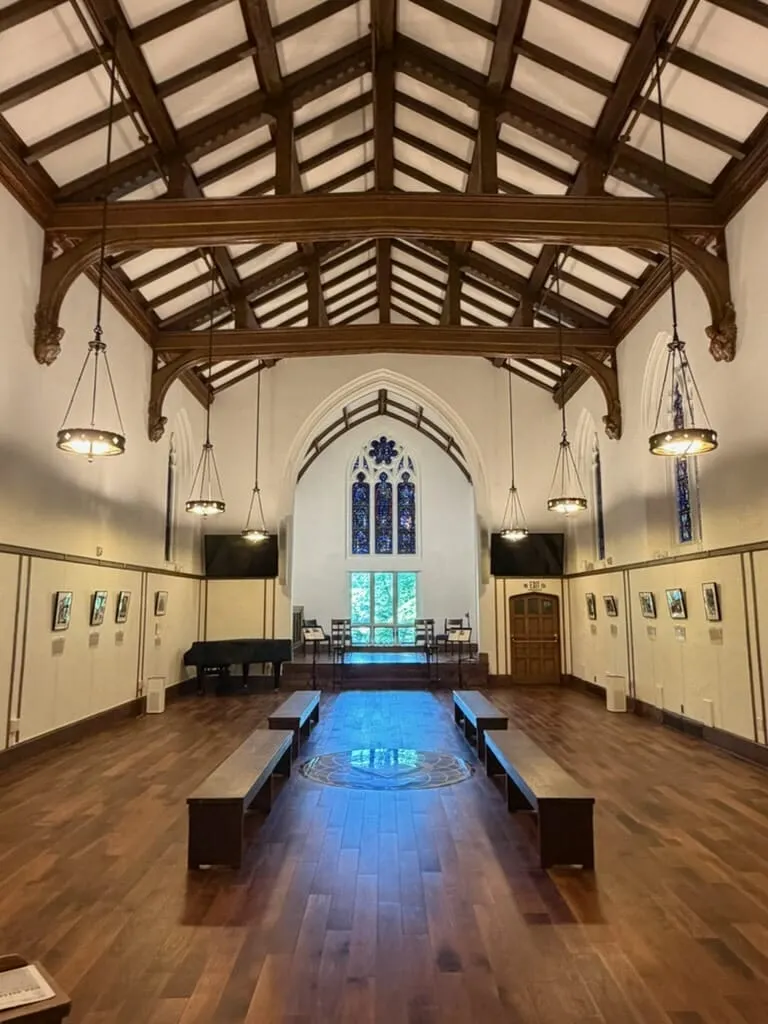
The room is quiet as the light splits into prismatic rays through the dazzling stained glass windows. Ripley Chapel has transformed into a gallery, with walls lined with framed portraits while people slowly move from one exhibit to another, reading one life at a time.
There is no music, no crowd, no rush. Every story has its individual respect. It is hard to skip a man who stopped eating in a Ugandan jail or a family who spent 17 years in a refugee camp.
The room requires just one thing to enter: your focus. That focus is the point.
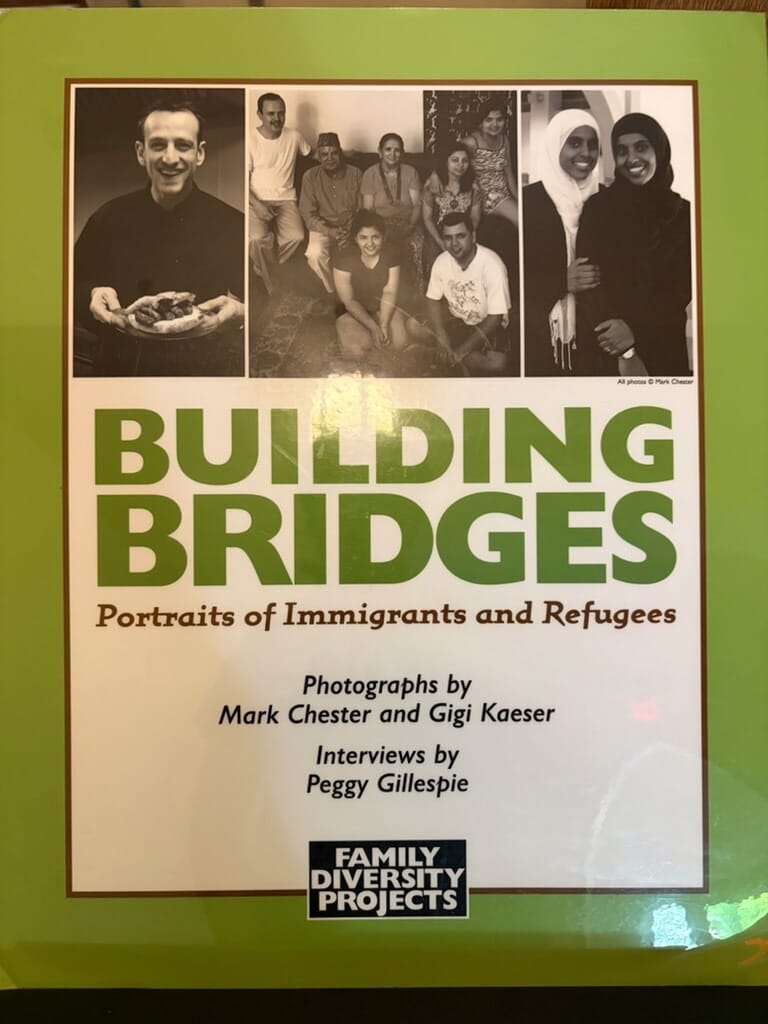
The exhibit, “Building Bridges: Portraits of Immigrants and Refugees,” is produced by the Western Massachusetts nonprofit Family Diversity Projects. With a small team of photographers, and journalists, stunning portraits are mixed with unique and touching firsthand stories of those who left their home and built entirely new lives in the United States.
The Family Diversity Project is a national nonprofit founded in 1995 by Peggy Gillespie and Gigi Kaeser. Their mission? To challenge ignorance and hatred with education and love.
“Building Bridges” is on view in the Ripley Chapel at the First Congregational Church in Winchester, 21 Church St., from now to June 14. Weekday hours are from 9 a.m. to 3 p.m. Sunday runs from 9 a.m. to 12 p.m.
There will be extended hours for PRIDEfest on June 11.
Many of these stories are at the intersection of LGBTQ+ and immigration identity which is why the host, an Open and Affirming, Open Table congregation in the United Church of Christ, chose the exhibit to take part in both Pride and Immigrant Heritage Month.
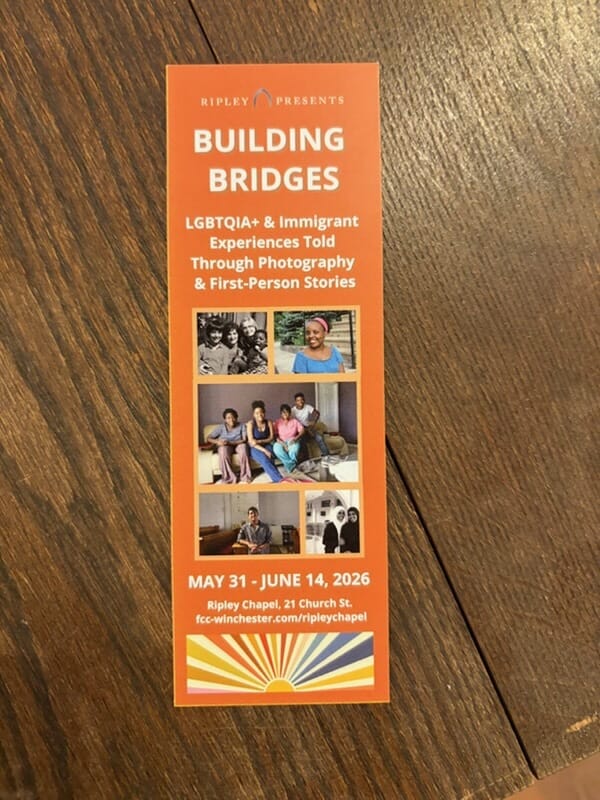
This is the church’s third annual exhibit and partnership with Family Diversity Projects and the engagement from the community has grown steadily. In 2024, “Authentic Selves” focused on trans and non-binary identity. The next year, “We Have Faith” shifted the exhibit to accentuate queer clergy and people of faith.
The goal, the organizers say, is to respond to a social crisis that is in the news and is getting more national attention. As anti-immigrant rhetoric has sharpened within this past year, this year’s theme could not have been more perfect.
Three stories from the wall
Part of the strength is that no two stories are ever the same. All are firsthand accounts with diverging, tangled journeys.
Associate Pastor at the First Congregational Church the Rev. Maeve Kieran Hammond explained.
“There are so many degrees of needing to leave your country of origin,” she said.
For some, the choice was personal. Yet for others, staying would have been fatal. For most, it is a mix of both.
Below highlights three stories from the wall.
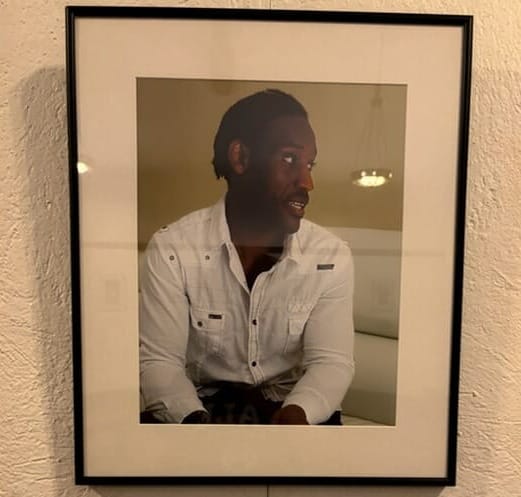
Yahya Jingo of Uganda demonstrates the crossroad between immigration and LGBTQ+ that the exhibit tries to highlight. He took part in Uganda’s first gay pride parade in 2012 where he was arrested.
On his own birthday, he was arrested again. He describes how the country could arrest you just for your heterosexual identity or even if you knew someone who was gay and chose not to report them.
“My partner in Uganda is in jail right now,” Jingo explained.
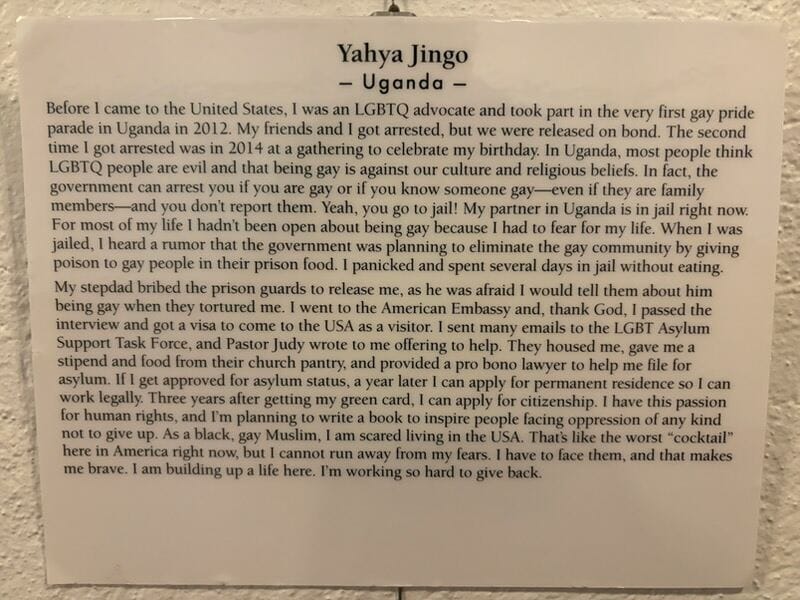
While jailed, rumor spread that the government planned to poison the food of all gay prisoners, thus he chose not to eat for days. After his stepfather bribed guards to release him, he reached the United States on a visitor visa.
He filed for asylum soon after. It was not easy.
“As a Black, gay Muslim, I am scared of living in the USA. That’s the worst ‘cocktail’ here in America right now, but I cannot run away from my fears,” Jingo said. “I have to face them, and that is what makes me brave.”
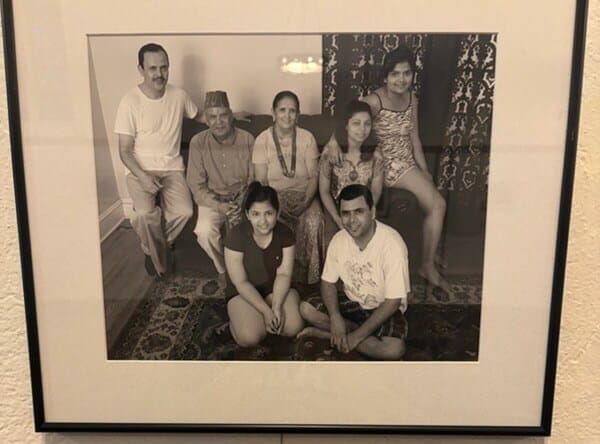
Bandhu Adhikari of Bhutan and Nepal offers the refugee experience in its longest form.
He was 8 years old back in 1992 when his family was forced out of Bhutan during an ethnic cleansing. They walked for two straight days to reach a refugee camp in Nepal.
With little options, the family lived in a tent for 17 years, surviving on food rations provided by the United Nations. His younger brother passed away due to disease during that time.
The family resettled in the United States in 2009. In 2015, Adhikari became a citizen.
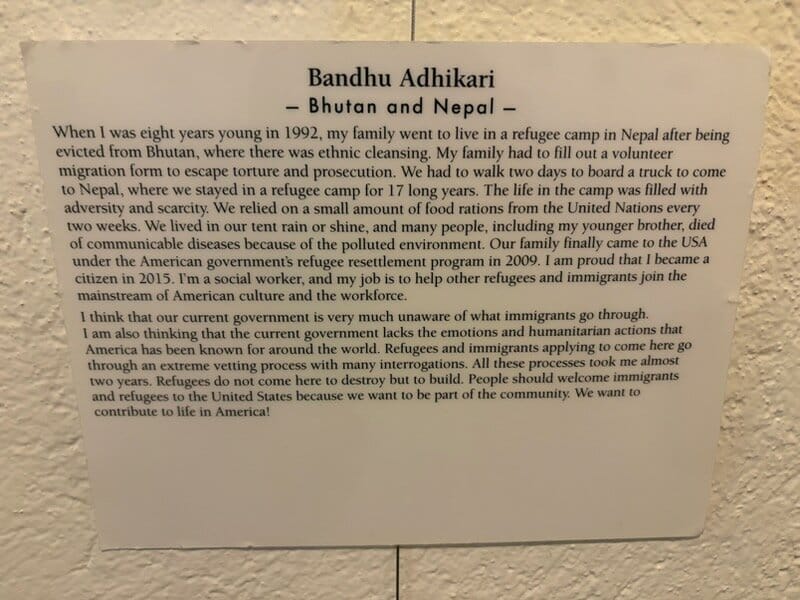
Currently, he works to help other refugees and immigrants reach or settle in the U.S.
His message is blunt: “Refugees do not come to destroy, but to build.”
This comes at a time of growing tension and xenophobia. Adhikari hopes to change that with his story and support other families, refugees, and immigrants to obtain a better life in the U.S.
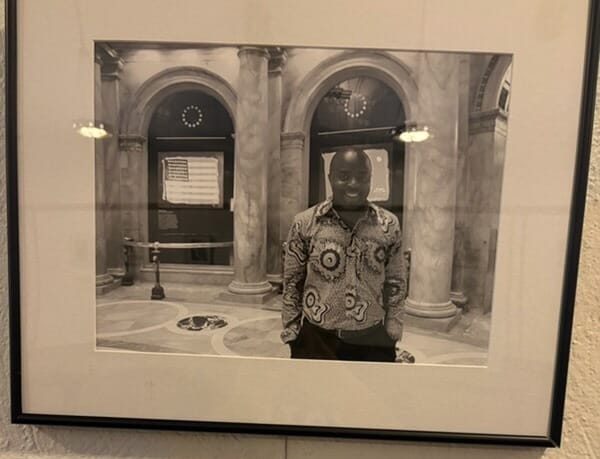
Victorien Ndounou of Gabon took a completely different path. He arrived in the U.S. on a college scholarship from Gabon, an oil-rich country where most people do not leave. He chose to stay after graduation, became a citizen and now works in radio-frequency engineering in the telecom industry.
Ndounou says the U.S. is not perfect, racism and discrimination are real social problems that need action today. However, fear-mongering damages America more than the people that it targets.
He gives the exhibits its name, exclaiming that, “We should be building bridges, not walls!”
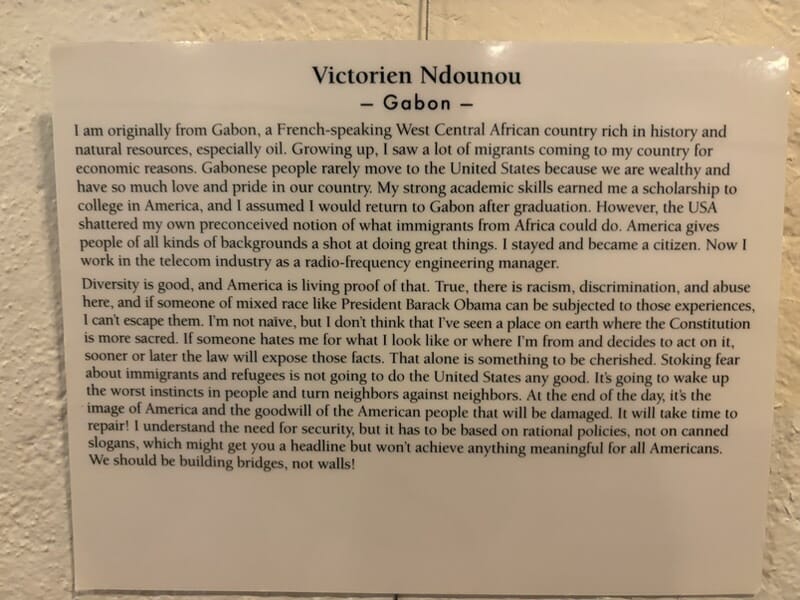
Part of the exhibit is the proximity of all these stories. They are local and they feel tangible to the average person walking through.
The exhibit argues this removes the abstract national argument about immigration and refocuses it on who your neighbor, who your friends and who your fellow community members are.
Church’s mission
For the congregation, the project is rooted in their scripture rather than politics.
“As people of faith, we are called in our scriptures to care for immigrants,” Hammond elaborates, pointing to the constant reminders in the Hebrew Bible that people of God were once immigrants themselves.
The church voted to become open and affirming back in 2001, which was ahead of the curve and well before it was common. Even today, some religious organizations have not followed. Both the immigration and LGBTQ+ aspects work hand-in-hand to recognize the same commitment: care for all people.
The exhibit’s numbers have been growing steadily in the past two years. About 100 people came to take a look in the first year, and that jumped 20% in the second year.
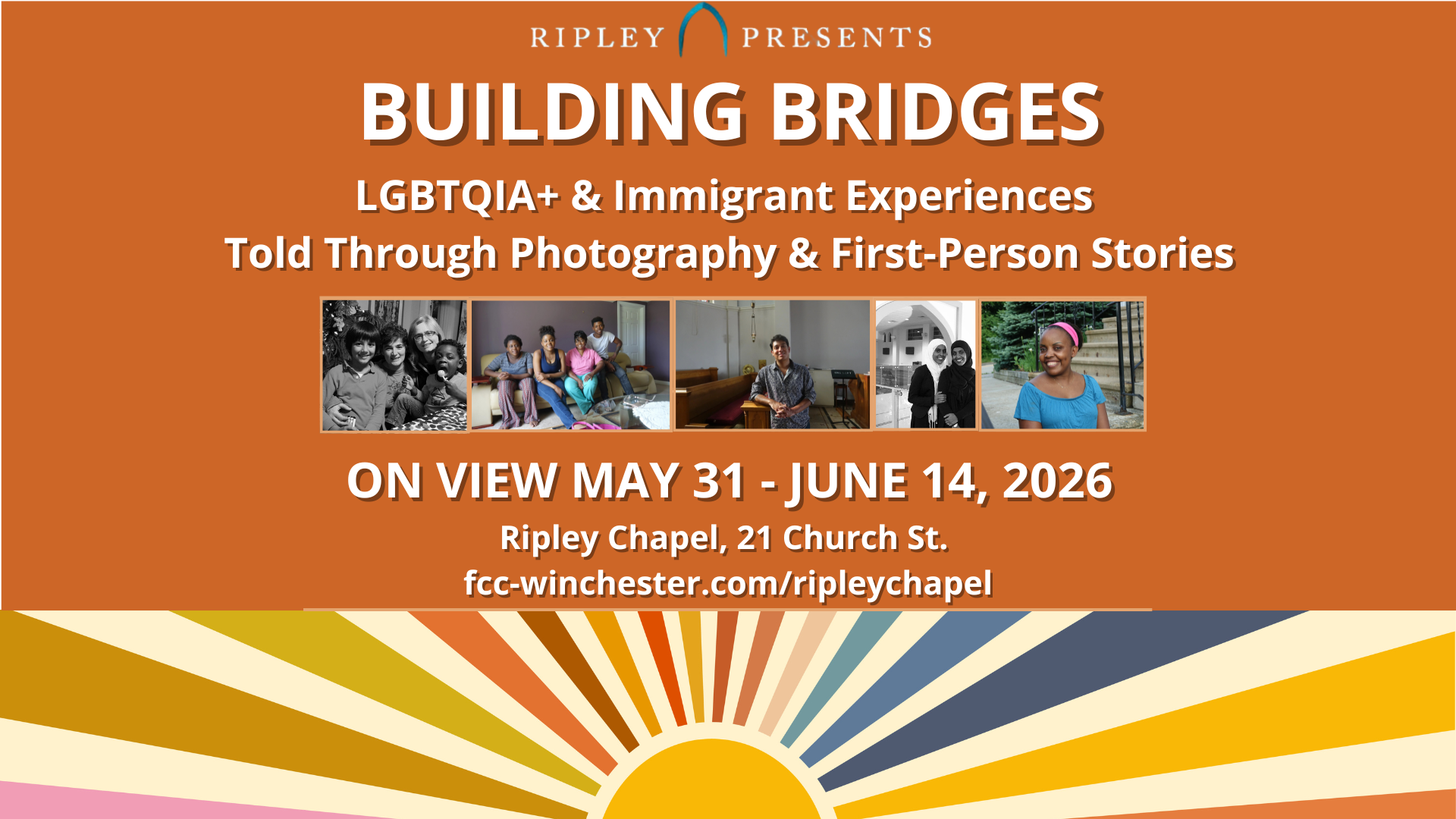
The organizers know that June is crowded with events and can get extremely busy. The worry is that the exhibit can get lost in it. The invitation is simple: come in, read, take it in, and take a bookmark to remember.
Some of the testimonies presented in “Building Bridges” may be age-inappropriate or confusing for some children. It is recommended that parents/families of children under the age of 12 accompany their children at the exhibit.
Xiyue Eric Han is a student at Winchester High School. He has been an intern with Winchester News since summer 2025.