Table of Contents
Malden City Councilor Carey McDonald delivered the sharpest line of an Aug. 8 Democratic Senate forum without naming anyone.
Massachusetts, the Malden city councilor said, is still party to a 287(g) agreement that allows state resources be used to deport people — the only blue state they said still has one, after most canceled theirs during the first Trump administration.
“This contract that uses state resources to deport people from Massachusetts is a perfect example of where we could be fighting harder, but we are pulling punches,” McDonald said.
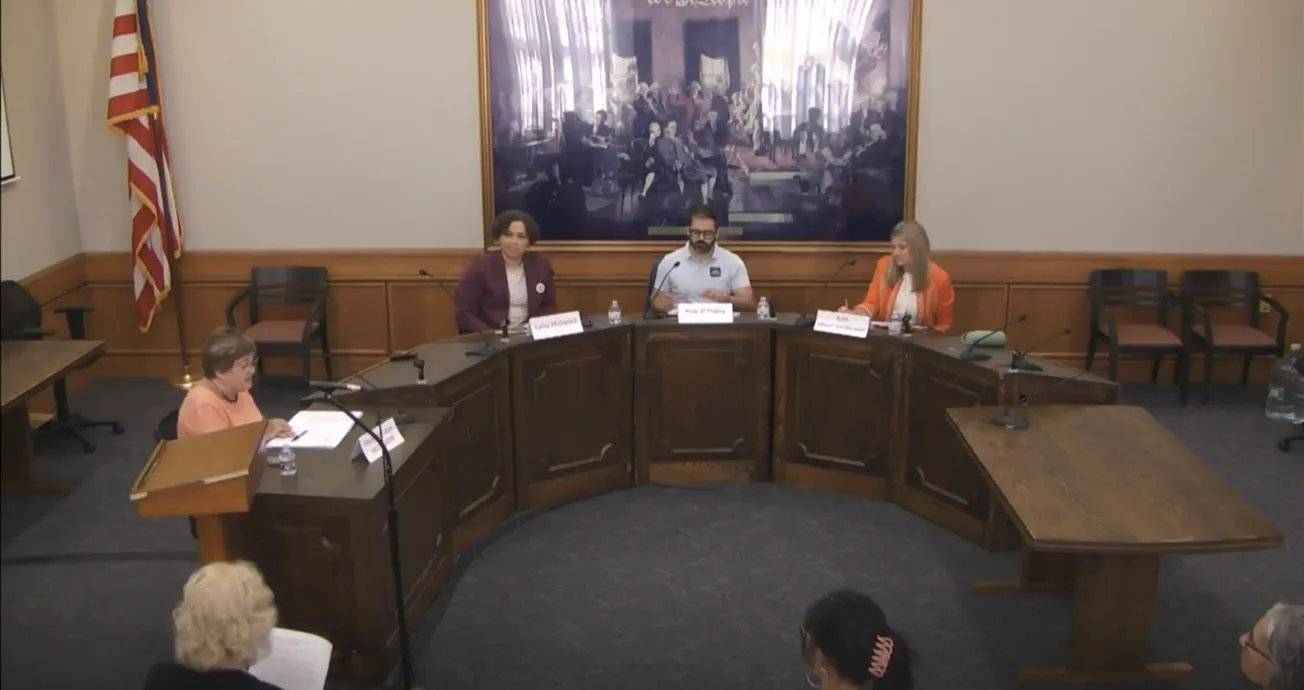
That was the argument running under most of Saturday’s forum at Stoneham Town Hall, where McDonald, fellow Malden City Councilor Ryan O’Malley and state Rep. Kate Lipper-Garabedian answered questions prepared by the League of Women Voters of Winchester, which sponsored the event with the League of Women Voters of Melrose.
The forum can be viewed on Stoneham TV.
The three are competing in the Sept. 1 Democratic primary for the 5th Middlesex District seat, which covers Malden, Melrose, Reading, Stoneham, Wakefield and part of Winchester. State Sen. Jason Lewis is not seeking re-election.
The candidates agreed on nearly every yes-or-no question the moderator put to them. All three opposed ballot question five, which would tighten limits on state revenue collections and return larger surpluses to taxpayers. All three backed question one, applying public records law to the Legislature and the governor’s office.
All three opposed the use of Flock surveillance cameras. Two of the three said yes outright on question seven, the zoning measure allowing single-family homes on 5,000-square-foot lots, and Lipper-Garabedian said she leans yes.
What separated them was speed — whether the Legislature moves fast enough to matter, and whether six years inside it counts as an asset or an explanation.
287(g) contract draws McDonald’s sharpest criticism
McDonald pressed that case hardest on immigration. The Protect Act, which Lipper-Garabedian said the governor signed into law days before the forum, includes reforms McDonald supports but arrived late, they said: introduced in January, with hundreds of people deported from the state in the months since, and available in a stronger form years ago as the Safe Communities Act.
“I’ve watched deportations happen on my street,” McDonald said.
They said they have donated to families whose relatives were taken and helped organize a Malden City Hall Plaza rally to get someone out of detention.
Lipper-Garabedian defended the new law in detail. She said it directs local and state public safety officials away from civil immigration enforcement, allows accountability when federal agents harm people and bars agents from entering schools, child care facilities, health care settings and courthouses to serve civil immigration warrants.
She described federal agents taking residents from Malden and Wakefield and said Congress has failed to reform immigration law for decades.
O’Malley returned to the subject unprompted in his closing statement, saying he might have missed the mark earlier. He said he has defended immigrants publicly and privately, and warned against tokenizing immigrant residents.
Transparency question turns on a five-second answer
The same divide surfaced on legislative transparency, where the phrasing of a five-second answer did more work than the 90-second ones. Asked whether the Legislature should fully comply with the 2024 vote giving the state auditor authority to audit it, O’Malley said, “Yes, definitely yes.” McDonald said yes. Lipper-Garabedian said, “certainly within the confines of the Constitution.”
She expanded on that. Lipper-Garabedian said she is the only candidate who has worked in all three branches of government — for a federal judge, for a secretary of education and now in the House — and that separation of powers matters more, not less, when the president is overriding Congress and the courts.
She listed changes already made: public committee votes, virtual testimony at hearings, an annual audit posted online. She writes a monthly newsletter recording her votes, holds monthly office hours and answers more than 1,000 constituent emails a year, she said.
“I’d say I have an established record, but I’m certainly not establishment,” Lipper-Garabedian said, adding the audit fight has become personal among high-level officials. “Let’s get the conversation back to how we open up government more for everyone.”
O’Malley wants a structural fix. He said legislative leaders use stipends and committee assignments to force members into line, and he would change state ethics law to prohibit it.
“I’m not going to call it bribes, but it feels bribey,” O'Malley said.
Members who break with leadership, he said, see their districts punished. He also noted Malden’s youth council must follow open meeting law: if children have to comply, he said, legislators should too.
McDonald said they began their career working in another state’s legislature that was subject to open meeting and public records laws, and the world kept spinning. They said they signed the Act on Mass “Every District Accountable” pledge.
Local aid formula produces a direct dispute
Money for cities and towns produced the forum’s one direct factual dispute. O’Malley said his understanding is that unrestricted general government aid follows no formula in practice and is distributed “completely at the whim of the Legislature,” based on currying favor with leadership.
Lipper-Garabedian pushed back: the distribution is not as intentional as it should be, she said, but “it’s not willy nilly” — it tracks what a community received the prior year, set largely when the program began. She said cities and towns are the second-largest bucket in recent state budgets after health insurance, and that she brought nearly $5.3 million in earmarks back to her district in the last two years.
McDonald called the answer proof of the problem.
“This is Exhibit A for how Beacon Hill does not seem to understand the urgency of the local budget crisis that every community is facing,” they said.
Malden proposed an override this year; McDonald worked to pass it, it failed, and the city eliminated 30 positions, which they said covered only half the gap. They would build a formula weighing commercial tax base, population growth and progress on state housing goals.
McDonald would make childcare a tax‑exempt use and expand childcare vouchers to lower costs for working families, while the others emphasized broader measures like universal pre‑K, utility rate caps, and housing supply increases.
O’Malley would pursue universal pre-kindergarten and use the Department of Public Utilities’ regulatory power to cap utility rates, arguing companies are booking record profits while passing deferred maintenance costs to ratepayers.
Lipper-Garabedian pointed to a higher renter income tax deduction she pushed for, which she said was the first increase in decades.
On transportation, O’Malley alone rejected congestion pricing, saying the state should use the carrot of better service rather than the stick. Lipper-Garabedian said she is tentatively for it; McDonald said they are open to it but would not start there.
Early voting runs Aug. 22 through Aug. 26. Lipper-Garabedian, who has Lewis’ endorsement, told the room that no one on the stage will fight harder and none has her record of delivering. McDonald, speaking last, put it the other way: “This crisis has to have urgency in response from Beacon Hill.”
Will Dowd is a Massachusetts journalist who covers municipal government and community life for Winchester News. He is also the founder and editor of The Marblehead Independent, a reader-funded digital newsroom.