Table of Contents
Winchester closed its books on fiscal 2026 with $600,090 set aside for electricity the town has used, but has not been billed for.
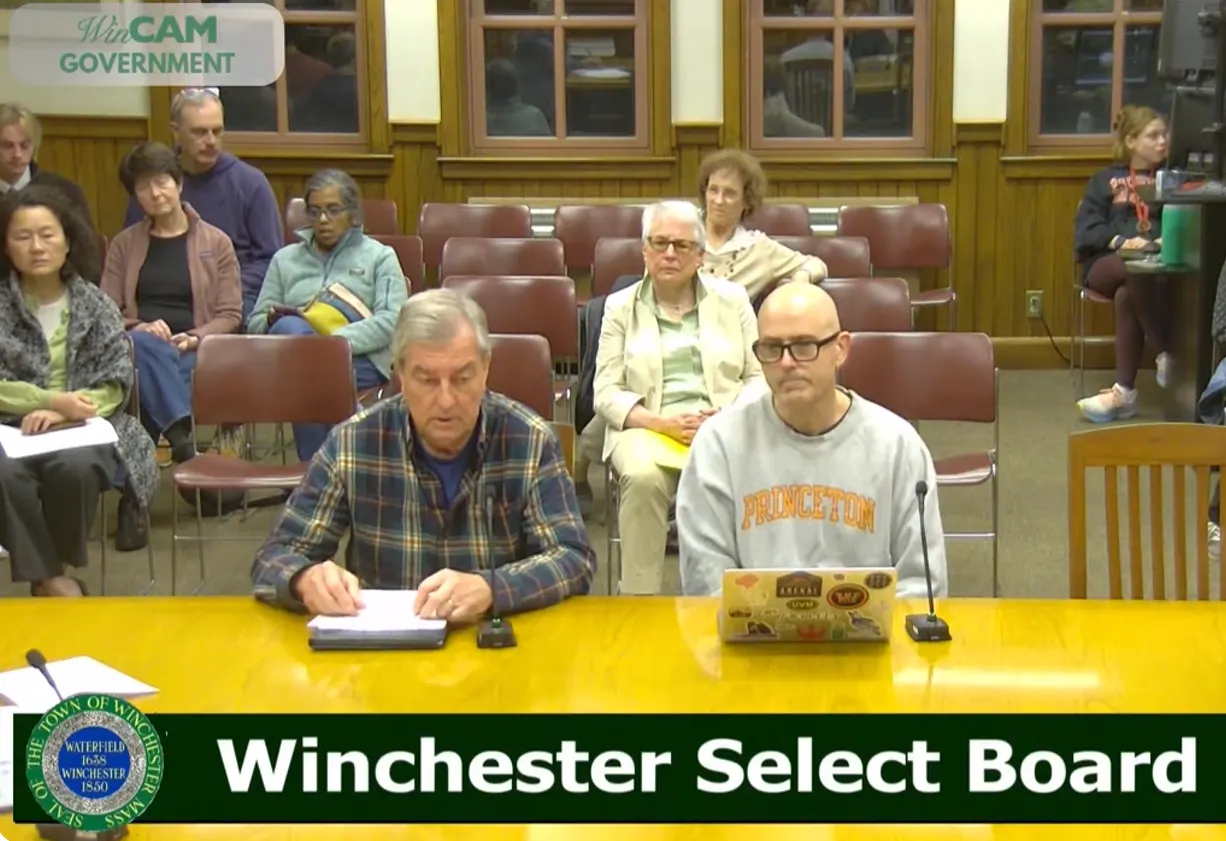
Comptroller Stacie Ward told the Select Board on Aug. 24 that Eversource has not produced bills for the town since about December 2025, leaving roughly six months of unbilled usage on the town’s accounts.
The money is an encumbrance — funds reserved against an expected obligation so they cannot be spent on anything else — not an invoice. Ward said the town still does not know what the real total is.
If the bill totals come in higher than what has been set aside, Ward said the town will have to ask Town Meeting to appropriate money for a prior-year bill pay. If the bill comes in lower, she said the unused balance will go back into the general fund.
“You have $600,000 set aside for a bill you might get,” Select Board member Michelle Prior said.
Six months without bills
Prior’s question started somewhere else. She asked about a $268,000 reserve fund transfer for energy, approved by the Finance Committee at the end of June, and whether it was because solar generation was not running at Lynch Elementary School.
It was, Ward said. But she added the larger problem was not Lynch. It was every other account. With no bills arriving, the town encumbered what was left of its energy budget to cover them.
The comptroller’s fiscal 2026 report shows how tight that was. Winchester budgeted $2,760,013 for energy, spent $2,159,922 and encumbered $600,090.
The account finished the year with 69 cents unspent. A year earlier, the town carried $114,651 in energy encumbrances.
Ward said Winchester had until July 15 to settle fiscal 2026 budget items.
“That’s all we knew as of July 15, which is very sad,” she said.
No more street opening permits
Town Manager Christopher Senior said Eversource had trouble billing municipalities after it changed its billing process, and that Winchester was not alone.
“It’s been an absolute nightmare,” he said, adding the town had a number of heated calls with the company.
Senior said about two months ago, Winchester was prepared to tell Eversource that without answers it would get no more street-opening permits — the approvals a utility needs to dig in a public way. He said the town did not have to follow through. The board took no vote on the matter.
Senior said he is fairly confident public works estimated conservatively, given the town’s long record of its own electrical usage. He said he believed the utility had made progress; public works had stopped asking him to get Eversource to the table.
Ward said the explanation does not account for the delay.
“Even if their billing system changes, how can they wait this long to send a bill?” she said.
What if the estimate is short
Ward said there should be consequences for leaving a municipality to close its books with unknown liabilities that large. She said she did not want the encumbrance read as spare money; the town wants accurate bills, not big ones.
The $268,000 energy transfer is a separate matter. It was one of four reserve fund transfers the Finance Committee approved in fiscal 2026, totaling $369,000, and the comptroller’s report describes it as paying Eversource for unplanned costs tied to Lynch Elementary School.
Ward said the figure was calculated on solar not being in place, going back to about April 2025, and that the contractor has agreed to cover some of the energy costs incurred during construction. Those charges began, she said, once the project reached substantial completion.
Winchester otherwise finished the year in solid shape. Ward reported about $3.4 million in surplus revenue, driven largely by local receipts, and $2.2 million in departmental turnbacks, much of it from police, fire and public works budgets that carried vacancies.
She projected free cash between $21.2 million and $21.4 million, pending certification by the state Division of Local Services in early September.
Waiting for a final number
Ward said Eversource met on the billing backlog around Aug. 7 and was wrapping up its discussions the following week. Beyond that, neither she nor Senior could say Aug. 24 how much of the backlog remains.
“Is it done? Is it over?” Prior asked. “We’ve got most of the iceberg revealed. What’s left?”
Senior said he would find out. He had returned to the office that afternoon from a long weekend, he said, and would report back on where the town stands.
Winchester cannot go into another fiscal year with the same problem, he said.
Chair Anthea Brady asked for a one-page status update in Senior’s report for the board’s Sept. 14 meeting, noting the timing if it has to go to Town Meeting. The fall Town Meeting warrant closes Sept. 21.
Will Dowd is a Massachusetts journalist who covers municipal government and community life for Winchester News. He is also the founder and editor of The Marblehead Independent, a reader-funded digital newsroom.