
Table of Contents
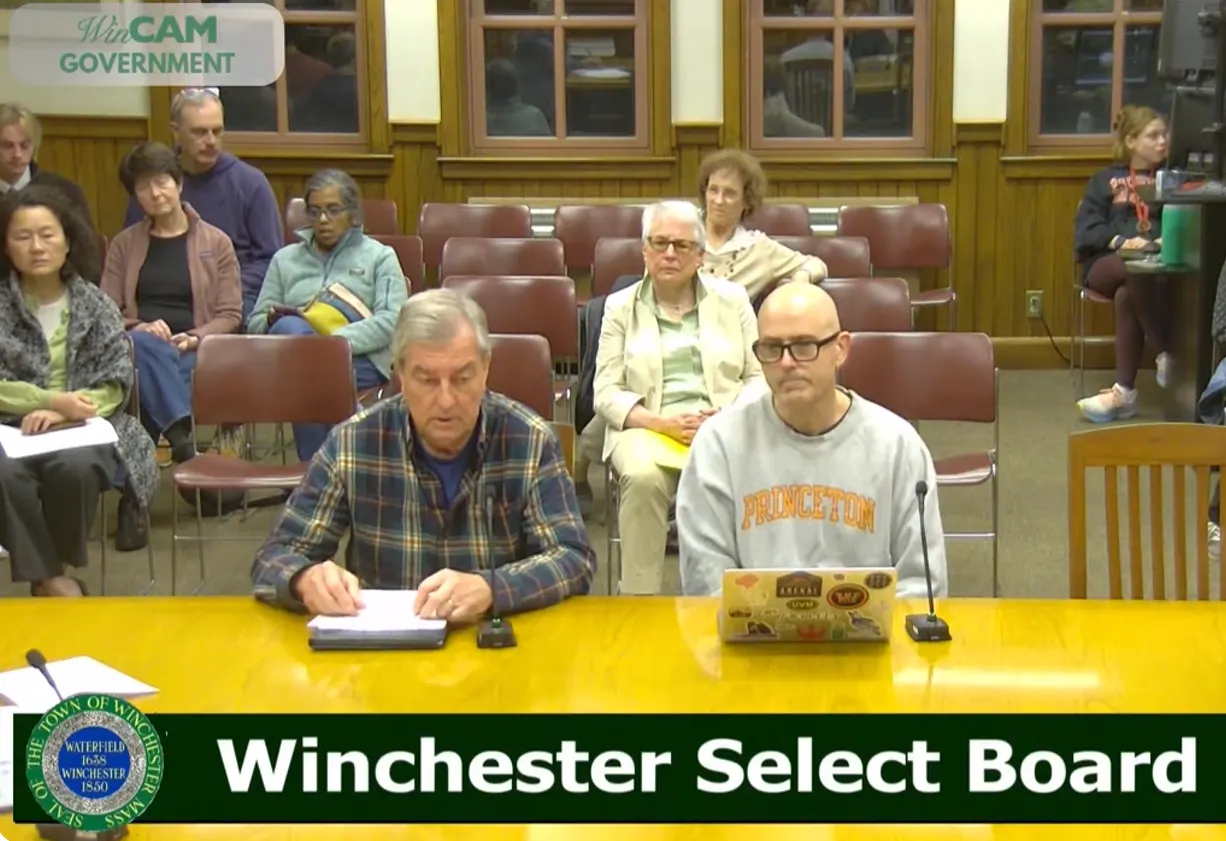
The Winchester Select Board on April 13 voted favorable action on Article 4, a proposal to establish a Human Rights Commission in the town's bylaws, even as members pressed the working group behind the article on how the new body would operate, keep records and measure whether its work was making a difference.
Article 4, sponsored by the Select Board, would add Sections 4.6 through 4.6.7 to Chapter 2 of the Code of Bylaws.
The commission would have nine members: four residents, with one serving as liaison to the Council on Aging and another as liaison to the Disability Access Commission; two student members; one member who is a senior School Department administrator or a member of the School Committee; the town manager or a designee; and the police chief or a designee. The motion-book background accompanying the article lists similar commissions in Lexington, Arlington, Stoneham, Medford, Woburn and Belmont.
Rebecca Slisz, co-chair of the Human Rights Commission working group and executive director of the Network for Social Justice, walked the board through the group's work at the meeting.
Slisz noted the network helped create the town's Human Rights Statement, which Winchester first adopted in 2009 and updated in 2012 and again in 2020 to add country of origin and immigration status. She told the board the commission would give the town a formal partner for translating that statement into practice.
"There's an opportunity for a Human Rights Commission to be one of the bodies that helps our town make that statement and those values that it embodies, a reality," Slisz said.
Slisz said the seven-member working group formed after Fall Town Meeting 2025, divided its work into one team focused on the commission's duties and another on its composition, and benchmarked against neighboring towns.
Under the motion-book text, the commission's duties could include serving as a point of contact, collaboration, support and advocacy for residents who believe they have faced bias, harassment, exclusion or discrimination in the community, and making referrals to appropriate local, state or federal agencies. The bylaw would also let the commission hold educational programs and events and review existing and proposed town bylaws and policies.
"Almost all of the surrounding towns, or the towns that surround Winchester, have a Human Rights Commission, and they also have other entities that support human rights in their town," she said, adding the network "is wholeheartedly supportive of this commission."
Board member Michelle Prior used most of the discussion to press on operational details. She asked how often the commission would meet and whether the bylaw language implied a need for a paid recording secretary to keep minutes.
Chair Anthea Brady said no funding source is attached and that other town bodies handle minutes without a dedicated staffer; Prior said she was comfortable if the commission used a transcription tool "as long as Chris [Senior, town manager] is good about minutes."
Prior also questioned how to read a clause referring to consultation with the Massachusetts Commission Against Discrimination, asking whether "jurisdiction" in the bylaw referred to the new Winchester commission or to the state agency.
Select Board member Paras Bhayani said the working group's reading was that the Winchester commission would be the body with jurisdiction under the bylaw and would consult the state agency when it needed outside help.
Slisz agreed, saying the local commission would turn to the state agency if it had "something that it needed to be, it needed to resolve, and was looking for a larger body."
The sharpest line of questioning was on effectiveness. Prior pointed to language directing the commission to monitor the implementation of policies and programs and evaluate their effectiveness, and asked how that evaluation would actually happen.
Slisz acknowledged the commission would need to establish baseline data in certain areas before it could judge whether recommendations had been carried through.
Prior urged the group to build benchmarks into its standard practice so "the programs are going to move the needle in certain ways."
Bhayani and Brady framed much of that work as implementation that the commission itself would have to take on once seated. Bhayani compared it to the rollout of another town body that "had a similarly length" bylaw but then spent its first months building procedures.
"They just had to create a bunch of stuff right before they could really get going," he said.
Brady added that the bylaw "is not prescriptive on how the bits and pieces work," leaving those questions to the commission as it is stood up.
After the exchange, Bhayani moved favorable action on the bylaw. Brady seconded, and the board voted in favor.
Slisz is expected to return to present the article on the first night of Town Meeting, scheduled for April 27.
Will Dowd is a Massachusetts journalist who covers municipal government and community life for Winchester News. He runs The Marblehead Independent, a reader-funded digital newsroom.