Table of Contents
Three years ago, walking back to his car from a Network for Social Justice Pride Fest, School Committee Chair Tim Matthews passed a Jeep full of teenagers with his then-6-year-old son. The teenagers screamed a slur at the boy.
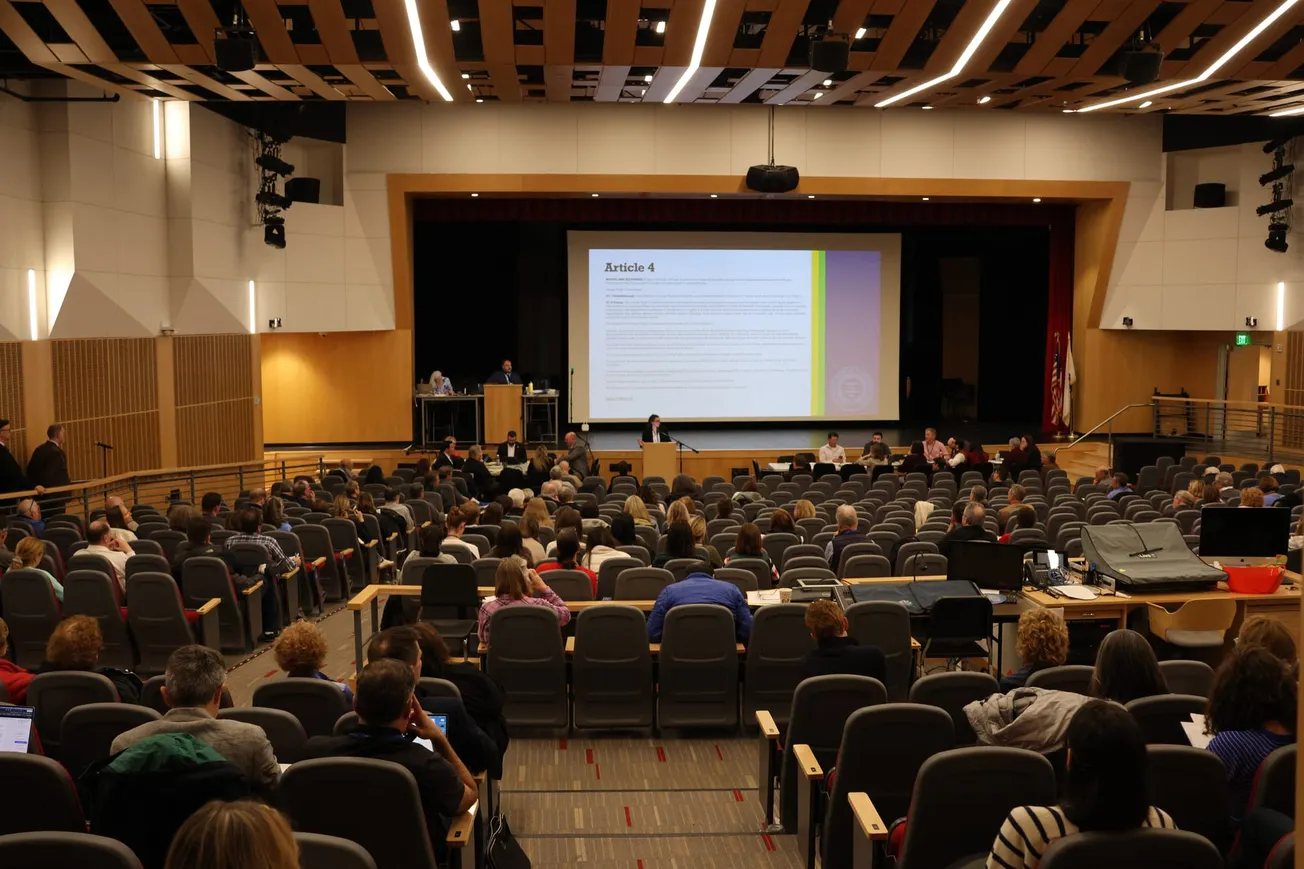
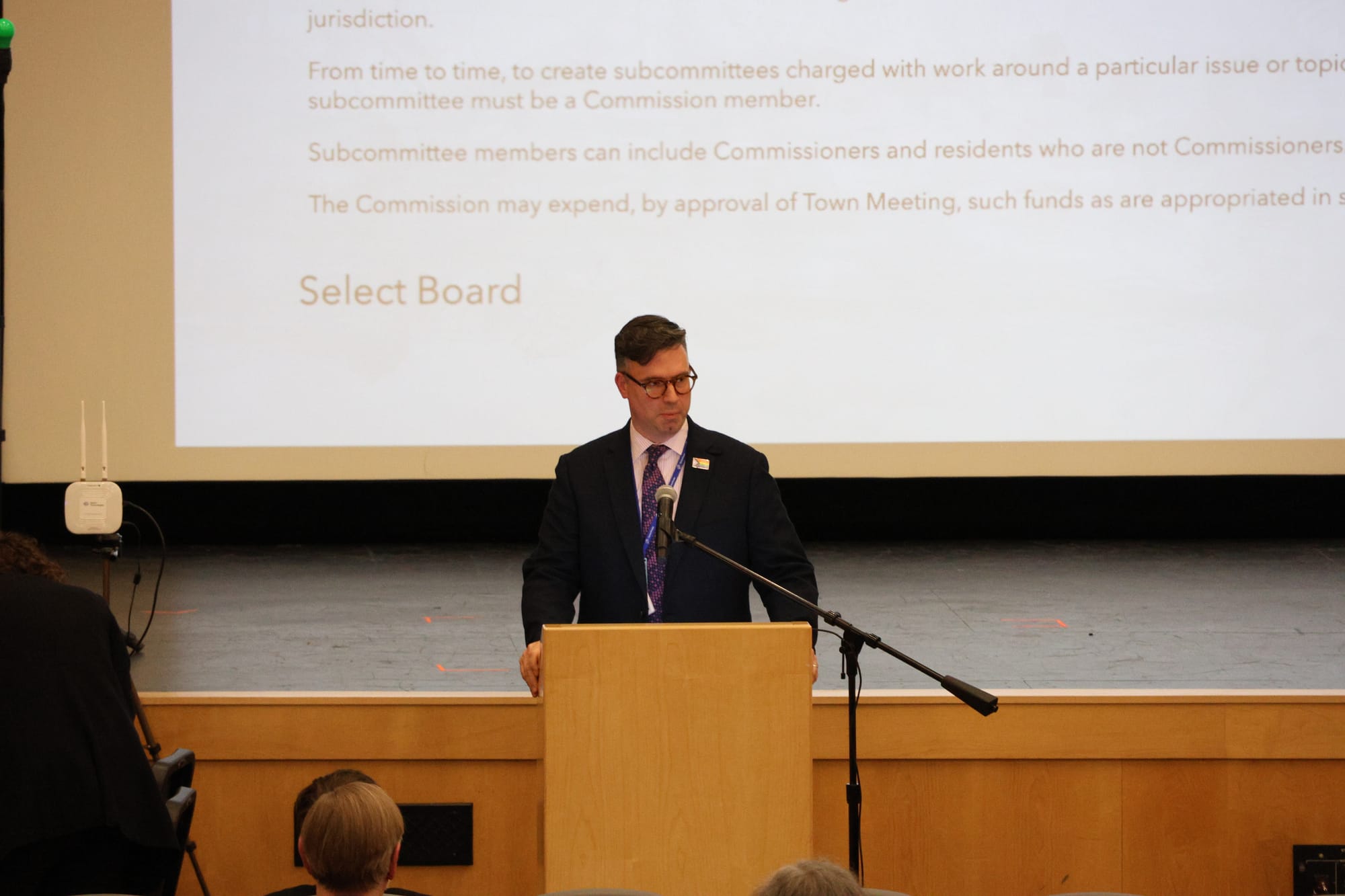
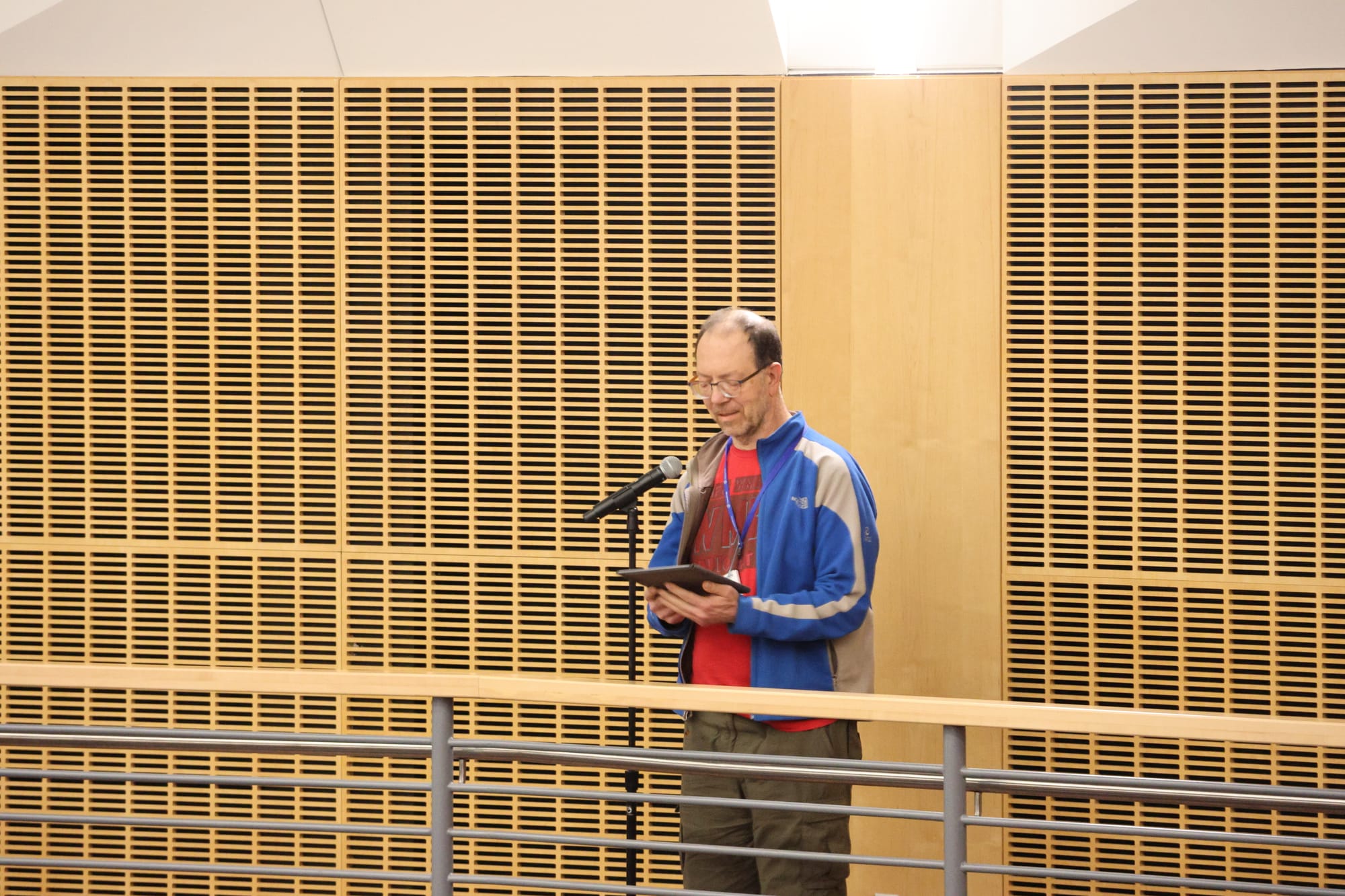
Matthews told that story on April 30 from a floor microphone at Winchester High School, where Town Meeting was deciding whether to write a Human Rights Commission into the town’s bylaws. He was speaking as a Town Meeting member from Precinct 1, not as the School Committee chair he is.
The Pride Fest incident was the second anti-LGBTQ bias episode his family had experienced since moving to Winchester in 2018.
“I think it is a material and egregious omission that our town does not have this,” he said, of a Human Rights Commission.
Members passed Article 4 by electronic vote, 124-29.
It was one of three pivotal decisions in the second session of spring Town Meeting — a night that also saw unanimous approval of a $1.5 million Muraco Elementary School feasibility study and rejection, 61-89, of a $300,000 plan to demolish the Sanborn carriage house at 21 High St.
Members reconvene for Session 3 on Monday, May 4 at 7 p.m.
The Human Rights Commission will have nine members: four residents, two high school students, a senior school administrator, a town manager designee and a police designee. Appointments will be split among the Select Board, School Committee and superintendent. The article carries no direct budget impact.
Select Board Chair Anthea Brady said the body would serve as a point of contact for residents, partner on educational programming and review bylaws affecting human rights.
Network for Social Justice Executive Director Rebecca Slisz, a Precinct 8 Town Meeting member, told the floor that 3,243 new discrimination complaints were filed with the Massachusetts Commission Against Discrimination in 2025, and that antisemitic incidents rose 23% from 2023 to 2024.
The argument against the article never touched its purpose. Committee on Government Regulations Chair Stephen Boksanski, of Precinct 4, said his committee voted 8-0 unfavorable action on procedural grounds — the commission’s duties, he said, exceeded the narrow study-and-report role the Town Charter assigns to standing committees.
“It’s a square peg trying to fit into a round hole,” Boksanski said.
Brady said a revised motion answered the objection by establishing the commission as a new bylaw chapter rather than a Section 2-11 standing committee.
Town Counsel Karis North told members the bylaw approach gives the public clearer notice. The article now goes to the Massachusetts Attorney General’s Office for review.
The sole no vote
The carriage house was the only no vote of the night, and the only one where a coalition of the Select Board, School Committee and Capital Planning Committee lost the room.
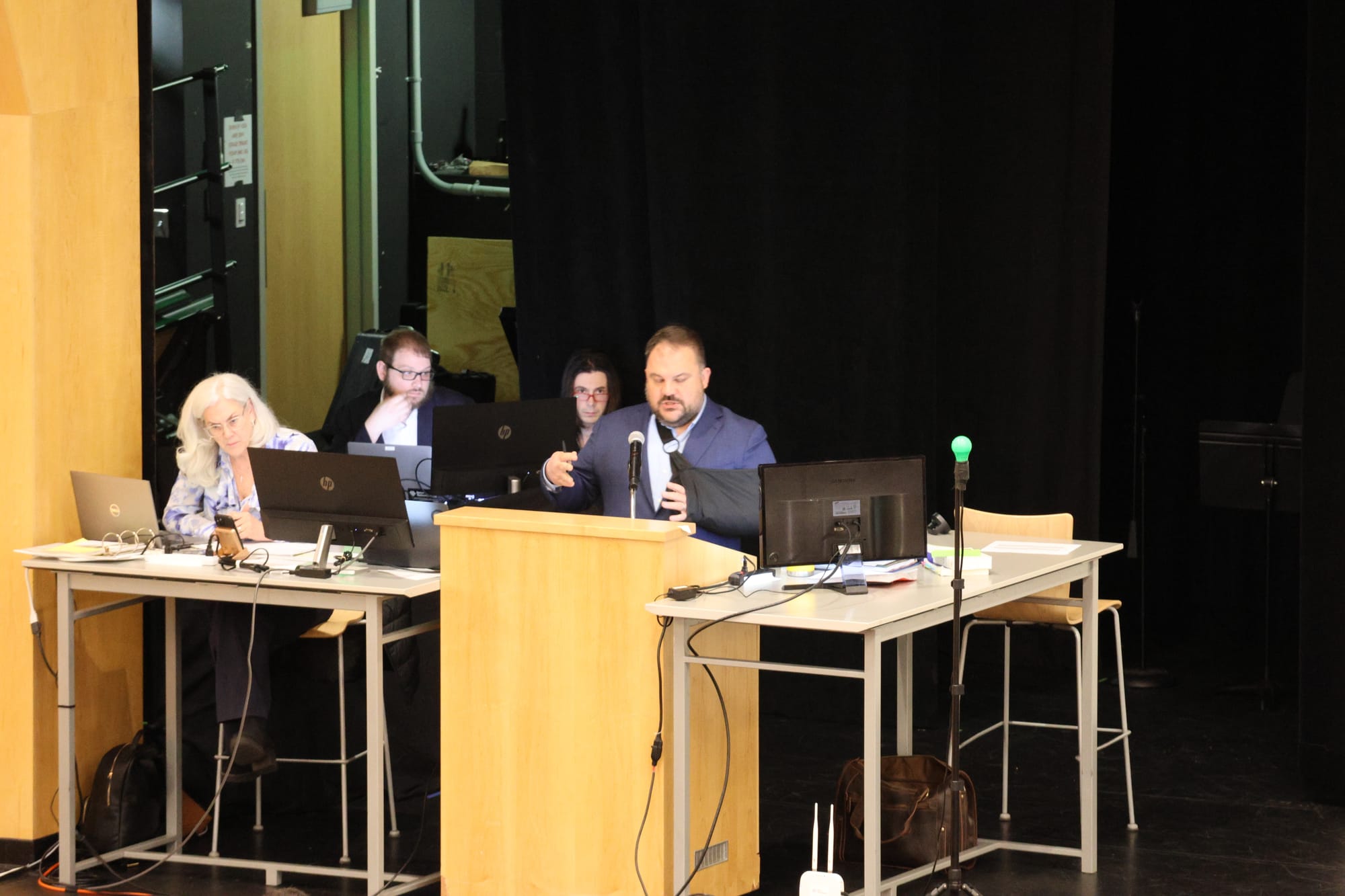
Stefanie Mnayarji, of Precinct 5, presenting for the School Committee, said the recommendation came “with a heavy heart.” The building sits on an active Ambrose Elementary campus along a state-designated safe route to school — circumstances that ruled out housing or community-center reuse, she said.
Recent visits had turned up drug paraphernalia, condom wrappers and a high chair that had migrated from inside the structure to outside it.
A slide titled “Why now?” answered a member’s challenge: students on Ambrose’s third floor can see a family of raccoons coming and going through a hole in the roof.
The Winchester Historical Commission deemed the carriage house “historically significant” in August 2025 and imposed a 12-month demolition delay.
Capital Planning Committee Chair Roger McPeek said keeping the building costs the town about $3,000 a year in insurance, plus the risk that vandals disturbing contained asbestos could turn a manageable hazard into a contaminated structure.
“There’s no joy in this,” McPeek said. “There’s nobody happy about any of this.”
The opposition was not preservationists at large — it was preservationists with a plan.
Michelle McCarthy, of Precinct 7, a Historical Commission member, said a newly formed group had lined up pledges and donors for private renovation.
William Swanton, of Precinct 5, a Winchester Historical Society board member, said the society envisioned a single-floor exhibit and performance space, an approach that avoids triggering full ADA upgrades on all three floors and brings the cost well below the multimillion-dollar plans the town had rejected before.
“The Historical Society is asking to not spend your money,” McCarthy said. “We’re going to save you money.”
That was enough. The motion fell well short of the two-thirds it needed.
Muraco to get feasibility study
There was no joke before the Muraco vote. Article 27, authorizing $1.5 million in borrowing to launch a Massachusetts School Building Authority feasibility study for Muraco Elementary School, passed unanimously on a voice vote.
Muraco is the last of Winchester’s five elementary schools yet to be rebuilt or comprehensively renovated.
School Committee member John Bellaire, of Precinct 2, a Muraco alum, said the 1967 Bates Road building serves about 300 students and has the second-highest concentration of high-needs students of any elementary in town. MSBA cited aging structural systems, boarded-up windows, deteriorated brickwork and a basement unusable since flood damage when it invited Winchester into the eligibility period in December 2025.
The reimbursement rate is capped at 32.47% because of Winchester’s relatively high community income, Matthews said. An opening as soon as fall 2031 is possible if the town stays on schedule.
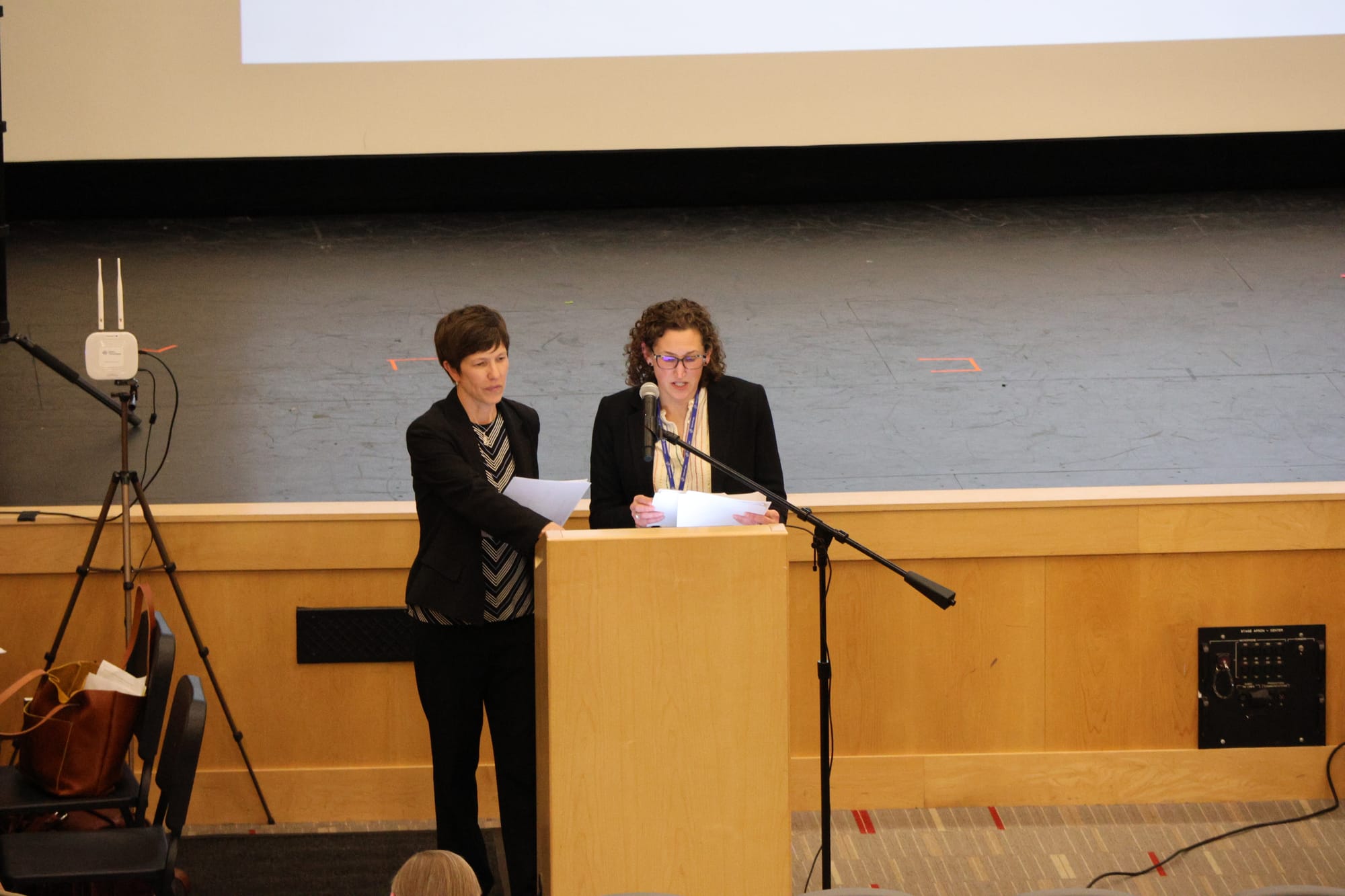
Joanna Shea O’Brien, of 41 Lincoln St., who said she has spent nine years on Muraco’s health and safety committee, was given the floor by unanimous consent. She told members the auditorium doubles as the gym, that students do individual work at tables in the hallways and that the lower level has been unusable for years.
“Muraco parents have shown up for every school initiative in this town,” O’Brien said. “Tonight, we’re asking you to show up for us.”
Meredith Mason-Crowley, of Precinct 1, a retired teacher, rose next.
“The Muraco children all know that their school is next,” she said. “What we do here tonight will be a very powerful message to them.”
Making quick work of capital planning
The night moved more quickly through capital planning.
Members approved $830,000 for repair at the South Reservoir Dam, a state-regulated structure where deferred maintenance carries legal consequences; $2.4 million for Town Hall and library roof work, bell tower renovation and library windows; and $325,000 for the town’s ADA Transition Plan, federal MS4 stormwater compliance and an engineering analysis of Everett Avenue drainage — a response to resident videos of street-level flooding near the boat-club culvert.
They doubled the standing appropriation to the Strategic Capital Maintenance Fund to $200,000.
McPeek welcomed Jason Roeder, of Precinct 5 to Capital Planning, replacing Helen Philliou, who McPeek said served Winchester for more than 30 years across Town Meeting, the Finance Committee and Capital Planning.
Members also adopted Article 5, swapping Robert’s Rules of Order for Town Meeting Time and codifying the assistant moderator role, “Move the Vote” practice and the consent agenda. Those bylaw changes also go to the attorney general for review.
The session ended around 10:20 p.m. after members waived the seven-day delivery requirement on the fiscal year 2027 operating-budget motion book, moving the budget vote off Monday and into later in the week. Members reconvene May 4 at the high school.
To read our live blogging of Session 2: click here.
Will Dowd is a Massachusetts journalist who covers municipal government and community life for Winchester News. He runs The Marblehead Independent, a reader-funded digital newsroom.