Table of Contents
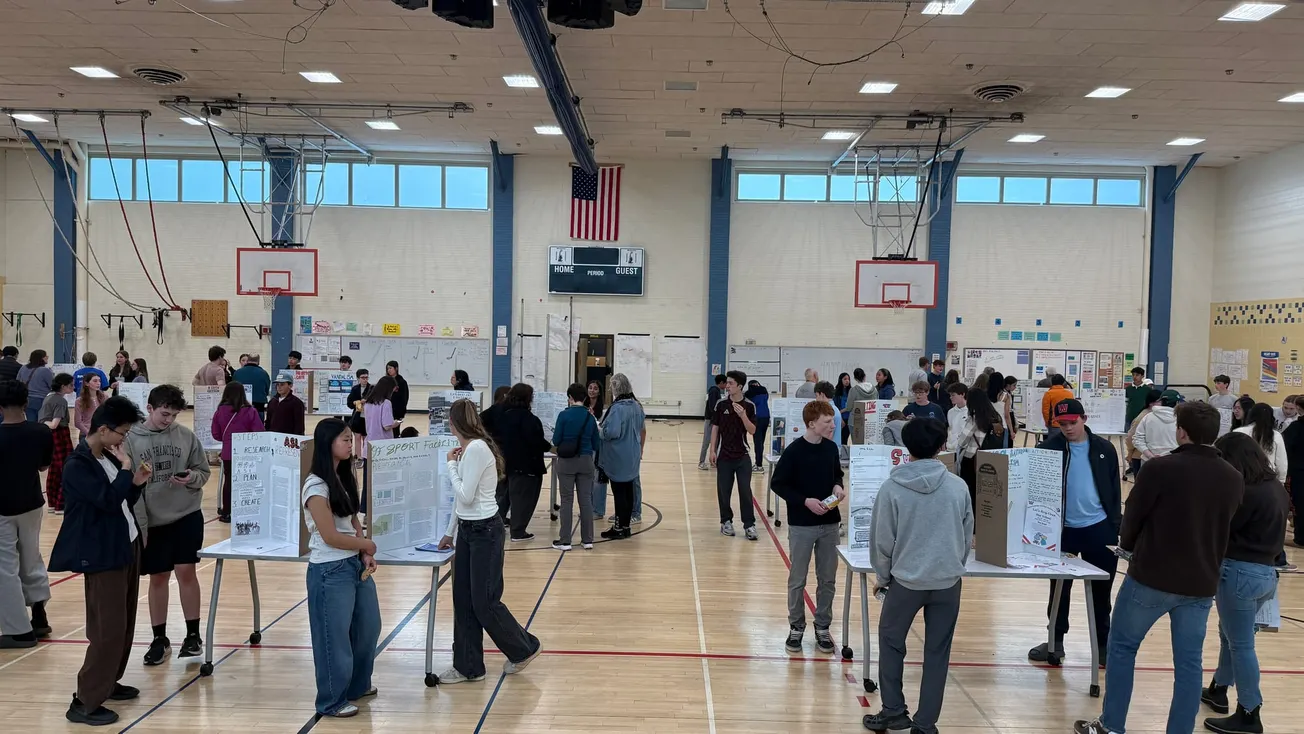
For 90 minutes Saturday afternoon, the McCall Middle School gym functioned as something it was not, entirely, built to be: a civic forum.
The basketball hoops were raised. The scoreboard was dark. Sneakers squeaked across the polished court as folks made their way from showcase to showcase.
The students from McCall Middle School and Winchester High School stood beside tri-fold boards covered with survey results, QR codes, cost estimates, pie charts and taped paragraphs of research.
Adults moved from table to table, asking questions. Students answered with the practiced seriousness of people who had spent weeks learning not only what they thought, but how to say it in public.
The composting project
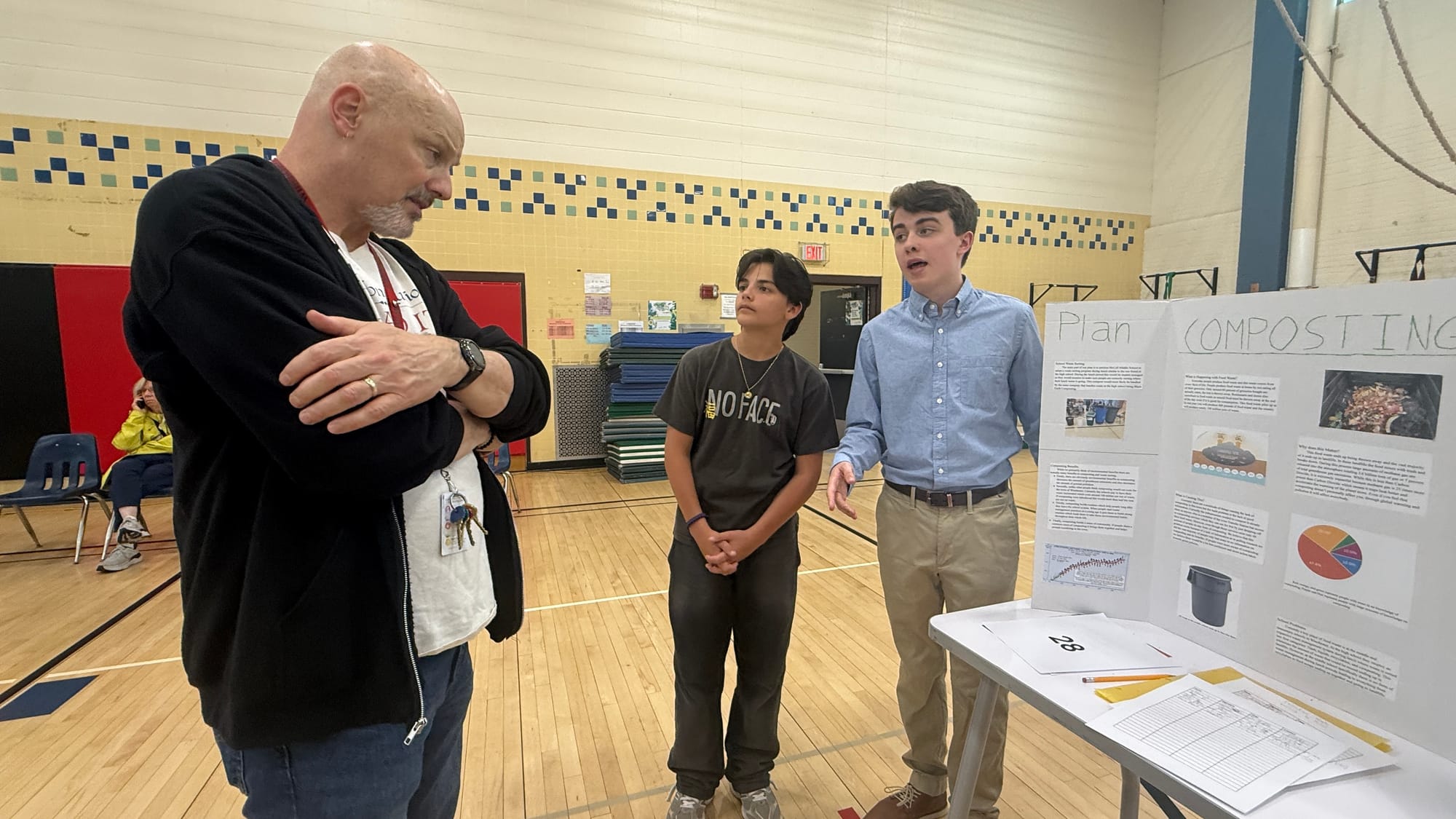
Near one end of the gym, eighth-graders Miles Blower and Maxime Besse were making the case for composting lunch waste at McCall.
Their board, titled “Plan Composting,” walked visitors through the school’s waste-sorting problem, what composting would cost, what it could save and — notably — who would carry the work forward after they left for ninth grade.
The middle school has no lunch waste-sorting program. The high school does, sorting waste into four categories: trash, liquids, recyclables and compost.
According to the students’ display, food waste in landfills releases methane as it decomposes — a gas their board described as 25 times more potent than carbon dioxide. The display said incineration costs about $100 per ton of waste; composting, Blower said, could reduce that to about $20 or $30.
But the real problem, they said, was not whether composting made sense. It was whether anyone would keep doing it.
Blower said composting efforts at the middle school have been tried before, but failed to take hold.
“There’s also been multiple attempts of this every year,” Blower said. “The main problem, the reason why it didn’t end up actually happening — it dies out. A lack of commitment, a lack of making it more of a habit.”
Their plan called for a student-managed sorting system, with Black Earth Composting — the same company that handles the high school’s compost — managing pickup. They wanted sixth and seventh graders to inherit the work.
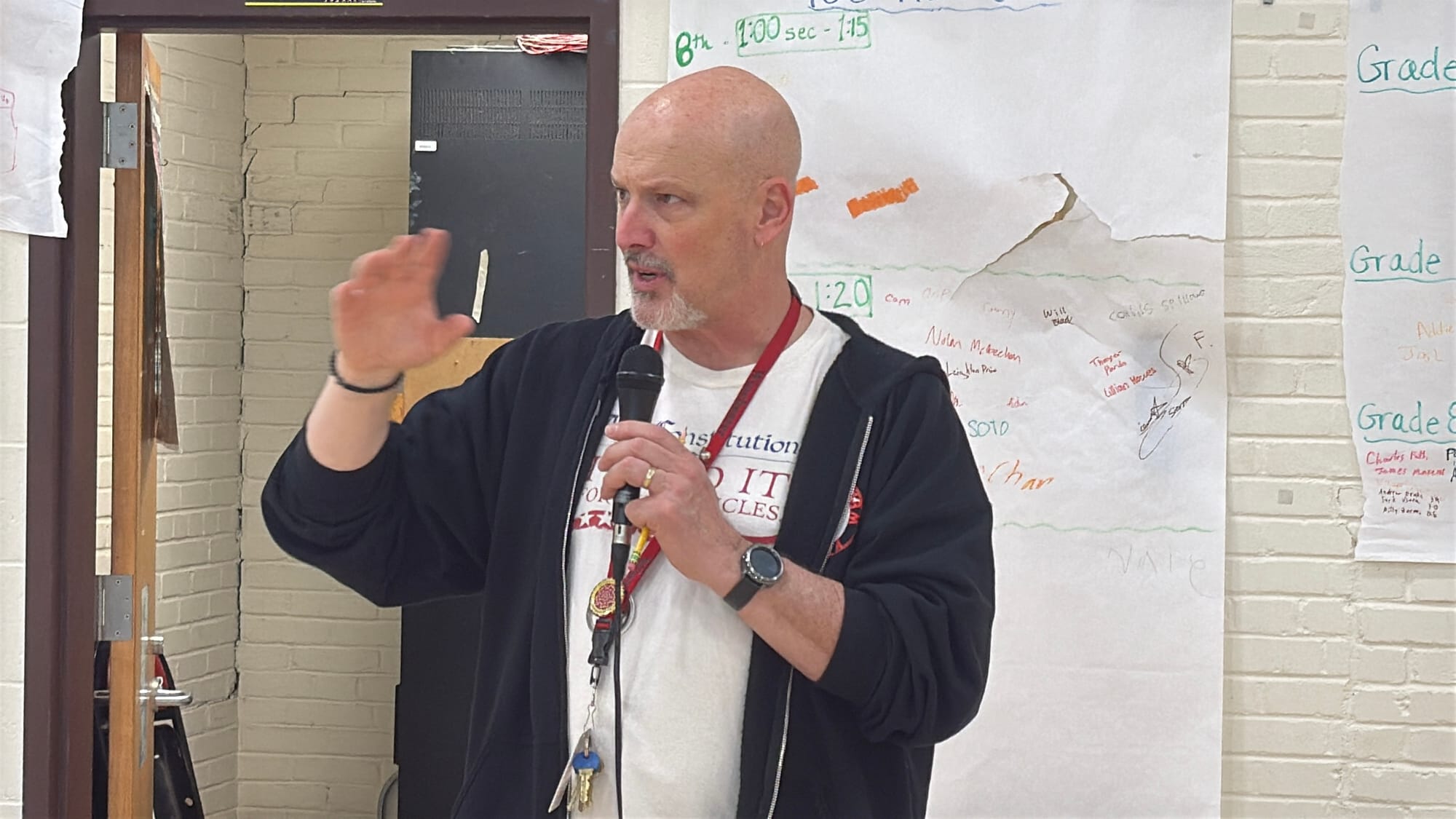
Chris Kurhajetz, Winchester’s director of social studies for grades six through 12, said there were 26 middle school projects and four high school projects at the May 9 Winchester Civics Action Project Showcase.
The middle school projects are part of the eighth-grade curriculum. The high school projects came through an elective active citizenship class; four of five groups from that class attended.
The projects exist because Massachusetts requires them. Chapter 296 of the Acts of 2018, signed by Gov. Charlie Baker on Nov. 8, 2018, mandates that every public school serving eighth graders and every public high school provide at least one student-led, nonpartisan civics project per student.
The state calls this action civics — students applying civic knowledge to real-world problems and systems.
In the gym, those systems were often the ones students encountered every day.
AI and cheating
Across the floor, eighth-graders Sindhi Saraswatula, Elle Christiansen and James Maselli had taken on artificial intelligence misuse and academic integrity. Their board was titled “Academic Integrity & AI Misuse & Cheating.”
Their survey of 125 peers found that more than 100 had witnessed classmates cheating using artificial intelligence. When asked to rate AI misuse as a problem on a scale of 1 to 10, about 18 of the 125 respondents chose 10.
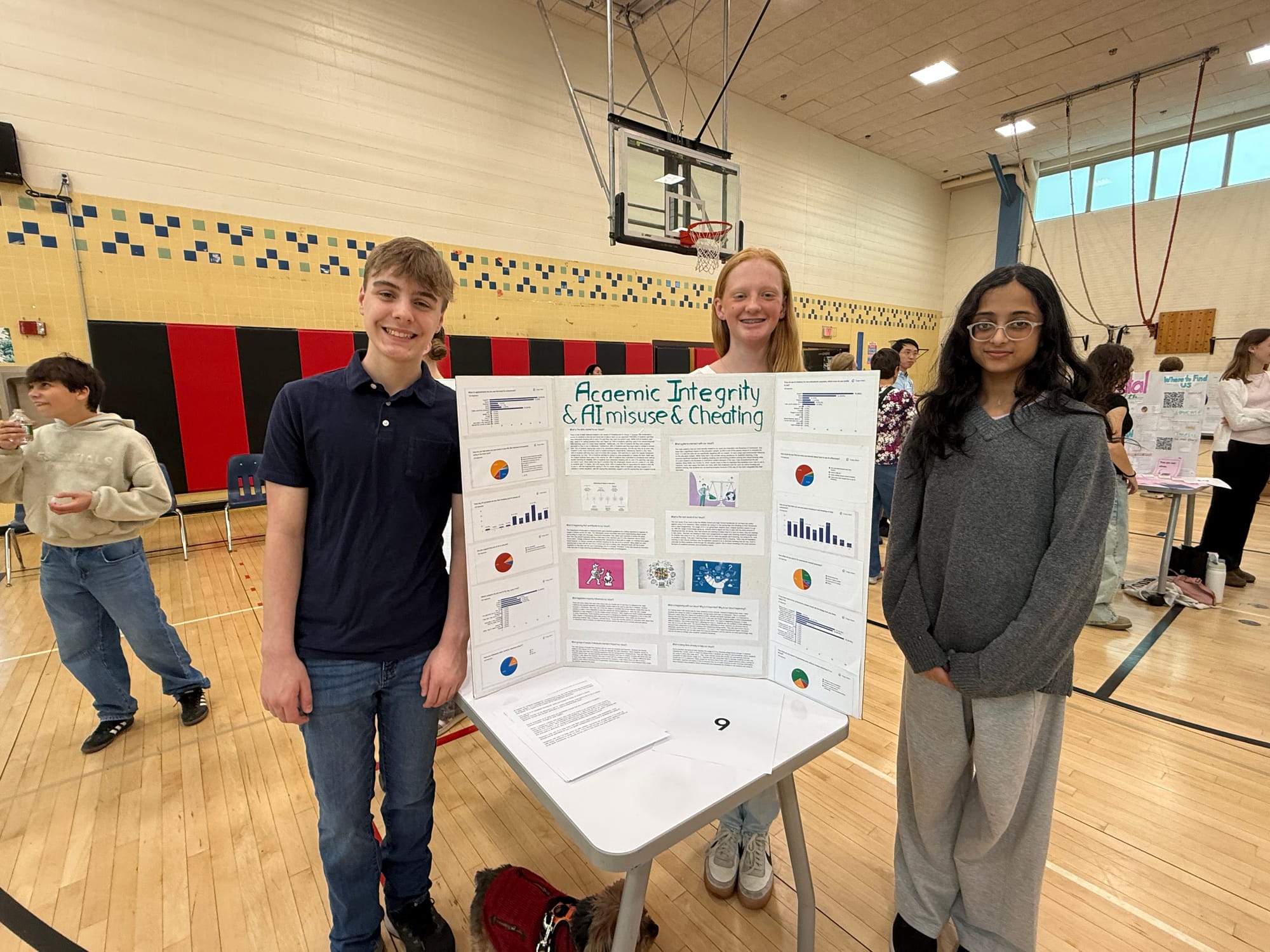
Their position was not against artificial intelligence. It was about rules, clarity and fairness.
“It’s about fairness,” Maselli said, “and how some people shouldn’t be getting the same reward as others for doing less work — especially in a town like this where there’s a lot of academic competitiveness.”
They had reached out to a Winchester official about adding policy language to student handbooks governing proper and improper artificial intelligence use in schools.
More civic minded
Social studies teacher Erin Leonard could hear versions of civic-project arguments rising and falling around her.
The project’s value, she said, becomes clear only over time. When the civics unit begins, Leonard said, students discussing civic responsibilities tend to rank participating in local community as the least important.
“My hope is that, throughout this entire process — as they talk to their local government officials and people in their community — they see how pivotal it is to understanding government in general,” Leonard said, “and that is how you keep a democratic republic alive.”
That democratic republic looked, on Saturday, like students pointing to charts in a gym.
Vandalism project
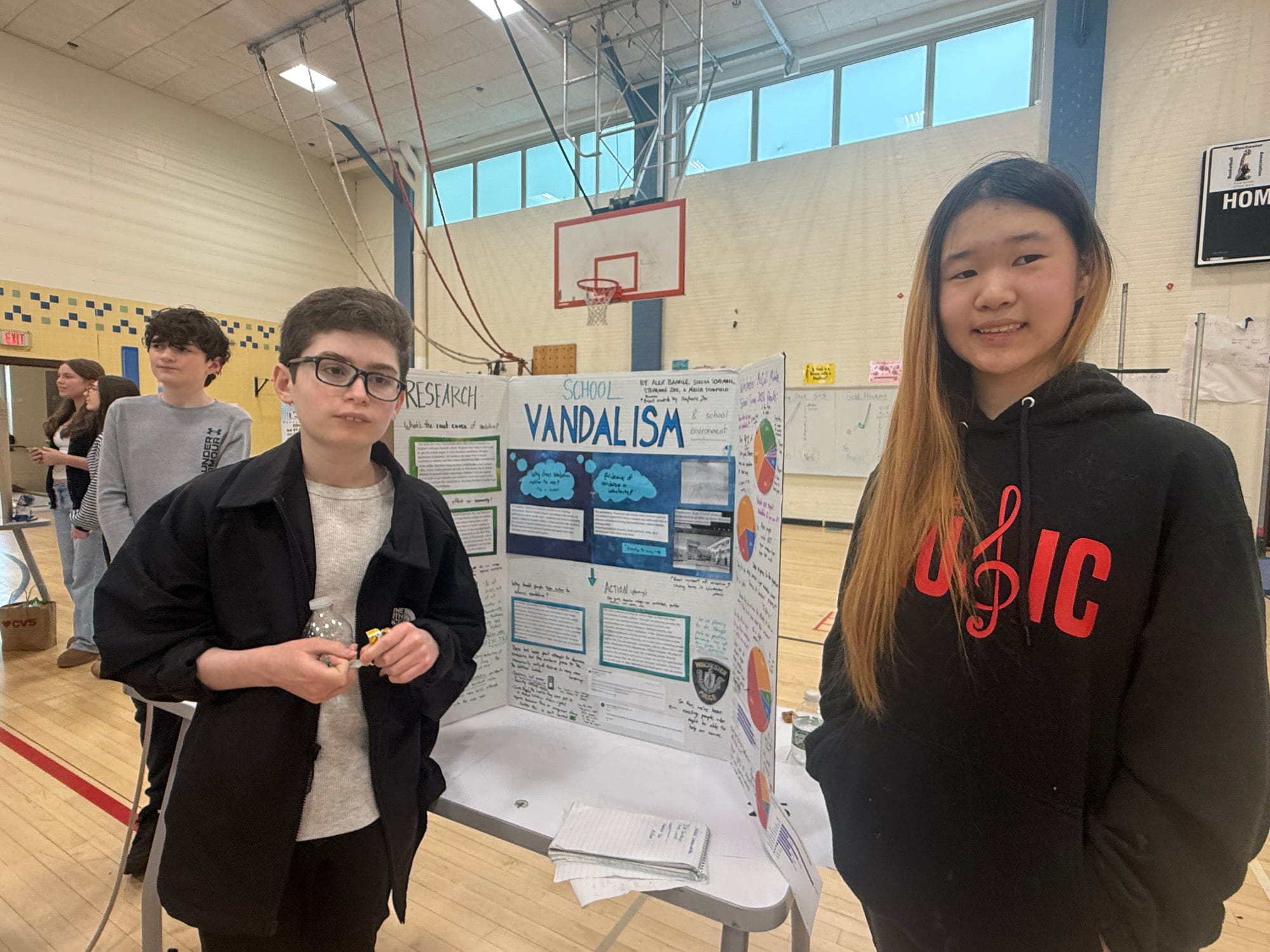
At another table, eighth-graders Stephanie Zhu and Miller Schotiell, joined on their board by Alex Barile and Serena Schiavi, explained school vandalism not only as a discipline issue, but as one of access and shared space.
Zhu said directly what many students might only think: when bathrooms close because of destruction, students lose access to basic needs.
Their display cited survey data indicating over 90% of students had seen or been affected by vandalism in school — a figure their board attributed to a student survey whose full base was not provided.
Their research examined past interventions, including electronic hall passes and a Crime Stoppers-style reporting system, and compared school handbook punishments with state law.
Nearby, John Hogan, who teaches United States history to eighth graders, described the doubt many students bring into the project before they ever stand beside a board.
“They say, ‘No one’s gonna listen to us. We’re just a bunch of eighth graders,’” Hogan said.
He has helped run the project for six years and said mental health comes up every year, with multiple groups trying to address it. Part of the lesson, he said, is that students do not have to wait until adulthood to enter public life.
High school projects
At the high school tables, the problem was smaller, quieter and easier to miss.
Tenth graders Josh Perez and Mason Finley were asking visitors to look at paper.
The boys explained Winchester High School orders about 1.6 million sheets annually — more than 6.5 tons per year — produced from roughly 180 trees that would have absorbed about 8,000 pounds of carbon dioxide annually.
Of the 46 faculty members they surveyed, about 18 reported handing out one to three sheets of paper to every student every day.
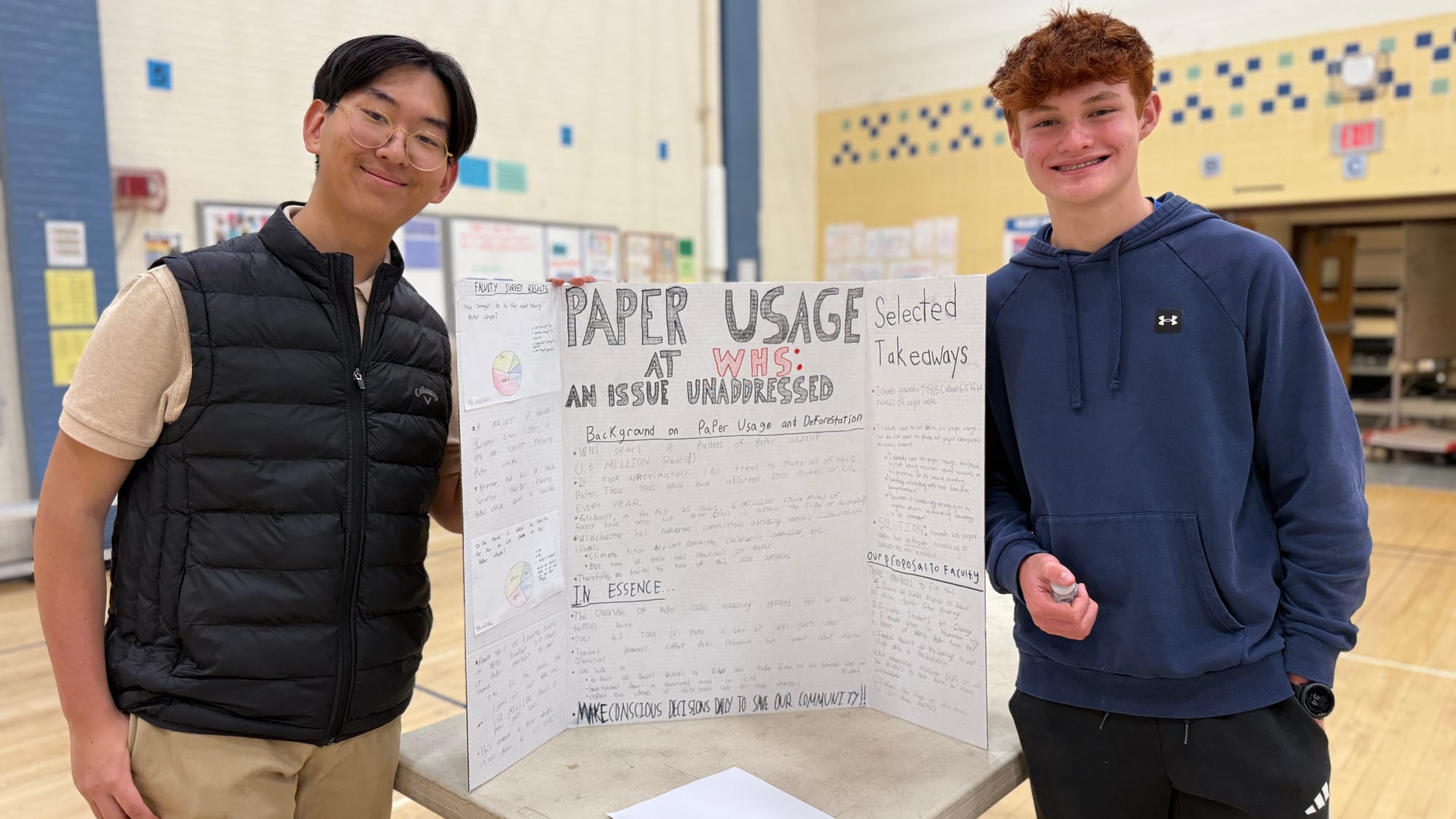
Their proposed changes were narrow: default printers to black-and-white, double-sided printing; put reminder slips on printers; show a five-minute video on Nov. 6 for World Paper Free Day. They were not arguing against paper. Several surveyed teachers noted comprehension benefits and concerns about students using devices to access AI.
“People talk about how, at a large scale, the town government needs to be more efficient,” Perez said. “But theree’s also the small level — things like how much paper students are getting every single day — that also have just as devastating consequences but arene’t as addressed.”
Kurhajetz said the League of Women Voters Winchester had been instrumental in turning the school project into a public forum. Marilyn Mullane among other League members were present, serving as community reviewers.
By mid-afternoon, the movement reversed. Visitors drifted out. Students folded their tri-fold boards. Tables were disassembled and rolled away. The gym returned to itself.
Will Dowd is a Massachusetts journalist who covers municipal government and community life for Winchester News. He runs The Marblehead Independent, a reader-funded digital newsroom.