Table of Contents
Many Winchester residents who voted against the March 2026 operating override said they still wanted the schools and town services the money would have paid for. What they did not trust was the price, the packaging or the explanation.
That distinction ran through a post-election survey and three listening sessions the Select Board reviewed on July 13, and it leaves the board two problems if it asks again: showing what gets cut without new revenue, and convincing residents that officials squeezed the budget, weighed alternatives and built a question people could follow.
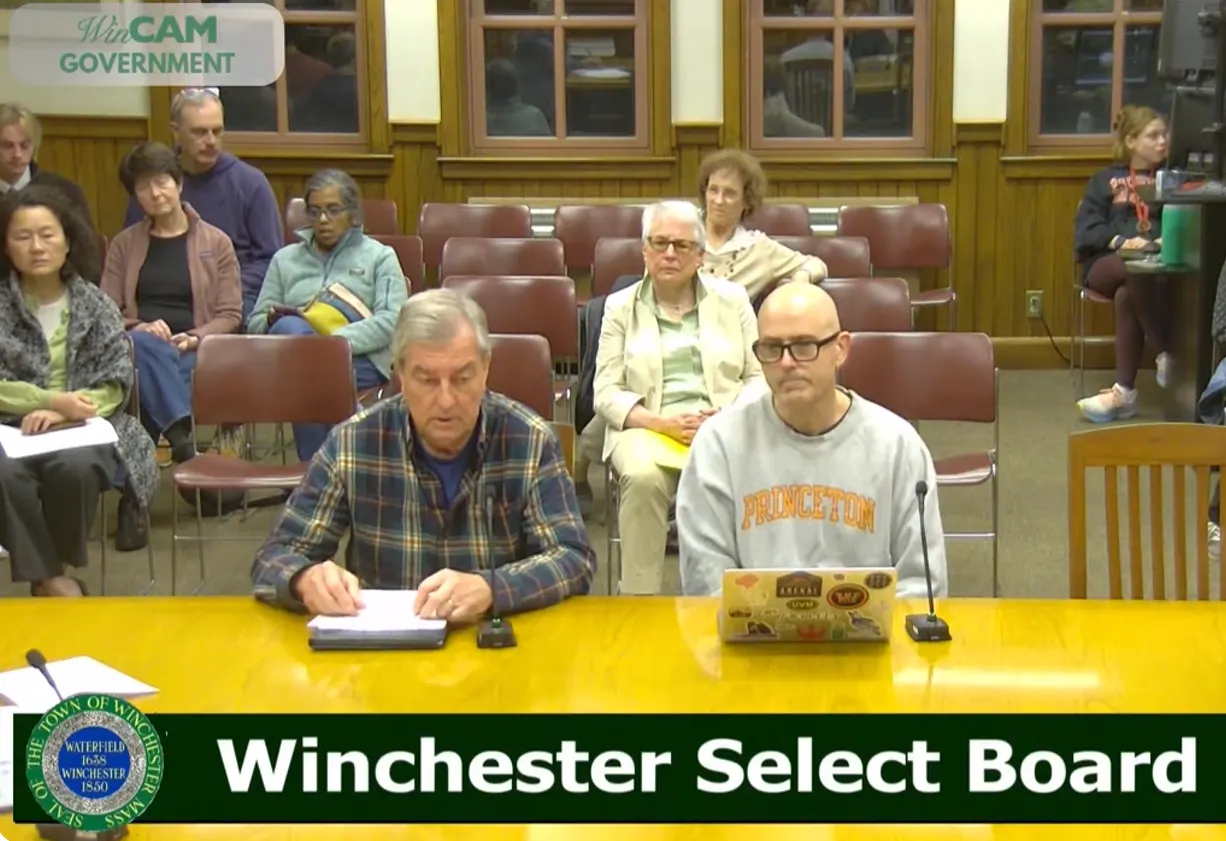
The board took no formal action and did not authorize another override, treating the feedback as guidance for coming budget and communication decisions.
The $11.5 million question failed 2,558 to 2,265 on March 21, a 293-vote margin and the town’s first Proposition 2½ rejection after seven straight approvals since 2017.
It would have raised $9 million for operations and $2.5 million for capital stabilization, roughly $719 in the first year on the average single-family tax bill, against a structural deficit officials put at about $5 million.
The survey drew 256 usable responses. Of those, 244 reported being aware of the March election and 225 reported voting. All eight precincts were represented.
The survey was an open online form with no verification of residency, and the summary cautioned the pool was highly engaged and should not be treated as a random sample of all voters. About 40 people took part in listening sessions held June 10, June 17 and June 23.
Asked what made a yes vote compelling, respondents pointed most often to school services and educational quality, cited in 85 coded responses. Maintaining municipal services and staffing followed at 26, long-term fiscal planning and the structural gap at 17, capital needs and facilities at 14, and trust in the analysis, committees or process at 10.
The no side was led by tax affordability and household financial pressure, cited 83 times. Concerns about the school budget and enrollment appeared 52 times, spending discipline or waste 39 times, insufficient information, confusion or transparency 37 times, and the structure, size or permanent nature of the question 26 times.
The counts reflect how open-ended answers were sorted into themes, not percentages of the electorate.
Affordability came up at every listening session, according to the summary Select Board member Michelle Prior prepared, and not only from seniors and residents on fixed incomes, who described inflation and rising utility and water bills.
Several said they had not seen enough evidence that the town and the schools had exhausted efficiencies before asking for more. Others wanted the school budget opened up, including a “second budget” showing what a failed override would actually mean.
Some tied their hesitation to the Muraco School, reluctant to approve an operating increase with a large borrowing request possibly ahead. The two are separate questions, though Prior said residents who see one big bill may land on the debt piece rather than the operating request.
Residents wanted earlier outreach, plainer language, verifiable information in a single trusted place and side-by-side scenarios showing what an override funds and what its failure costs.
They wanted clearer lines drawn among operating overrides, capital spending and debt exclusions. They asked for facts over messaging several called emotional, and for outreach beyond people already reading Select Board packets.
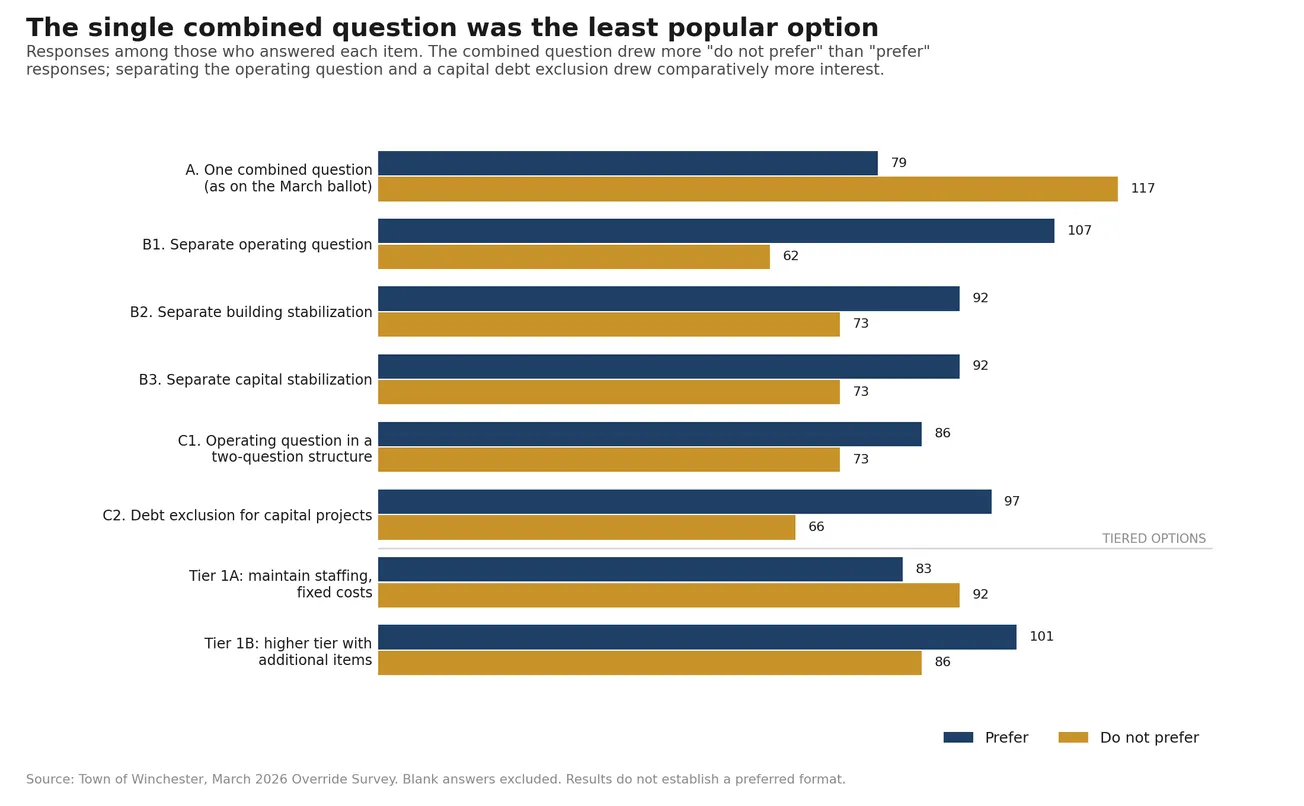
Ballot structure drew the sharpest split. Among those answering, March’s combined question drew more “do not prefer” responses than “prefer.”
Respondents showed stronger interest in separating the components, particularly a standalone operating question and a debt exclusion for capital projects. A tiered override offering two funding levels split roughly down the middle, and the summary noted tiers would need very clear explanations of what each level funds.
Prior said the sessions showed broad support for schools and municipal services, including from many who voted no, alongside concern about affordability, efficiency and school spending.
The takeaway, she said, was “less about support for public services” and “more about trust, affordability, and confidence in the process.”
Select Board member William McGonigle, participating remotely, was less satisfied with the reach.
“I’m most interested in the opinions of the people who aren’t plugged in and who wouldn’t know there was a survey or a listening session,” he said.
He urged colleagues to read the individual answers on transparency.
Select Board member Paras Bhayani, at his final meeting, pointed to Arlington’s override materials as a model, calling the presentation “very crisp” and praising it for laying out what that town’s select board, school committee and finance committee were committing to without promotional language.
Select Board Chair Anthea Brady noted voter records show who did not vote in March. Nobody volunteered to go knock on those doors.
Will Dowd is a Massachusetts journalist who covers municipal government and community life for Winchester News. He is also the founder and editor of The Marblehead Independent, a reader-funded digital newsroom.