Table of Contents
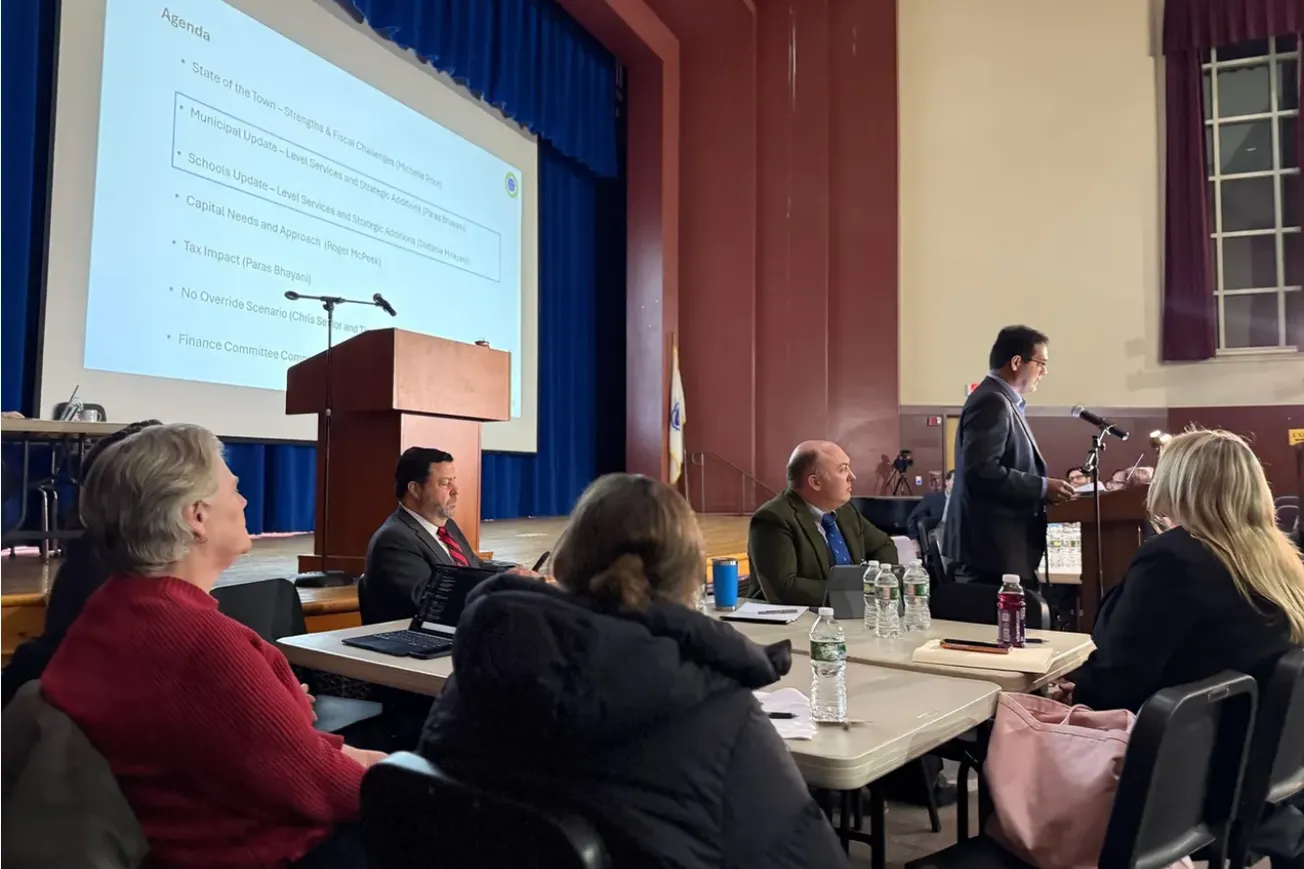
Monday’s opening session of the spring annual Town Meeting was the warm-up — the table setting, if you will; the hard votes are still to come.
Across roughly three hours of debate at Winchester High School, the failed $11.5 million Proposition 2½ override from March 21 colored almost every report, every recommendation and every dollar moved. By the time members adjourned after Article 16 — before the Capital Planning Committee could begin its revised fiscal 2027 presentation — the through-line was clear. The town is operating in override’s shadow even before the main budget articles hit the floor.
Select Board Chair Anthea Brady set the tone in opening remarks, telling members the failed override carries consequences for school staffing, class sizes and seasonal Department of Public Works workers. Brady projected a slide listing seven Massachusetts communities — Arlington, Brookline, Lynnfield, Malden, Melrose, Natick and Stoneham — that put operating overrides on the ballot for fiscal 2026 or 2027, with figures ranging from $4.65 million in Lynnfield to $23.25 million in Brookline. The slide noted that more than 37 additional communities had done the same, representing more than 12% of all Massachusetts cities and towns.
“This problem isn’t isolated to Winchester,” Brady said.
Stabilization deposit cut $250,000 on the floor
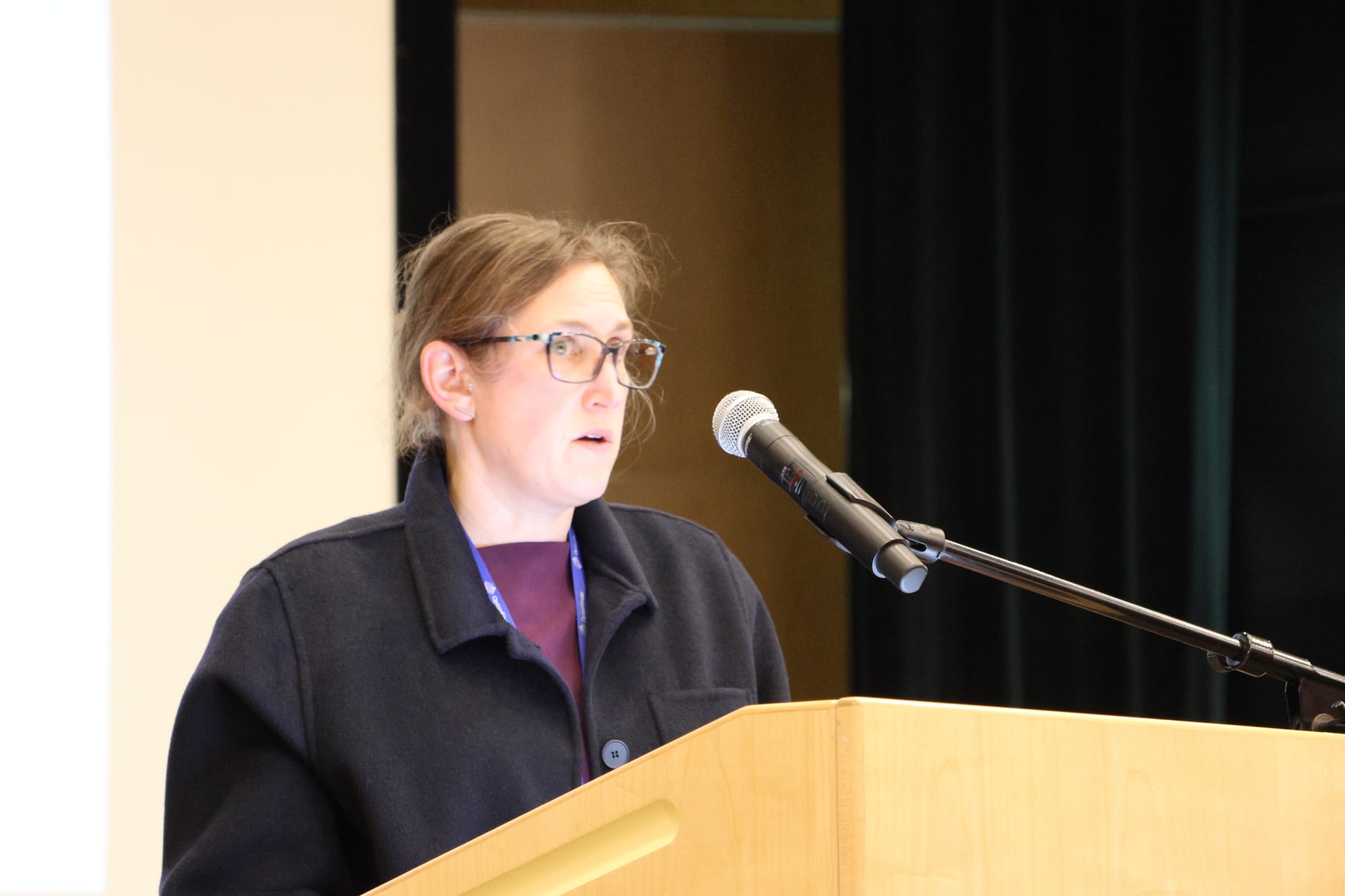
The fiscal squeeze showed up first in Article 15. The Select Board came in asking for a $1 million deposit into the General Stabilization Fund and amended its own request down to $750,000 on the floor. Select Board Chair Michelle Prior said the change reflected remaining fiscal year obligations — including snow and ice costs and Fire Department personnel expenses — that will draw on free cash before June 30. The fund currently holds $5.4 million, well short of the $10 million floor that Moody’s and the state Department of Revenue recommend.
“We really haven’t done anything deliberately in all those years,” Prior said of past inaction on the fund.
Select Board member Paras Bhayani said the town’s total operating reserves should ideally split evenly between free cash and the stabilization fund, and that reaching that balance would require the stabilization fund to grow closer to $13 million.
Solar bonding passes despite Finance Committee split
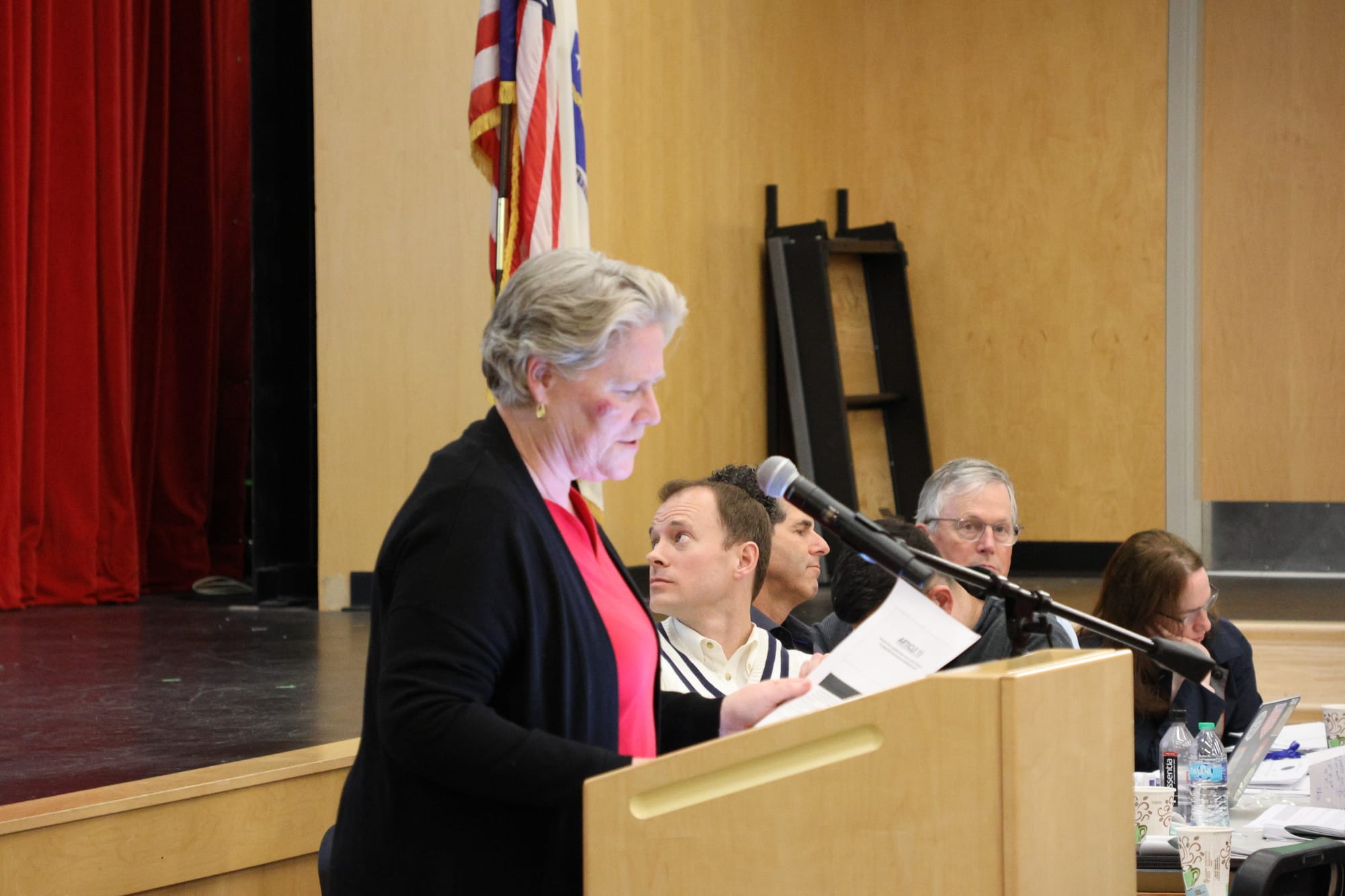
Article 16 told a different version of the same story. Town Meeting authorized $7.943 million in borrowing for town-owned solar panels at six sites — Winchester High School, McCall Middle School, Vinson-Owen Elementary, the DPW, the Transfer Station and Ambrose Elementary, added on the floor by Town Meeting member Chris Nixon — despite a 6-3 unfavorable Finance Committee recommendation.
Sustainability Director Ken Pruitt and Select Board member Mike Bettencourt told members the town stood to lose $2 million in federal tax incentives and a $1 million state climate leader grant if borrowing was not authorized this session. They projected total energy savings of more than $16 million over 25 years, with first-year net savings of about $100,000 and an average of about $300,000 a year thereafter.
Bhayani defended the proposal, saying the package had been roughly 11 months in development through a cross-functional working group with representatives from the School Committee, the Energy Management Committee and the Finance Committee. He said Pruitt has saved the town close to $4 million as sustainability director, including identifying the Lynch project after staff initially concluded federal incentives would not apply. Energy Conservation Coordinator Susan McKee said more than 300 schools across Massachusetts run similar systems with low maintenance costs.
Not every member was convinced. Town Meeting Milan John urged the town to focus instead on deferred maintenance like Town Hall and questioned the projected returns, citing a negative net present value at Lynch Elementary. He also said existing solar arrays at the high school had caused roof damage that required an emergency Finance Committee repair transfer, raising questions about whether other parts of the building could safely carry additional weight.
Finance Committee Chair Derek Ross said his members raised concerns about timing given the town’s broader budget picture and questions about the net present value calculation. The amended article required a two-thirds vote and passed on an electronic vote.
Schools preview the cuts to come
The night’s most consequential preview came from outside the warrant articles themselves. School Committee Chair Timothy Matthews echoed Brady’s framing directly, citing Arlington and Melrose as communities that had passed successful overrides while Winchester now joins Malden among those whose recent attempts failed.
Matthews said the district is projecting a 5% year-over-year increase for fiscal 2027 but still expects layoffs and reductions, with about 22 positions on the table on top of previously planned enrollment-based cuts. The reductions would affect paraprofessionals, instructional staff, coordinators and central office roles. Half-time elementary math interventionist positions added at five elementary schools last year are expected to be eliminated, and Matthews said fee increases are coming for high school sports, transportation and nutrition.

Matthews said about 88% of fiscal 2025 school spending went to salaries and benefits, leaving little flexibility to reduce costs without affecting personnel. He pointed to rising special education and transportation costs, along with state aid that has not kept pace. The district is continuing to roll out a new K-5 literacy curriculum, Arts and Letters, following a multi-year review. Matthews did not state the schools’ total operating budget figure during his presentation, the dollar baseline against which both percentages would be measured.
“Winchester is not alone … in facing severe funding challenges,” Matthews said.
The actual school-side reductions arrive with Article 29, the post-override fiscal 2027 operating budget, which is not expected to come up Thursday.
Town manager outlines municipal squeeze
Town Manager Chris Senior, addressing his first spring Town Meeting in the role, said the town has identified roughly $1 million in reductions across municipal departments and undesignated accounts. Those include hiring freezes in the Fire Department and DPW, elimination of seasonal DPW workers, one fewer police cruiser than planned and a cut to the recreation subsidy. The reductions do not include layoffs of existing municipal employees but will affect services.
“We can’t not respond to a call. We can’t not plow a road,” Senior said.
Senior said Winchester’s AAA bond rating was reaffirmed in February and that the town has received about $400,000 in municipal grants this year for water asset management, energy efficiency and recreation programming. Building fees have been reviewed and aligned with surrounding communities, and transfer station fees, parking fees and fines are under evaluation.
“Penalties should dissuade people,” Senior said. “They shouldn’t be an easy way out.”
Reserves are tight, FinCom chair says
Ross said the town is on track to meet or come close to its fiscal 2026 operating budget but continues to face an unsustainable structural deficit. Officials are still resolving about $900,000 in remaining items to close that gap. Winchester has about $21 million in free cash, with roughly $10 million considered a reserve floor to protect borrowing capacity. That leaves about $11 million in usable funds, though Ross noted at least $3 million is likely to be drawn down soon.
“Be prudent on what we use and make sure it’s something we definitely need, and need now,” Ross said.
Other business
Town Meeting also passed Article 6, shifting authority to set permit fees for recreational children’s camps from Town Meeting to the Board of Health; Article 7, imposing a 6% local occupancy excise tax on short-term rentals such as Airbnbs and VRBOs; and Article 8, authorizing a 7% annual increase in water and sewer rates through fiscal 2031. The water and sewer increase will raise the average residential quarterly bill about $16 — from $267.61 to $283.89.
Articles 4 and 5 — the bylaw establishing a nine-member Human Rights Commission and the rewrite of Town Meeting’s rules of procedure — were postponed to Thursday at the start of the night. Town Meeting reconvenes Thursday, May 1, at 7 p.m. at Winchester High School.
To read our live blogging on the Town Meeting floor Monday, click here.
Will Dowd is a Massachusetts journalist who covers municipal government and community life for Winchester News. He runs The Marblehead Independent, a reader-funded digital newsroom.