Table of Contents
Winchester voters who are not yet on the rolls have until Saturday, Oct. 24, to fix that, and the clock runs differently depending on how they do it. The state’s online registration system accepts applications until 11:59 p.m. that day. A paper form must be postmarked or handed to the Town Clerk’s office by 5 p.m., and Town Clerk MaryEllen Marshall’s office at Town Hall, 71 Mt. Vernon St., will be open that Saturday from 9 a.m. to 3 p.m. because it is also an early voting day, according to the clerk’s Oct. 13 notice.
Early voting began Oct. 17 in the Winchester Room on the first floor of Town Hall, not at the high school where everyone votes on Election Day. By 4 p.m. Oct. 22, 2,073 Winchester voters had cast ballots, 12.1% of the town’s 17,195 registered voters, according to figures the Secretary of the Commonwealth’s office released that afternoon. Statewide, 541,346 of 5,174,124 registered voters had voted, 10.5%.
What they found is a two-card ballot. The state senator on it depends on the precinct; both Senate seats that touch Winchester are going to newcomers with no November opponent; the one contested legislative race is the House seat covering Stoneham and seven of Winchester’s eight precincts; and nine statewide questions wait at the end. This guide replaces the newspaper’s Aug. 7 primary guide; candidates eliminated Sept. 1 are not on the November ballot.
Register by Oct. 24
Online registration requires a Massachusetts driver’s license, learner’s permit or state ID with a signature on file at the Registry of Motor Vehicles. Residents without one can still use the online system to generate a form, then print, sign and mail it to the Town Clerk or bring it to the first-floor office; the clerk’s notice also points to a voter drop box in front of Town Hall, next to the U.S. Postal Service mailbox. First-time Massachusetts registrants who use the mail should include a copy of identification showing name and address or may be asked for it when they first vote, the state’s registration page says. Residents naturalized after Oct. 24 may still register in person until 4 p.m. Monday, Nov. 2, with proof of the ceremony date.
Anyone unsure of their status, address or precinct can check their registration online. The precinct determines which Senate district, and in Precinct 6 which House district, appears on the ballot; the town posts precinct maps, and the state’s polling place lookup returns a precinct number from a street address.
Early voting at Town Hall
The town’s remaining early voting hours in the Winchester Room are Friday, Oct. 23, 8 a.m. to noon; Saturday, Oct. 24, 9 a.m. to 3 p.m.; Monday through Thursday, Oct. 26-29, 8 a.m. to 4 p.m.; and Friday, Oct. 30, 8 a.m. to noon. There are no hours on Sunday, Oct. 25. Any registered Winchester voter can vote early there regardless of precinct, and every early voting and Election Day site must offer an AutoMARK accessible voting machine, the state’s disability-access page says. Through Oct. 22, 529 Winchester voters had voted early in person; the other 1,544 ballots cast so far came by mail.
Voting by mail
Two deadlines matter, and they are not the same. An application for a mail ballot must reach the Town Clerk’s office by 5 p.m. Tuesday, Oct. 27. Applying through the state’s mail-ballot system is the fastest route; paper applications need a handwritten signature and can be mailed, dropped off or emailed to townclerk@winchester.us as a PDF or photo, the town’s mail-ballot page explains.
Returning the ballot is the second deadline. A completed ballot can go in the drop boxes at the front and back of Town Hall, be handed to the clerk’s office or be dropped at the Winchester Room during early voting hours, and in every one of those cases it must arrive by 8 p.m. Tuesday, Nov. 3. A ballot sent back through the mail counts if it is postmarked by Nov. 3 and reaches the clerk by 5 p.m. Friday, Nov. 6, under state law. Ballots cannot be dropped off at Winchester High School on Election Day.
As of Oct. 22, the clerk had received 4,361 mail-ballot applications from Winchester voters and mailed 4,339 ballots, of which 1,544 had come back, 35.6% of ballots mailed; the statewide return rate was 41.5%, or 432,427 of 1,043,183 ballots mailed. Voters can confirm when a ballot was mailed, returned and accepted through Track My Ballot. A voter whose mail ballot has not been accepted can still vote in person; one whose ballot has been accepted cannot. Under a legal notice, the clerk’s staff begins opening those ballots at 7 a.m. Sunday, Oct. 25, with observers welcome if they register a day ahead by email; no totals are released until polls close.
Election Day logistics
On Tuesday, Nov. 3, all eight precincts vote at the Winchester High School gymnasium, 80 Skillings Road, from 7 a.m. to 8 p.m., according to the state election warrant the Select Board signed Oct. 5. Massachusetts does not require identification at check-in for most voters; poll workers may ask for it from first-time Massachusetts voters, voters on the inactive list and anyone casting a provisional or challenged ballot, and any document showing name and registered address will do, including a utility bill or lease, the state says.
Two cards, two districts
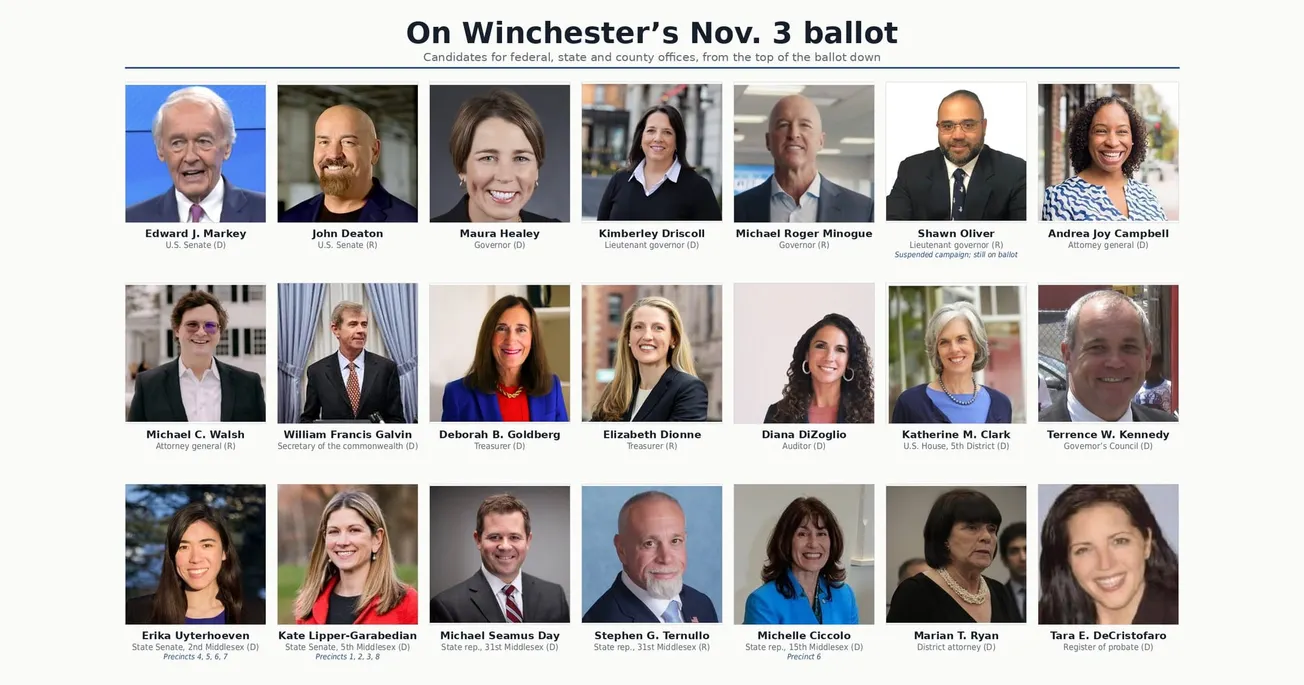
The sample ballots the clerk posted come in three versions. Precincts 1, 2, 3 and 8 vote in the Fifth Middlesex Senate District, with Malden, Melrose, Reading, Stoneham and Wakefield, and will see Kate Lipper-Garabedian. Precincts 4, 5, 6 and 7 vote in the Second Middlesex, with Somerville, Medford and part of Cambridge, and will see Erika Uyterhoeven. Nobody sees both, and the two are not running against each other. Precinct 6 differs again: it sits in the 15th Middlesex House District, so its ballot carries Michelle Ciccolo rather than the Michael Day-Stephen Ternullo contest, and it ends with two non-binding questions, numbered 10 and 11, that appear only in that House district.
Every version shares the rest: 13 contests and the first seven questions on the first card, Questions 8 and 9 on the second.
U.S. Senate
Edward J. Markey, the Democratic incumbent, faces Republican John Deaton, independent Shiva Ayyadurai and Joe Tache, who runs under the Socialism and Liberation designation. Markey won renomination over U.S. Rep. Seth Moulton 580,628 votes to 314,198, or 63.5% to 34.4% of the 913,768 Democratic ballots cast statewide, a race the Associated Press called 31 minutes after polls closed, Winchester News reported. Winchester was closer: Markey took 2,026 of the town’s 3,712 Democratic ballots, 54.6%, to Moulton’s 1,633, 44.0%, in the Secretary of the Commonwealth’s certified returns. Moulton ran on Markey’s age; Markey, who will be 86 at the end of the term he now seeks, answered across three debates that experience is what a legislator uses to create change. Deaton, the 2024 Republican nominee against Elizabeth Warren, was unopposed for his nomination with 221,950 votes. Massachusetts has not sent a Republican to the Senate since 2010.
Governor and the ticket
Gov. Maura Healey and Lt. Gov. Kimberley Driscoll, Democrats, run as a ticket against Republicans Michael Roger Minogue and Shawn Oliver and the independent ticket of Andrea James and Kayla Kittredge. Minogue won the Republican primary over Brian Shortsleeve 194,758 votes to 62,161 of 260,781 Republican ballots cast; in Winchester, 599 of 816 Republican primary voters chose Minogue, 73.4%, and 212 chose Shortsleeve.
The Republican ticket changed after the ballots were printed. Oliver was charged with operating under the influence and other offenses after a crash in New Bedford late on Oct. 17 and announced the next day that he was suspending his campaign, ABC News reported. He pleaded not guilty Oct. 19. His name stays on the ballot because the deadline to remove it was Sept. 4, and the Minogue campaign is still asking supporters to vote for the ticket while stating, “To be clear, Oliver will not be Minogue’s lieutenant governor,” CBS Boston reported. The Secretary of the Commonwealth’s office told the station Oliver could decline the oath if the ticket won, leaving the office vacant.
Other statewide offices
Four Democratic incumbents face single challengers. Attorney General Andrea Joy Campbell faces Republican Michael C. Walsh of Lynnfield. Secretary of the Commonwealth William Francis Galvin, the state’s chief elections officer, faces Republican Anne R. Brensley of Wayland, who won her nomination as a write-in with 21,330 votes. Treasurer Deborah B. Goldberg faces Republican Elizabeth Dionne of Belmont. Auditor Diana DiZoglio, whose voter-approved audit of the Legislature runs through the campaign rhetoric and Question 1 alike, faces Libertarian Al Ozonoff of Medford; no Republican filed.
Congress and the council
U.S. Rep. Katherine M. Clark, the Democrat who has represented the 5th Congressional District since 2013, is alone on the ballot after defeating Jonathan Paz and Tarik Samman with 85,802 of 123,129 Democratic primary ballots, 69.7%; Winchester gave her 2,814 of its 3,712, 75.8%, with 464 for Paz and 187 for Samman. No Republican qualified. Governor’s Council member Terrence W. Kennedy of Lynnfield, the Democratic incumbent in the 6th District, is likewise unopposed after beating Marblehead immigration lawyer Diann Mary Baylis 56,963 votes to 40,722 districtwide and 1,857 to 943 in Winchester. The council confirms judges and acts on pardons.
Second Middlesex: Uyterhoeven
For precincts 4, 5, 6 and 7, the Senate line reads Erika Uyterhoeven, Democrat, 11 Wesley Park, Somerville, with no opponent. She succeeds Patricia Jehlen, the Somerville Democrat who has held the seat since 2005 and who said in February it was simply time after 50 years of public service.
Uyterhoeven, a third-term state representative from Somerville, former Bernie Sanders campaign staffer and co-founder of Act on Mass, entered the race in March arguing that the Legislature itself is the obstacle. She points to the fight that made committee votes public, to an investigation she published of the Healey administration’s contract to put OpenAI’s ChatGPT in front of as many as 40,000 state employees and to legislation restricting federal immigration agents’ access to courts and schools, and she has described towns like Winchester as caught between Proposition 2½ and school and health insurance costs that outrun revenue. “I learned from a young age that workers, immigrants, and strong women like my mom, we aren’t going to win by asking nicely,” she said at her launch.
She won Sept. 1 without Winchester. Certified returns posted by the Secretary of the Commonwealth give her 12,546 of 35,912 Democratic ballots cast districtwide, 34.9%, to 10,340 for state Rep. Christine Barber, 6,201 for Cambridge Vice Mayor Burhan Azeem and 4,218 for Somerville Councilor Matthew McLaughlin. Barber, endorsed by Jehlen and Healey, carried Medford and Winchester’s four precincts, where she took 618 of 1,918 Democratic ballots, 32.2%, to Uyterhoeven’s 461, 24.0%; Somerville settled it, 6,886 to 4,446, as the newspaper’s analysis of the certified returns found. Winchester School Committee member Tom Hopcroft drew 307 of those 1,918 ballots, 16.0%, though he had ended his campaign July 28, too late to leave the ballot.
Fifth Middlesex: Lipper-Garabedian
For precincts 1, 2, 3 and 8, the line reads Kate Lipper-Garabedian, Democrat, 21 Mystic Ave., Melrose, with no opponent. She succeeds Jason Lewis, the Winchester resident who announced Feb. 24 that he would leave the seat he won in a 2014 special election, and who endorsed her Aug. 25.
Lipper-Garabedian, a Melrose state representative since a 2020 special election and chair of the House Committee on Ethics, taught through Teach For America, clerked on the U.S. Court of Appeals for the First Circuit and was chief legal counsel to the state secretary of education during the Student Opportunity Act, her Winchester News profile recounts. She led the bill that lets candidates spend campaign funds on child care and is the House lead on the Location Shield Act on data brokers. At an Aug. 8 forum in Stoneham she said the Legislature should comply with the 2024 audit vote “certainly within the confines of the Constitution,” a hedge her rivals attacked, and she said she opposed Question 5, backed Question 1 and leaned yes on Question 7. “I’d say I have an established record, but I’m certainly not establishment,” she said.
She won everywhere but Malden. The certified returns give her 15,890 of 27,889 Democratic ballots districtwide, 57.0%, to 5,825 for Malden Councilor Carey McDonald and 3,319 for Malden Councilor Ryan J. O’Malley; McDonald won Malden 2,907 to 2,248. In Winchester’s four Fifth Middlesex precincts, where six town officials including Select Board Chair Anthea Brady joined Lewis in endorsing her, she took 1,165 of 1,794 ballots, 64.9%, to McDonald’s 200 and O’Malley’s 155.
Both will arrive on Beacon Hill in January as freshmen in a 40-member chamber, without the committee chairmanships Jehlen and Lewis held.
House: Day vs. Ternullo
The 31st Middlesex District, Stoneham plus Winchester precincts 1, 2, 3, 4, 5, 7 and 8, holds the one legislative race with two names. Michael Seamus Day, the Stoneham Democrat who has held the seat since 2015, faces Republican Stephen G. Ternullo of Stoneham, a refrigeration technician and Pipefitters Local 537 member, quartermaster of Stoneham VFW Post 620 and former member of Stoneham’s Override Study Committee who has not held elected office.
They met Oct. 15 at a League of Women Voters Winchester forum, Winchester News reported. Day defended the MBTA Communities Act, cited state aid of a little over $14 million to Winchester in 2025 and called for building public housing: “We haven’t expanded our stock of public housing since World War II,” he said. “It’s high time we do that.” Ternullo said housing mandates belong to towns, opposed the act and called for an all-of-the-above energy policy and a rewritten local aid formula; he has criticized Day’s vote for the $63.4 billion state budget as offering no predictable local aid while Winchester faces what he called a projected $5 million structural deficit. Day opposes Question 5 and supports keeping the Question 9 gun law; Ternullo supports Question 5 and would back repeal; both support Question 1. On the legislative audit, Day said the auditor and her supporters were pushing toward a “constitutional crisis”; Ternullo said Day and Attorney General Campbell should honor the 2024 vote. “I’m not going to Beacon Hill to make friends with political establishment,” Ternullo said. “I’m going there to hold them accountable.” The forum is posted by Stoneham TV.
Precinct 6 and Ciccolo
Precinct 6 is the piece of Winchester inside the 15th Middlesex House District, where Democrat Michelle Ciccolo of Lexington is unopposed for another term. Its voters also get Question 10, asking whether their representative should back single-payer health care, and Question 11, asking whether she should vote to limit the House speaker’s and Senate president’s control over legislative stipends. Neither is binding.
County offices
Middlesex District Attorney Marian T. Ryan, the Democratic incumbent, is unopposed after defeating David Marc Solet 169,715 votes to 50,867 across the Northern District and 2,374 to 809 in Winchester. Register of Probate Tara E. DeCristofaro, listed as a candidate for reelection, faces Tara Martorella of Everett, who runs under the Justice for All designation. The vacancy election for the Malden seat on the Northeast Metropolitan Regional Vocational School Committee, the Northeast Metro Tech board, lists two Malden residents, James Bancroft Perry and Sean M. Salazar; it appears on every Winchester ballot because the town belongs to the district.
Nine statewide questions
Each question is decided by a simple majority statewide. The summaries, yes-and-no statements and fiscal statements below come from the state’s 2026 Information for Voters booklet, which also prints 150-word arguments from each side. Winchester News covered how the ballot reached nine, and CommonWealth Beacon’s question-by-question guide is linked here. Unless a question sets its own date, an approved initiative law takes effect 30 days after the election.
Question 1: Legislative and governor’s records. A yes vote makes most records held by the Legislature and the governor’s office subject to the Public Records Law, exempting policy still being drafted and constituent requests for help with government services. A no vote keeps both branches exempt, as now. Effective Jan. 1, 2027. The Executive Office for Administration and Finance found no material cost. Auditor DiZoglio signed the argument in favor; no organized opposition filed one, so the Secretary’s office compiled the case against from the Legislature’s committee report, citing privacy risks for constituent mail. Official page.
Question 2: Public defender union rights. A yes vote lets employees of the Committee for Public Counsel Services, the state public defender agency, form a union and bargain collectively, and requires the agency to ask the governor to fund any contract. A no vote changes nothing. Effective 30 days after the election. The state could not project the cost. Tom McKeever of SEIU Local 888 filed it after the 2025 right-to-counsel breakdown, when private bar advocates paid $65 an hour in district court stopped taking cases; because those lawyers are contractors, not agency employees, the question would not settle their pay dispute. No organized opposition filed an argument. Official page.
Question 3: All-party primaries. A yes vote ends separate party primaries for state offices, lists every candidate on one primary ballot, sends the top two finishers to November and makes governor and lieutenant governor candidates run jointly in the primary; a group whose statewide candidate draws 3% of primary ballots cast would gain party status. A no vote keeps party primaries. Effective Jan. 1, 2028. No material cost, the state found. Danielle Allen of the Coalition for Healthy Democracy signed the yes argument, citing a Legislature two-thirds of whose members run unopposed; Vanessa A. Snow of Voter Rights MA signed the no argument, saying top-two systems in California and Washington favored self-funded candidates and shut out third parties. Official page.
Question 4: Election Day registration. A yes vote lets eligible residents register, or update an address, at their polling place on Election Day by showing proof of residency and signing an oath, with provisional ballots for those without documents. A no vote keeps the current cutoff, 10 days before an election. Effective Jan. 1, 2028, so nothing changes for Nov. 3 or for next spring’s town election. The state found no material cost; Marshall, asked by the Select Board to assess the local impact, estimated the likeliest expense is part-time staff and training costing less than $10,000. Galvin proposed the question; Norma B. Shulman of YES on Election Day Registration signed the yes argument, and Amy Carnevale of the Massachusetts Republican Party signed the no argument, calling advance verification essential. Official page.
Question 5: The tax-cap formula. A yes vote rewrites Chapter 62F, the 1986 cap on state revenue, so the limit resets each year to the prior year’s collections plus the three-year average growth in wages and salaries, refunds any excess the following year and counts the Fair Share surtax, the 4% levied on each dollar of income above $1 million, inside the cap. A no vote keeps the current formula. Effective July 1, 2027. The cap has triggered twice, in 1987 and in fiscal 2022, when the state returned $2.94 billion to about 3 million taxpayers as credits equal to 14.0312% of each filer’s 2021 income tax liability, roughly $140 for every $1,000 owed. Administration and Finance states the change would leave less money for the state budget, including local aid, and for the rainy day fund; the Massachusetts Taxpayers Foundation calculated a fiscal 2024 refund under the new rules would have reached $3.9 billion, Winchester News reported. Taxpayers for an Affordable Massachusetts signed the yes argument; Andover teacher Colette Berard of Protect Massachusetts’ Future signed the no argument. Lipper-Garabedian and Day oppose it; Ternullo supports it. Official page.
Question 6: Conservation fund. A yes vote creates a Nature for All Fund that, subject to legislative appropriation, would receive half the state sales tax on sporting goods, recreational vehicles and golf in its first year and all of it after July 1, 2028, overseen by a 15-member board and spent on land, water and park projects. A no vote leaves that revenue in the general fund. Effective July 1, 2027. Administration and Finance estimates the diversion at tens of millions of dollars a year plus implementation costs; Mass Audubon, which filed the question and signed the yes argument, says as much as $100 million a year. No organized opposition filed an argument; the Secretary’s compiled case against notes the Legislature keeps final say over appropriations even if voters approve. Official page.
Question 7: Single-family lot sizes. A yes vote bars cities and towns from requiring more than 5,000 square feet of land or more than 50 feet of frontage for a single-family house on residential land served by public water and sewer, while leaving towns able to regulate height, setbacks, open space, parking and short-term rentals. A no vote keeps zoning minimums local. Effective 30 days after the election. The state found no material cost. This is the question that reaches Winchester’s zoning map directly: every single-family district in town requires more than 5,000 square feet, from 6,500 in the RG general residence district to 20,000 in the RDA-20 district west of Cambridge Street, and the town runs its own water and sewer systems, the Planning Board explained in an Oct. 6 FAQ that also cites a Tufts finding that fewer than one in 1,000 owners of already-subdividable lots add a house in a decade. Wesley Lima of Legalize Starter Homes signed the yes argument; Adam Chapdelaine of the Massachusetts Municipal Association signed the no argument. Official page.
Question 8: Marijuana repeal. A yes vote repeals the laws that legalize, regulate and tax retail sales of adult-use marijuana, closing licensed stores, growers and labs, while keeping possession of up to an ounce legal for adults 21 and older, keeping medical marijuana and leaving the Cannabis Control Commission to oversee only the medical market. A no vote keeps the current market. Effective Jan. 1, 2028. Administration and Finance reports the retail tax raised about $280 million for the state and $50 million for cities and towns in fiscal 2025. The Coalition for a Healthy Massachusetts qualified the question with $1.55 million, all from SAM Action Inc. of Alexandria, Virginia; retired physician Jeffrey Morgan signed its yes argument, and Ryan Dominguez of the Massachusetts Cannabis Coalition signed the no argument. Official page.
Question 9: The 2024 gun law. This one is a referendum on a law already in force, and it reads in reverse. A yes vote keeps Chapter 135 of the Acts of 2024, which the House passed 124-33, the Senate passed 35-5 and Healey signed July 25, 2024; it regulates ghost guns, treats bump stocks and similar devices as machine guns, broadens the assault-style weapon definition, expands extreme risk protection orders and requires live-fire training for licenses. A no vote repeals it. Administration and Finance says repeal would force the state to unwind training, licensing and computer systems already built. Ned Notis-McConarty of Vote Yes for a Safe Massachusetts signed the yes argument; Toby Leary of the Civil Rights Coalition signed the no argument, calling the 116-page law bureaucratic overreach. Day supports keeping the law; Ternullo would support repeal. Official page.
Turnout so far
The 12.1% of Winchester voters who had cast ballots by Oct. 22 put the town ahead of the 10.5% statewide pace and ahead of Medford, at 12.0%, Somerville, at 9.6%, Stoneham, at 8.9%, and Malden, at 6.0%, but behind Melrose, at 15.6%, and Lexington, at 17.2%, in the Secretary of the Commonwealth’s town-by-town workbook. Those figures measure ballots already recorded against each community’s registered voters on that date; they are not final and will move daily until polls close.
Before you go
Three things to settle before Nov. 3: confirm your registration and precinct through the state lookup before 11:59 p.m. Oct. 24; if you hold a mail ballot, return it by hand to Town Hall by 8 p.m. Nov. 3 or mail it in time to carry a Nov. 3 postmark; and read the sample ballot for your precinct, because Questions 8 and 9 sit on the second card. Questions go to the Town Clerk at 781-721-7130 or townclerk@winchester.us. The clerk will post results on the town’s election results page after 8 p.m. Nov. 3, once the mail and early ballots opened the week before are added to the count.